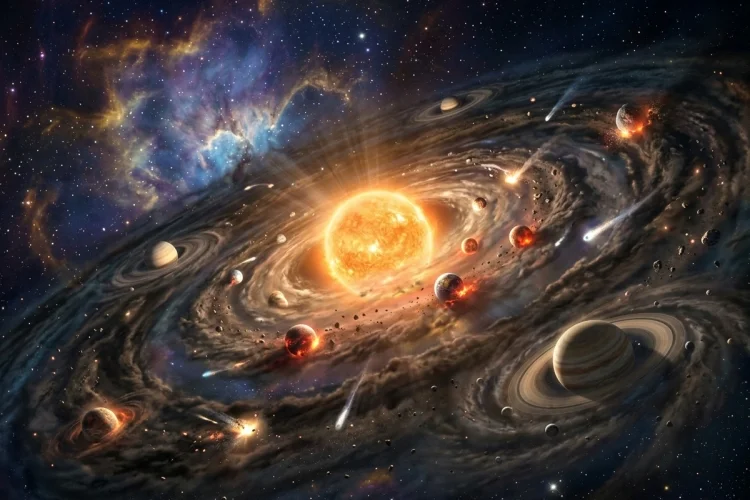
The Solar System is our cosmic neighborhood, but it is far more crowded than the tidy diagrams in schoolbooks suggest.
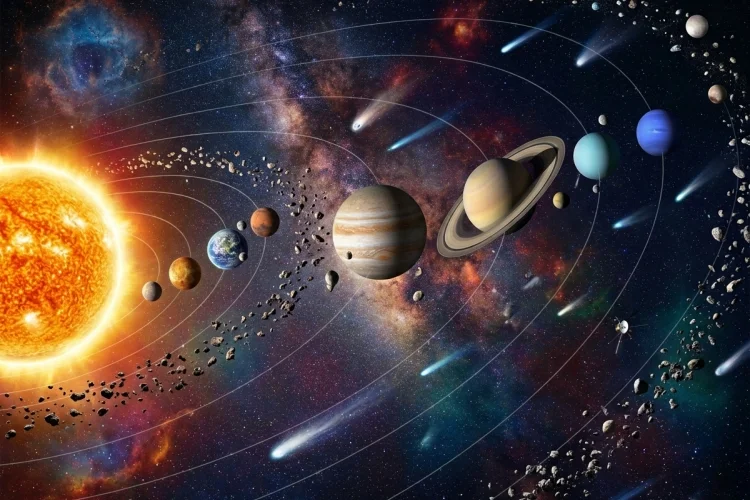
At the center is the Sun, surrounded by eight planets, five officially recognized dwarf planets, hundreds of moons, and huge numbers of asteroids, comets, and smaller pieces of debris.
Gravity keeps this enormous family together. Some objects follow nearly circular paths, while others move through long, tilted orbits that carry them into distant regions of space.
The system formed about 4.6 billion years ago from gas and dust, and many of its smaller bodies still preserve material from that ancient beginning.
Learning how the Solar System works helps us understand why Earth is habitable, how planets evolve, and where scientists might find environments suitable for life. It is also our best natural laboratory for studying how planetary systems develop.
Let’s take a simple tour from the blazing Sun to the icy frontier far beyond Neptune.
The Sun Holds Everything Together
The Sun is a star, not a planet. Its gravity keeps planets, moons, dwarf planets, and countless smaller objects in orbit. It also supplies the light and heat that make life on Earth possible.
Each planet follows its own path around the Sun. The time required to complete that journey defines its year. Earth needs about 365 days, while distant Neptune takes roughly 165 Earth years to finish a single orbit.
The Sun also releases a stream of charged particles called the solar wind. This creates the heliosphere, a vast bubble of solar influence that surrounds the planets and stretches far into space.
Meet the Four Rocky Inner Planets
Mercury, Venus, Earth, and Mars are called terrestrial planets because they have solid, rocky surfaces. They are smaller than the outer planets and sit relatively close to the Sun.
1. Mercury and Venus
Mercury is the smallest planet and the closest to the Sun. Its extremely thin atmosphere cannot retain much heat, causing major temperature differences between its daytime and nighttime sides.
Venus is almost the same size as Earth, but conditions there are dramatically different. Its thick atmosphere traps heat through a runaway greenhouse effect, making Venus the hottest planet in the Solar System-even hotter than Mercury.
2. Earth and Mars
Earth is the only world currently known to support life. Liquid surface water, a protective atmosphere, and a suitable temperature range make our planet unusually welcoming.
Mars is colder, smaller, and much drier. However, ancient lakebeds, river channels, and minerals shaped by water show that the Red Planet had a wetter past. That history makes Mars a major target in the search for signs of ancient microbial life.
Explore the Four Giant Outer Planets
Beyond Mars and the main asteroid belt are Jupiter, Saturn, Uranus, and Neptune. These enormous worlds do not have solid surfaces like Earth. Jupiter and Saturn are gas giants, while Uranus and Neptune are classified as ice giants.
Jupiter is the largest planet in the Solar System. Its atmosphere contains colorful cloud bands and enormous storms, including the Great Red Spot, which has been observed for hundreds of years.
Saturn is famous for its spectacular rings. Rather than being solid structures, the rings consist of billions of pieces of ice, rock, and dust orbiting the planet at different speeds.
Uranus is unusual because it rotates almost completely on its side. Neptune is the most distant recognized planet and the windiest world in the Solar System, with winds that can exceed 1,200 miles per hour.
Moons Are Fascinating Worlds Too
Moons, also called natural satellites, orbit planets, dwarf planets, and even some asteroids. NASA’s moons database lists more than 891 confirmed moons in the Solar System, although the total continues to change as astronomers discover and verify new objects.
Some moons are little more than irregular rocks, while others are complex worlds with atmospheres, volcanoes, oceans, and active geology.
Jupiter’s Europa appears to contain an ocean beneath its icy crust. Saturn’s Enceladus and Titan also have subsurface oceans, while Titan has a thick atmosphere and surface lakes made from liquid methane and ethane.
These moons are exciting because sunlight is not the only possible source of warmth. Gravitational forces from a parent planet can stretch a moon and generate internal heat, potentially allowing liquid water to remain beneath an icy surface.
Dwarf Planets and Pluto’s New Status
According to the modern definition, a planet must orbit the Sun, be nearly round, and clear other similarly sized objects from its orbital neighborhood. A dwarf planet meets the first two requirements but not the third.
Five dwarf planets are officially recognized: Ceres, Pluto, Haumea, Makemake, and Eris. Ceres lies in the main asteroid belt between Mars and Jupiter, while the others occupy the colder outer Solar System.
Pluto was considered the ninth planet until the International Astronomical Union reclassified it in 2006. This change did not make Pluto any less interesting.
During its 2015 flyby, NASA’s New Horizons spacecraft revealed a surprisingly complex world with mountains, glaciers, wide plains, and a thin atmosphere. Scientists also believe many more distant objects could eventually qualify as dwarf planets.
Asteroids, Comets, Meteors, and Meteorites
Asteroids are mostly rocky or metallic leftovers from planet formation. Many travel within the main asteroid belt between Mars and Jupiter, although others pass close to Earth or share orbital paths with planets.
NASA reports that about 1.4 million known asteroids and approximately 4,000 known comets are part of our Solar System. New objects continue to be identified through telescope surveys.
Comets contain frozen gases, rock, and dust. As a comet approaches the Sun, it heats up and may develop a glowing cloud called a coma, along with one or more long tails.
A meteoroid is a small piece of rock or metal traveling through space. When it enters Earth’s atmosphere and creates a bright streak, it becomes a meteor—often called a shooting star. If part of it survives and reaches the ground, that fragment is called a meteorite.
These small objects are more than space rubble. Many have changed very little over billions of years, so they can reveal information about the materials that formed planets and may have delivered water and organic compounds to early Earth.
Beyond Neptune: The Solar System’s Icy Frontier
The Solar System does not suddenly stop at Neptune. Beyond the planet lies the Kuiper Belt, a broad, doughnut-shaped region containing Pluto, other dwarf planets, comets, and potentially millions of smaller icy worlds.
Much farther out is the proposed Oort Cloud. Scientists think it is a vast spherical shell of icy, comet-like objects surrounding the Solar System.
The Oort Cloud is too distant to photograph directly. However, the paths of long-period comets support the idea that this remote reservoir exists.
Studying these distant regions helps researchers reconstruct how the Solar System formed. It also reminds us that the familiar planets occupy only a small central portion of the Sun’s enormous gravitational territory.
The Solar System is a diverse collection of worlds shaped by gravity, collisions, heat, chemistry, and time.
It contains the Sun, eight planets, more than 891 confirmed moons, five officially recognized dwarf planets, and countless smaller objects spread from the asteroid belt to the distant Oort Cloud.
Each destination tells part of our cosmic history. Rocky planets reveal changing climates, giant planets host remarkable moon systems, and frozen objects preserve ancient material from the Solar System’s birth.
Start exploring by learning the planets in order, following a current space mission, or observing the Moon and bright planets from your backyard. The closer you look, the less empty space seems.