It is strange to imagine that Earth, Saturn’s rings, the Moon, and every asteroid once began as material floating inside the same enormous cloud.
There were no planets, oceans, or familiar constellations-just cold gas, tiny dust particles, gravity, and a very long chain of cosmic events.
So, how was the Solar System formed? The leading scientific explanation says it began about 4.6 billion years ago when part of a giant interstellar cloud collapsed.
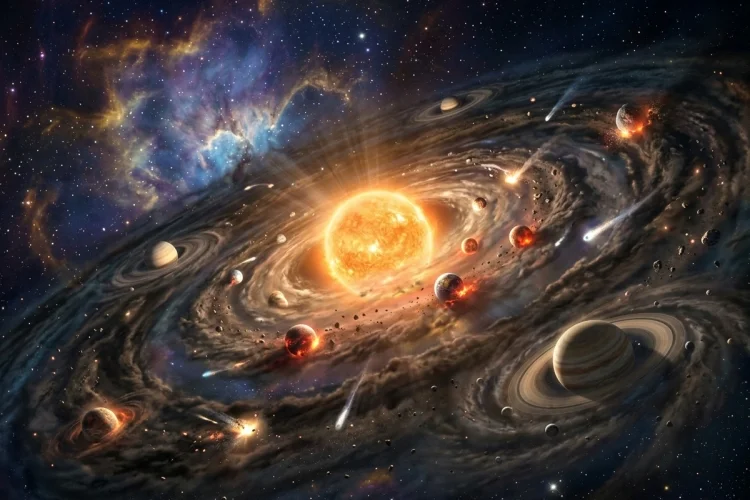
Most of the material gathered at the center and eventually became the Sun, while the rest flattened into a spinning disk. Inside that disk, particles repeatedly collided, stuck together, and gradually grew into planets, moons, asteroids, and comets.
This process was not calm or perfectly organized. The early Solar System was a chaotic construction zone filled with collisions, shifting orbits, and unfinished worlds.
By studying meteorites, Moon rocks, planetary surfaces, and young star systems elsewhere in the galaxy, scientists can reconstruct this remarkable origin story.
It Began With a Giant Cloud of Gas and Dust
Before the Solar System existed, its material was part of a cold molecular cloud made mostly of hydrogen and helium, along with dust and heavier elements produced by earlier generations of stars.
Something caused a small region of that cloud to collapse under its own gravity. A shock wave from a nearby exploding star may have helped trigger the collapse, although scientists cannot confirm the exact event.
As the cloud contracted, it began spinning faster. You can picture a figure skater pulling in their arms and rotating more quickly, although the real process involved an enormous cloud stretching across space.
The collapsing material also flattened into a wide disk. Scientists call this structure the solar nebula or protoplanetary disk. Similar disks have been observed around young stars, giving astronomers real examples of planetary systems under construction.
The Young Sun Formed at the Center
Gravity pulled most of the nebula’s material toward its center. As more gas gathered there, pressure and temperature increased, creating a young object called a protostar.
Eventually, conditions in the core became hot and dense enough for nuclear fusion to begin. Hydrogen atoms started combining to form helium, releasing enormous amounts of energy. The Sun was born.
The Sun contains approximately 99.8% of the Solar System’s total mass. Its powerful gravity controls the orbits of the planets and countless smaller bodies that formed from the remaining material.
When the young Sun became active, its radiation and solar wind helped clear much of the leftover gas from the inner system. Planet formation therefore had a limited supply of material and did not continue forever.
Tiny Dust Grains Grew Into Planets
The planets did not appear fully formed. They began with microscopic particles moving through the disk around the young Sun.
These particles collided and sometimes stuck together. Small clusters became larger pebbles, rocks, and eventually kilometer-sized objects called planetesimals. This gradual buildup is known as accretion.
Once planetesimals became large enough, their gravity attracted additional material. Some developed into Moon-sized or Mars-sized bodies known as planetary embryos or protoplanets.
Collisions between these growing worlds were common. Sometimes an impact shattered an object, but in other cases, the pieces combined into something larger.
Over millions of years, a smaller number of dominant bodies swept up much of the material along their orbital paths. These survivors eventually became the major planets.
Why Rocky Planets Formed Close to the Sun
Temperature played a major role in determining what each planet became. The inner part of the protoplanetary disk was extremely hot, so substances such as water, methane, and ammonia could not easily freeze there.
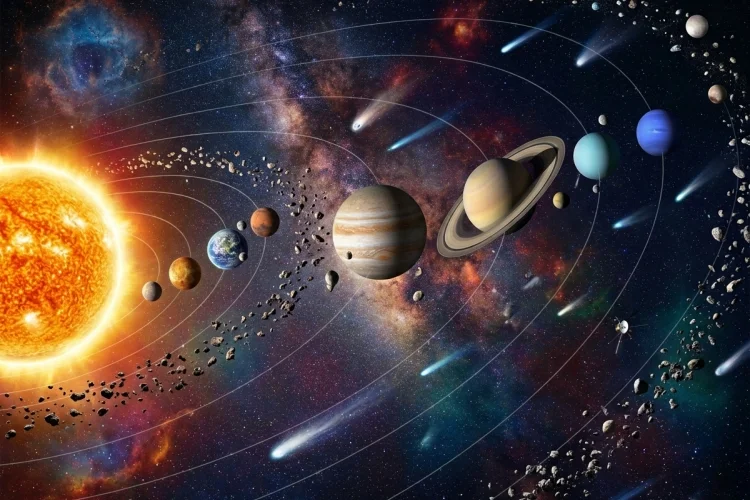
Only heat-resistant materials, including metals and silicate minerals, remained solid close to the Sun. These materials gathered to form Mercury, Venus, Earth, and Mars—the four relatively small, dense, rocky planets.
Farther from the Sun, temperatures were low enough for water and other compounds to freeze. This boundary is commonly called the snow line or frost line.
Beyond it, young planets could collect much larger amounts of solid material. Some developed massive cores that attracted hydrogen and helium from the disk, leading to the formation of Jupiter and Saturn.
Uranus and Neptune also formed in the cold outer region. However, they contain higher proportions of substances such as water, methane, and ammonia and are therefore classified as ice giants rather than gas giants.
Giant Collisions Reshaped the Young Worlds
Forming the planets was only part of the story. After they appeared, their surfaces, rotations, and orbits continued to change through enormous impacts.
The leading explanation for the Moon’s origin is the giant-impact hypothesis. According to this model, a Mars-sized body collided with the young Earth. Material thrown into orbit later gathered together and formed the Moon.
Evidence from Apollo samples suggests the Moon formed roughly 60 million years after Solar System formation began. Its early surface was likely covered by a deep ocean of molten rock that gradually cooled and created the lunar crust.
Other planets and moons also carry scars from the violent early period. Mercury, Mars, the Moon, and many satellites have enormous impact basins that remain visible today.
These collisions could destroy worlds, combine them, change their rotation, or send debris into new orbits. Planet formation was less like carefully assembling a model and more like an uncontrolled cosmic demolition site.
Where Did Moons, Asteroids, and Comets Come From?
Not all material became part of a planet. Many smaller objects survived as leftovers from the formation process.
Asteroids are mostly rocky or metallic bodies. Large numbers orbit in the main asteroid belt between Mars and Jupiter, where material never fully combined into a major planet.
Comets formed mainly in colder regions, where water, carbon dioxide, methane, and other substances could freeze. Many now occupy the Kuiper Belt beyond Neptune or travel inward from the extremely distant region known as the Oort Cloud.
Asteroids, comets, and meteoroids are valuable because some preserve ancient material that has changed very little since the Solar System formed. They are like natural time capsules from our cosmic past.
Moons may have several origins. Some formed from disks of material surrounding young planets, some may be captured objects, and others were created by major collisions.
How Scientists Know What Happened
No human witnessed the birth of the Solar System, so scientists must work like detectives. They combine several types of evidence to build and test formation models.
Meteorites provide some of the most important clues. Researchers can examine their minerals, chemical composition, magnetic properties, and isotopes to understand the conditions that existed in the ancient solar nebula.
Radiometric dating allows researchers to measure the ages of meteorites, Moon rocks, and Earth’s oldest minerals. These measurements are the main reason scientists estimate that the Solar System began forming about 4.6 billion years ago.
Astronomers also observe protoplanetary disks around young stars. Some contain rings, gaps, and structures that may be created by newly forming planets.
Finally, computer simulations allow researchers to test how gravity, collisions, temperature, and migrating planets could have produced the Solar System we see today. The model continues to improve as new mission data and telescope observations become available.
Is the Solar System Still Changing?
The major construction phase is over, but the Solar System is not frozen in time. Planets continue moving around the Sun, moons gradually alter their orbits, and asteroids occasionally collide.
Comets lose material each time they pass close to the Sun. Small objects sometimes enter planetary atmospheres, while impacts continue to create new craters.
The Sun is also changing as it uses the hydrogen in its core. Billions of years from now, it will expand into a red giant and dramatically transform the inner Solar System.
Planetary systems are dynamic rather than permanent. Even after planets form, gravity, radiation, collisions, and stellar evolution continue reshaping them.
The Solar System formed about 4.6 billion years ago from a collapsing cloud of gas and dust. Gravity created the young Sun at its center, while leftover material flattened into a disk where particles grew through accretion.
Heat produced small rocky planets near the Sun, while colder conditions allowed giant planets to develop farther away.
Collisions shaped the planets, created some moons, and left behind asteroids and comets that still preserve evidence from that early era. Scientists reconstruct the story through meteorites, planetary samples, telescopes, space missions, and computer models.
Explore images of modern protoplanetary disks or follow an asteroid sample-return mission. You will be looking at the same processes and materials that once built our own cosmic home.