One second sounds almost meaningless on a cosmic scale. You can barely snap your fingers in that amount of time.
Yet during the first second of the Universe, conditions changed more dramatically than they would during billions of years that followed.
The early cosmos was nothing like the quiet space filled with stars and galaxies that we see today. It was extreamly hot, incredibly dense, and packed with energy and fundamental particles.
Space itself was expanding rapidly, temperatures were falling, and the basic ingredients that would eventually form atoms, planets, and people were beginning to take shape.
Scientists cannot directly observe that first second with a telescope. The oldest light we can directly detect, the cosmic microwave background, was released roughly 380,000 years later.
Instead, physicists combine cosmology, particle physics, accelerator experiments, and mathematical models to reconstruct what probably happened.
The result is an extraordinary timeline in which important events may have happened within tiny fractions of a second.
Before 10⁻⁴³ Seconds: Where Known Physics Reaches Its Limit
The earliest meaningful point on many cosmological timelines is called the Planck time, around 10⁻⁴³ seconds after the beginning of cosmic expansion.
At times earlier than this, our current theories become incomplete. General relativity describes gravity extremely well on large scales, while quantum mechanics explains the microscopic world, but scientists still do not have a complete theory of quantum gravity that successfully combines both.
That means statements about the absolute first instant of the Universe should be treated carefully.
The Big Bang model does a good job describing the evolution of a hot, expanding cosmos after its earliest stages, but it does not provide a confirmed explanation for what caused the Universe to exist or what, if anything, came before.
CERN similarly notes that Big Bang theory can describe the earliest stages of expansion but not the conditions at the absolute beginning.
So the earliest slice of cosmic history remains one of physics’ biggest mysteries.
Cosmic Inflation May Have Happened Almost Immediately
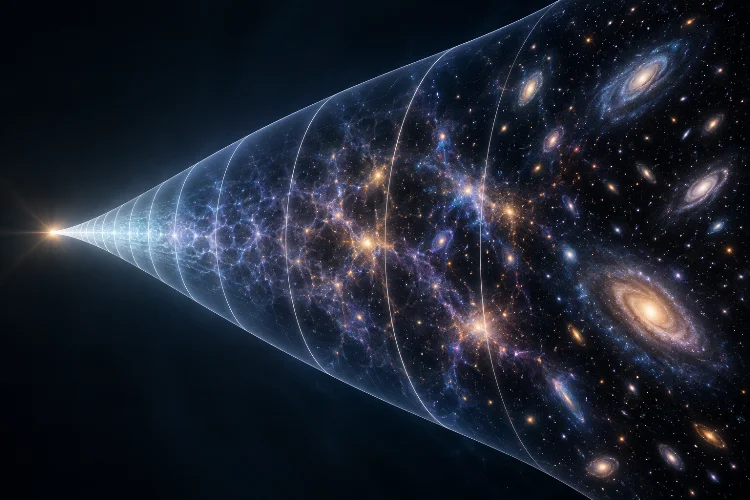
Shortly after the beginning, many cosmological models propose that the Universe entered a period known as cosmic inflation.
During inflation, space expanded at an astonishing rate. ESA describes inflation as a very short period that may have ended by roughly 10⁻³² seconds, after the Universe had expanded enormously.
This does not mean matter was traveling through space faster than light. Instead, space itself was expanding.
Why Inflation Matters
Inflation helps explain why the observable Universe looks remarkably smooth and similar in different directions. It also provides a mechanism for turning microscopic quantum fluctuations into larger variations in density.
Those tiny variations later became incredibly important.
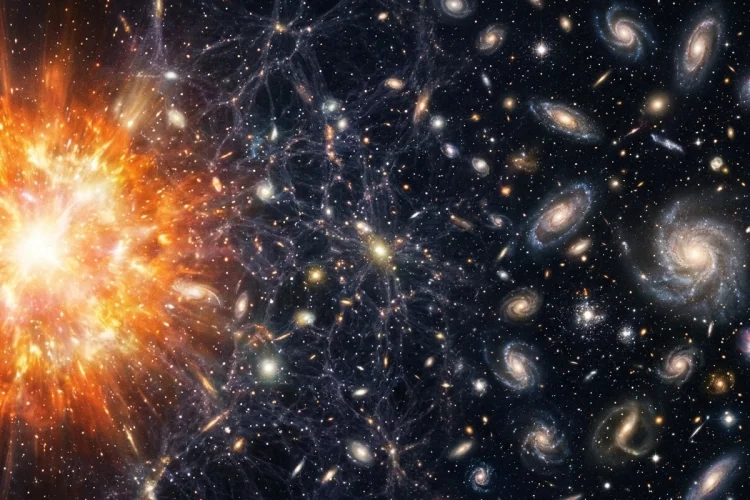
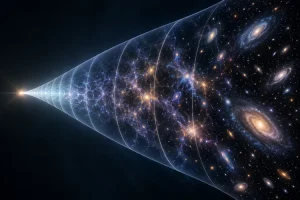
Regions with slightly more matter eventually attracted additional material through gravity. Over billions of years, these small differences developed into galaxies, galaxy clusters, and the enormous cosmic web we observe today.
Inflation is a leading explanation, but scientists are still investigating exactly how it worked and what physical process powered it. NASA explicitly notes that researchers still do not know what came before inflation or what caused it.
The Universe Became a Soup of Fundamental Particles
After inflation ended, the Universe remained unbelievably hot.
Energy existed in forms capable of producing large numbers of particles and antiparticles. Instead of atoms, molecules, planets, or stars, the cosmos contained much more fundamental ingredients.
Quarks, electrons, neutrinos, photons, and other particles moved through an intensely energetic environment.
At these temperatures, familiar matter could not exist.
A proton, for example, normally contains quarks held together by the strong nuclear force. But when temperatures are sufficiently high, quarks are not confined inside ordinary protons and neutrons.
Instead, the early Universe passed through a state called quark-gluon plasma.
CERN describes the first few millionths of a second as a period when the cosmos consisted of an extremely hot and dense mixture dominated by freely moving quarks and gluons.
Modern particle accelerators such as the Large Hadron Collider can briefly create similar conditions by smashing heavy atomic nuclei together at enormous energies.
These experiments give scientists a small experimental window into conditions that existed billions of years ago.
Matter and Antimatter Were Competing
Another major event during the earliest cosmic moments involved matter and antimatter.
According to particle physics, many processes create matter and antimatter together. When a particle meets its corresponding antiparticle, they can annihilate each other and convert their mass into energy.
If the early Universe had contained exactly equal quantities of both, almost all ordinary matter should eventually have disappeared.
Yet that clearly did not happen.
Everything from galaxies and planets to humans is made mostly from matter.
CERN explains that some still-unknown mechanism appears to have produced a tiny excess of matter-roughly one extra matter particle for every billion matter-antimatter pairs. After most particles and antiparticles annihilated each other, that small surplus remained.
That tiny imbalance became enormously significant.
Without it, stars, planets, and biological life as we know them might never have existed.
Exactly why the asymmetry developed remains a major mistery in modern physics. Scientists study processes such as CP violation in particle experiments to search for clues, but the known effects are not yet sufficient to fully explain the matter-dominated Universe.
Quarks Began Forming Protons and Neutrons
By roughly a few millionths of a second after the beginning, the Universe had expanded and cooled enough for another major transition.
Free quarks increasingly became bound together.
Groups of three quarks formed particles such as protons and neutrons, which belong to a broader family known as hadrons.
CERN describes this transition as occurring a few millionths of a second after the Big Bang, as quarks combined to produce protons and neutrons.
This event was critical because protons and neutrons would later become the building blocks of atomic nuclei.
Still, atoms were nowhere close to forming.
The environment remained far too hot for electrons to remain attached to nuclei, and even the first stable light nuclei would not begin forming in significant amounts until several minutes later.
The important point is that matter was gradually becoming more structured.
The Universe had gone from an extraordinarily energetic particle soup toward a state containing many of the basic particles familiar to physics today.
Neutrinos Began Breaking Away Around One Second
As cosmic expansion continued, the temperature kept dropping.
Around the one-second mark, the Universe had cooled to approximately 10 billion degrees Celsius, according to NASA’s overview of cosmic history. It was still an incredibly hot soup of radiation and subatomic particles.
Around this period, neutrinos also began interacting much less frequently with other matter.
Neutrinos are remarkably lightweight particles that rarely interact with ordinary matter even today. In the early Universe, however, temperatures were so high that they interacted much more often.
As expansion lowered the density and temperature, neutrinos effectively decoupled from the surrounding plasma.
Fermilab notes that primordial neutrinos may have begun traveling freely within roughly the first second after the Big Bang, far earlier than photons could travel freely.
These relic neutrinos should still exist throughout the Universe today as the cosmic neutrino background.
Unlike the cosmic microwave background, however, directly detecting this ancient neutrino signal remains extraordinarily difficult.
What Did the Universe Look Like at One Second Old?
By the time the first second had passed, the Universe was still almost unimaginably different from today.
There were no stars.
There were no galaxies, planets, atoms, or even stable atomic nuclei such as helium in large amounts.
Instead, the cosmos consisted mainly of radiation and elementary or subatomic particles, including photons, electrons, neutrinos, protons, and neutrons.
Matter and radiation were still tightly connected, and the entire Universe was opaque.
Yet many of the ingredients required for everything that followed were already present.
Expansion had cooled the cosmos enough for quarks to become bound into hadrons. The matter-antimatter annihilation process had left behind the small excess of matter that eventually formed everything we see.
The next major chapter would be Big Bang nucleosynthesis.
Within the following few minutes, protons and neutrons began combining to create the nuclei of hydrogen, helium, and small amounts of lithium and beryllium. NASA notes that most primordial helium formed within roughly the first five minutes.
Complete atoms would not appear until around 380,000 years later.
How Can Scientists Know About Such an Early Time?
No telescope can take a picture of the Universe at 10⁻¹² seconds old.
So how can researchers say anything useful about it?
The answer comes from combining several independent forms of evidence.
Particle accelerators recreate high-energy conditions that resemble parts of the early Universe. Experiments at CERN, for example, create quark-gluon plasma through heavy-ion collisions, allowing physicists to study how matter behaves under extreme temperatures.
Cosmologists also study the cosmic microwave background.
Although the CMB was released much later, tiny variations within it preserve information about density fluctuations established much earlier in cosmic history.
ESA’s Planck mission mapped these fluctuations with remarkable precision, helping researchers test models of inflation and early cosmic evolution.
Scientists then compare these observations with predictions from nuclear physics, relativity, and particle theory.
Not every detail is settled.
In fact, ESA has emphasized that the period earlier than roughly a millionth of a second contains substantial uncertainty because direct observational evidence is limited.
The timeline is therefore best understood as a combination of well-tested physics and increasingly speculative ideas as we approach time zero.
Why the First Second Matters So Much
The first second was short, but it established many of the conditions that shaped the next 13.8 billion years.
Tiny density fluctuations influenced where galaxies would eventually form. The cooling quark-gluon plasma produced protons and neutrons. A slight imbalance between matter and antimatter allowed physical matter to survive.
Even the early distribution of particles influenced later nucleosynthesis.
This is why scientists care so much about an interval of time shorter than an ordinary heartbeat.
Studying the early cosmos connects astronomy with particle physics. Large telescopes examine ancient light while enormous accelerators recreate tiny pieces of early-universe physics on Earth.
The seperated fields ultimately investigate the same question: how did a hot, almost structureless early Universe become the complex cosmos around us?
Every improvement in particle experiments, gravitational-wave searches, neutrino physics, and cosmological observations may reveal another part of that answer.
So, what happened during the first second of the Universe? In an almost impossibly short period, space expanded dramatically, the cosmos cooled from unimaginable temperatures, fundamental particles filled the Universe, quarks formed protons and neutrons, and neutrinos began to decouple.
Some stages, such as quark-gluon plasma and particle interactions, are supported by well-tested physics. Other ideas-especially what happened at the earliest instants and exactly how inflation began-remain less certain.
What makes this first second so fascinating is that nearly every galaxy, star, planet, and living organism ultimately traces its physical ingredients back to these early events.
Keep exploring cosmic history, because the next few minutes after this first second brought another remarkable transformation: the creation of the first atomic nuclei.