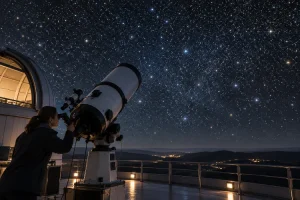
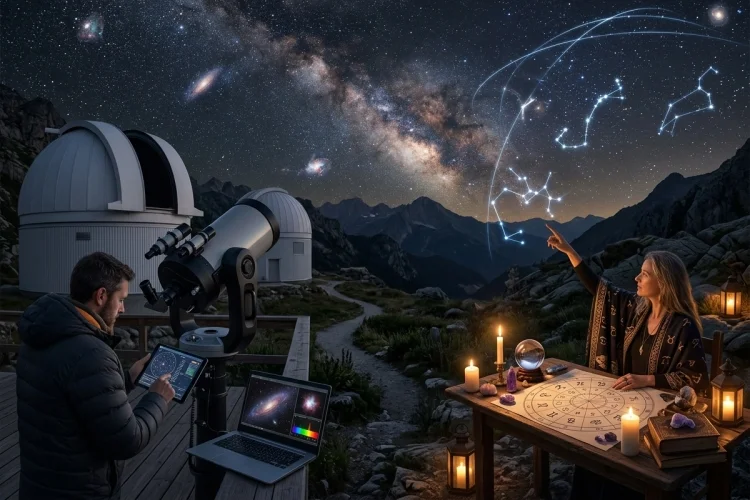
Astronomy and astrology both look toward the sky, use the names of planets, and discuss constellations. That is where most of their similarities end.
Astronomy is a scientific field that studies stars, planets, galaxies, black holes, and other objects in the universe. Astrology is a belief system that interprets the positions of celestial bodies as signs connected to personality, relationships, and events on Earth.
The American Astronomical Society makes the distinction clearly: astronomers rely on research and observation, while astrology proposes that planetary and stellar positions influence human affairs.
The confusion is understandable because astronomy and astrology share a long history. Ancient societies did not always separate measuring the sky from interpreting its possible meaning. Today, however, they have very different goals, methods, and standards of evidence.
This guide explores astronomy vs. astrology in simple terms, including their historical connection, how each field works, and why only one is considered a modern science.
What Is Astronomy?
Astronomy is the scientific study of the universe and the objects and phenomena found beyond Earth’s atmosphere. It investigates the positions, movements, physical properties, chemical composition, energy, and evolution of celestial bodies.
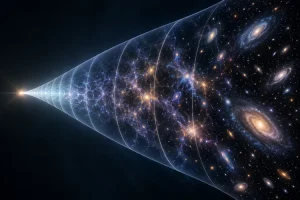
Astronomers study an enormous range of subjects. Some examine nearby planets, moons, asteroids, and comets, while others investigate distant stars, nebulae, galaxies, dark matter, and the expansion of the universe.
Modern astronomy also includes astrophysics, which uses physics to explain how cosmic objects behave. Scientists may study how stars generate energy, how planets form, why galaxies collide, or what happens near a black hole.
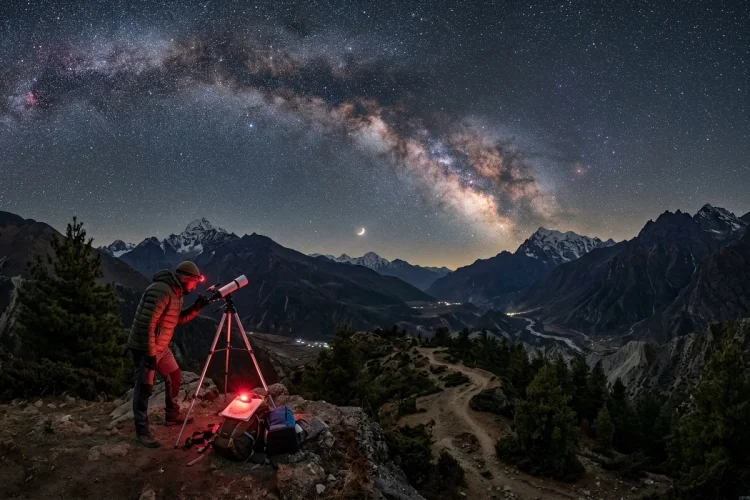
Although people often imagine astronomers looking through telescopes every night, much of their work involves mathematics, computer programming, data analysis, simulations, and scientific writing.
What Is Astrology?
Astrology is a system that assigns symbolic meaning to the apparent positions of the Sun, Moon, planets, and other points in the sky. Practitioners often use a birth chart, also called a natal chart, which maps celestial positions at the time and location of a person’s birth.
Many people know astrology through the 12 zodiac signs, such as Aries, Taurus, Gemini, and Cancer. Popular horoscopes may offer predictions or guidance about personality, romance, careers, finances, and future events.
Astrology can serve as entertainment, a spiritual tradition, or a tool for personal reflection. However, these uses do not make it a scientific discipline.
Scientific status depends on whether a system consistently produces testable, reliable, and repeatable results.
Educational resources from the University of California, Berkeley explain that astrological claims can sometimes be tested, but the broader field has not demonstrated the scientific characteristics needed to support its conclusions.
The Biggest Difference: Evidence and Testing
The main difference between astronomy and astrology is not simply that one uses telescopes while the other uses zodiac charts. The real difference is how each one builds and evaluates knowledge.
1. Astronomy Uses the Scientific Method
Astronomers begin with observations and questions. They create hypotheses, collect data, compare results, and allow other researchers to review their work.
For example, an astronomer may predict that a planet will pass in front of a distant star at a particular time. Other observatories can watch the same event and check whether the prediction is correct.
Scientific explanations can also change when better evidence becomes available. Pluto’s classification, models of planetary formation, and estimates of cosmic distances have all been revised as researchers collected more accurate data.
2. Astrology Relies on Interpretation
Astrology connects celestial positions with human qualities or earthly events. Its conclusions may differ depending on the astrological tradition, the practitioner, and the way a chart is interpreted.
Descriptions in horoscopes are also frequently broad enough to apply to many people. A statement such as “you value independence but sometimes seek reassurance” may feel personal, even though it could describe a large percentage of readers.
A well-known double-blind study published in Nature tested whether astrologers could accurately match natal charts with personality profiles. The experiment did not provide evidence that the astrological predictions performed as claimed.
Why Astronomy and Astrology Are Often Confused
The two subjects share vocabulary. Both discuss planets, constellations, the zodiac, and movements across the sky.
However, they use these concepts differently. In astronomy, a constellation is a defined region of the celestial sphere that helps scientists identify where objects appear. The International Astronomical Union officially recognizes constellation boundaries for mapping and communication.
In astrology, constellations and zodiac signs are part of an interpretive system. A planet appearing within a particular zodiac sign may be assigned symbolic meaning related to emotions, behavior, or future possibilities.
The zodiac itself is also handled differently. Astronomers observe that zodiac constellations vary in size, so the Sun does not spend an equal amount of time in each one. Astrological systems generally divide the zodiac into 12 equal sections, each covering 30 degrees.
The same sky is being discussed, but the purpose is different. Astronomy measures physical reality, while astrology interprets symbolic meaning.
A Brief History of Astronomy and Astrology
Ancient civilizations carefully tracked the Sun, Moon, planets, and stars. These observations helped people develop calendars, anticipate seasonal changes, support agriculture, and navigate across land and sea.
At the same time, many cultures interpreted unusual celestial events as messages or signs. Eclipses, comets, and planetary movements could be connected to rulers, wars, harvests, or natural disasters.
Because observation and interpretation happened together, early astronomy and astrology were closely connected. The separation became clearer as researchers increasingly tested explanations through measurement, mathematics, and repeatable observation.
Over time, astronomy developed into a physical science. It produced models that could accurately predict planetary orbits, eclipses, comet returns, and many other celestial events.
Astrology continued mainly as a cultural, spiritual, and divinatory practice. Its historical importance remains real, but historical influence is not the same as scientific validity.
Can Astrology Be Tested Scientifically?
Some astrological claims are too general to test easily. Others can be turned into specific predictions.
Suppose astrologers claim that people born under a certain sign are significantly more likely to possess a measurable personality trait. Researchers could collect a large sample, define that trait, control possible biases, and compare the results with chance.
Testing must also be fair. Researchers should avoid knowing which participants belong to each group, use clear scoring methods, and repeat the study with new participants.
When astrology has been evaluated under controlled conditions, it has not produced consistent evidence supporting its predictive claims.
This is why scientific and educational organizations generally classify it as a pseudoscience rather than a science. The National Science Board has included astrology in discussions of public understanding of science and pseudoscientific beliefs.
This does not mean people are forbidden from enjoying astrology. It means astrological advice should not be presented as scientifically proven information.
Astronomy and Astrology in Everyday Life
The difference becomes important when decisions carry real consequences. Reading a horoscope for entertainment is very different from using it to replace medical, legal, financial, or psychological advice.
Astronomical information, by contrast, is used in satellite operations, spacecraft navigation, calendars, timekeeping, and the prediction of events such as eclipses. It is based on measurements that can be independently checked.
You can also recognize the difference by asking a few practical questions. Is the claim specific enough to test? Can independent researchers repeat the result? Does the explanation change when evidence contradicts it? Are conclusions published and reviewed by specialists?
These questions are useful far beyond the astronomy vs. astrology debate. They can help you evaluate health trends, viral claims, personality tests, and other information encountered online.
Can You Enjoy Both?
A person can enjoy learning about astronomy while also reading horoscopes for entertainment or cultural reasons. The key is understanding that the two activities do not carry the same kind of evidence.
You might use astrology as a prompt for journaling or self-reflection. For example, a horoscope about communication could encourage you to think about how you handle disagreements.
Astronomy answers a different type of question. It can explain why planets appear to move backward in the sky, how stars are born, or how scientists discover worlds orbiting distant suns.
Keeping the categories clear allows people to respect cultural traditions without confusing personal belief with scientific knowledge.
The difference between astronomy and astrology comes down to purpose, method, and evidence. Astronomy is a science that uses observation, mathematics, experiments, and repeatable analysis to understand the physical universe.
Astrology interprets celestial positions as symbols connected to personality and events, but its predictions have not gained consistent scientific support. Their shared history and vocabulary explain why people still mix them up.
However, astronomy studies what planets and stars physically are and how they behave, while astrology asks what their positions might symbolically mean for human life.
The next time you see a planet, zodiac sign, or horoscope mentioned online, look at the type of claim being made. Then explore a trusted astronomy resource, observe the night sky, and discover what science can reveal about the universe.