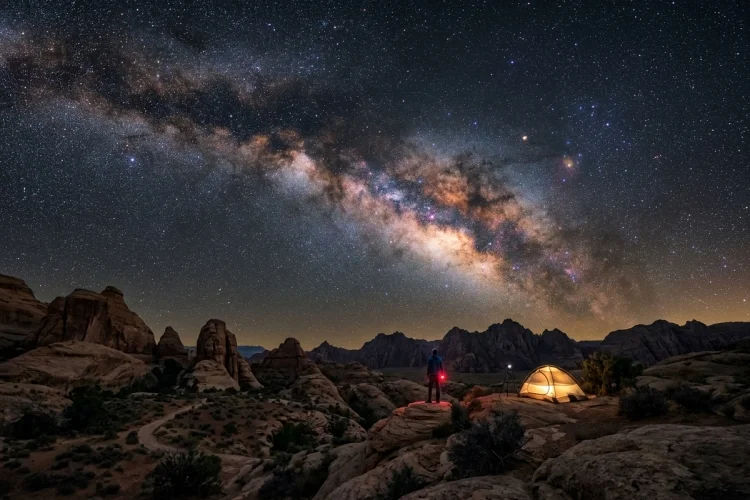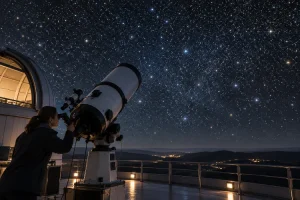
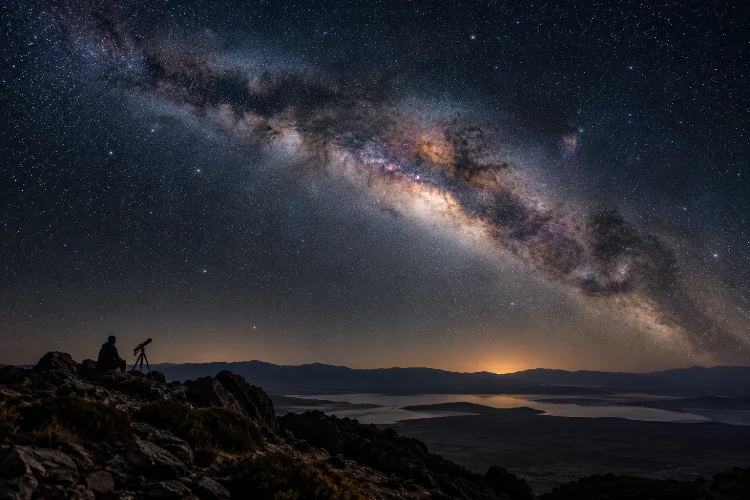
Look up at a dark sky far away from city lights, and you may notice a pale, cloudy band stretching across the heavens. That soft glow is not a cloud at all.
It is part of the Milky Way Galaxy, the enormous galactic system that contains our Sun, Earth, and everything else in the Solar System.
Although the Milky Way feels incredibly large from our perspective, it is only one galaxy among billions scattered throughout the observable universe.
Even so, understanding it is especially important because it gives astronomers a front-row seat to how galaxies form, evolve, create stars, and interact with their surroundings.
The Milky Way contains hundreds of billions of stars, huge clouds of gas and dust, star-forming regions, planets, stellar remnants, dark matter, and a supermassive black hole at its center. Yet scientists are still uncovering new details about its structure.
So, what exactly is our cosmic home made of, where are we located inside it, and how do astronomers study something so enormous while living inside it?
What Is the Milky Way Galaxy?
The Milky Way is a barred spiral galaxy, meaning it has a flattened disk with spiral features and an elongated bar of stars running through its central region.
NASA estimates that the galaxy is roughly 100,000 light-years across and contains somewhere between 100 billion and 400 billion stars.
A light-year is the distance light travels in one year, about 9.46 trillion kilometers. That means even traveling at the speed of light, it would take around 100,000 years to cross the main stellar disk from one side to the other.
The galaxy does not consist of stars alone. It also contains planets, nebulae, molecular clouds, stellar clusters, black holes, neutron stars, and large quantities of material that cannot be observed directly.
Much of its total mass is actually believed to exist as dark matter.
The Structure of Our Home Galaxy
From the outside, the Milky Way would probably resemble a glowing cosmic pinwheel. However, its structure is more complicated than a simple spiral.
1. The Galactic Disk and Spiral Arms
Most visible stars, gas, and dust are concentrated within a relatively thin rotating disk. Spiral structures extend outward through this disk, containing many regions where new stars are born.
Our understanding of those arms continues to improve. Data from ESA’s Gaia mission have shown that the Galaxy’s spiral structure is more complex and less sharply defined than older illustrations sometimes suggested.
Young, bright stars are commonly associated with these spiral regions because the arms contain dense clouds of gas where star formation can occur.
2. The Central Bulge and Galactic Bar
Closer to the center is a crowded bulge containing large numbers of older stars. A long bar-shaped structure crosses this central region and connects to the wider galatic disk.
Because interstellar dust blocks much of the visible light coming from the center, astronomers often study this region using infrared, radio, and X-ray telescopes.
3. The Galactic Halo
Surrounding the visible disk is a much larger, roughly spherical halo. It contains old stars and globular clusters, but an even more important component may be invisible dark matter.
Measurements using observations from missions such as Hubble and Gaia have suggested a total Milky Way mass of roughly 1.5 trillion times the mass of the Sun, with much of that mass associated with dark matter rather than visible stars.
Where Is Our Solar System in the Milky Way?
Fortunately, Earth is nowhere near the extremely crowded galactic center.
Our Solar System sits in a smaller spiral feature generally called the Orion Arm or Orion Spur, located between the Sagittarius and Perseus arms. NASA describes the Sun as occupying this partial arm while orbiting around the center of the Galaxy.
The entire Solar System travels through the Galaxy at approximately 828,000 kilometers per hour. Even at that remarkable speed, one complete orbit around the center takes roughly 230 million years.
This period is sometimes informally called a galactic year.
Think about what that means: dinosaurs appeared and disappeared during only a fraction of the Sun’s journey around the Galaxy. Since the Solar System formed roughly 4.6 billion years ago, the Sun has completed only around 20 galactic orbits.
Our location also gives us an interesting observational challenge. Because we are inside the galactic disk rather than floating above it, astronomers cannot simply take a photograph of the entire Milky Way from the outside.
Sagittarius A*: The Black Hole at the Galactic Center
At the heart of the Milky Way lies one of its most fascinating objects: Sagittarius A*, usually shortened to Sgr A*.
It is a supermassive black hole containing roughly four million times the mass of the Sun. NASA estimates its mass at approximately 4.3 million solar masses.
That may sound terrifying, but there is no danger of Earth suddenly being pulled into it. The Solar System is tens of thousands of light-years from the center, and the black hole behaves gravitationally like any other object of the same mass.
Black holes also do not automatically “vacuum up” everything around them.
Astronomers study stars orbiting near Sagittarius A* to better understand the black hole’s mass and the extreme physical enviroment around the Galactic Center.
These observations provide researchers with a natural laboratory for testing gravity under conditions that cannot be reproduced on Earth.
Stars, Planets, Gas, and Dust Everywhere
The Milky Way is not simply a giant collection of existing stars. It is an evolving ecosystem where stars are continually born, live their lives, and eventually die.
Stars begin inside cold molecular clouds made primarily of gas and dust. Gravity causes dense regions within these clouds to collapse, eventually producing protostars. Depending on their mass, those stars may live anywhere from millions to trillions of years.
Massive stars can eventually explode as supernovae, scattering elements such as oxygen, silicon, and iron into surrounding space. Those materials can later become part of new stars, rocky planets, and possibly living organisms.
Our own Solar System is therefore built from material processed by earlier generations of stars.
Planets are probably extremely common as well. Astronomers have already discovered thousands of planets beyond the Solar System, known as exoplanets, suggesting that planetary systems are hardly unusual.
Somewhere among the Galaxy’s enormous stellar population, scientists continue searching for worlds with conditions that might support life.
That possibility remains one of astronomy’s biggest misteries.
How Scientists Map the Milky Way From the Inside
Mapping your own galaxy is a little like trying to map an entire forest while standing between the trees. Nearby objects can block distant ones, and cosmic dust makes the problem even harder.
Astronomers therefore combine information from visible-light telescopes, infrared observatories, radio telescopes, X-ray instruments, and spacecraft.
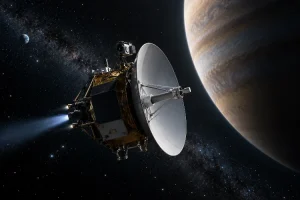
One of the most important projects has been the European Space Agency’s Gaia mission.
From 2014 until its science observations ended in January 2025, Gaia made more than three trillion observations of around two billion stars and other objects. It precisely measured properties such as positions, movements, brightness, temperature, and composition.
Using techniques such as parallax, researchers can calculate stellar distances. By combining distance measurements with information about how stars move, astronomers can build an increasingly detailed three-dimensional model of our Galaxy.
These observations also help scientists trace groups of stars that may have originated in smaller galaxies absorbed by the Milky Way billions of years ago.
In other words, the stars around us preserve clues about the Galaxy’s history.
The Milky Way Is Still Changing
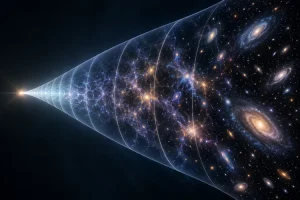
Galaxies are not static structures frozen in space. They evolve over billions of years through star formation, gravitational interactions, mergers, and exchanges of material.
The Milky Way has likely absorbed numerous smaller galaxies throughout its history. Some populations of stars that appear seperated today may actually be remnants of those ancient collisions.
Our Galaxy also belongs to a collection of galaxies called the Local Group, which includes the Andromeda Galaxy and dozens of smaller galaxies.
These galaxies influence one another through gravity.
Studying these interactions helps astronomers understand not only the future of our own Galaxy but also the broader processes that shaped galaxies throughout the universe.
Modern surveys are making that history increasingly visible, turning the Milky Way into something more than a beautiful streak across the night sky. It has become an enormous archaeological record of cosmic evolution.
The Milky Way Galaxy is more than the place where Earth happens to exist. It is a vast and dynamic system containing hundreds of billions of stars, planetary systems, clouds of gas and dust, a mysterious dark matter halo, and a supermassive black hole at its center.
Our Solar System occupies only a tiny neighborhood within this immense structure, yet studying that neighborhood helps astronomers understand how galaxies across the universe form and change.
And the story is far from complete. Missions such as Gaia, along with powerful space and ground-based telescopes, continue to reveal new details about our cosmic home.
The next time you see the Milky Way stretching across a dark sky, take another look. You are not simply looking at distant stars-you are looking through the enormous galaxy that you already call home.