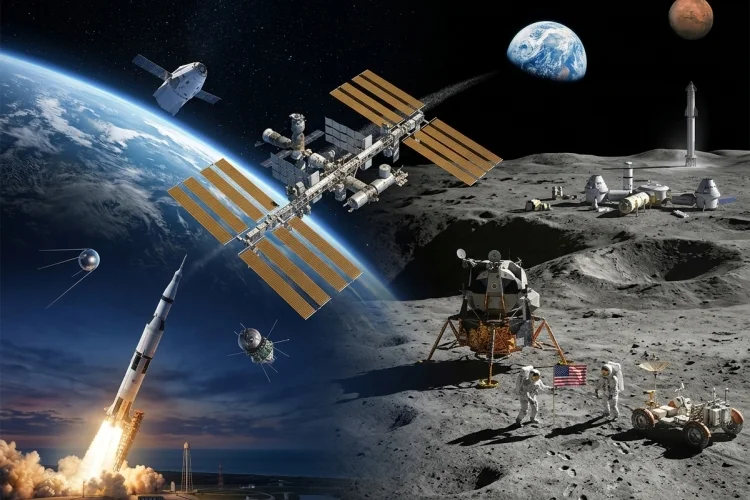
Humans have walked on the Moon, lived aboard space stations, and sent spacecraft into orbit for decades.
But when scientists want to explore places that are too distant, dangerous, or expensive for astronauts to visit, they often rely on robotic explorers known as space probes.
So, what is a space probe, exactly?
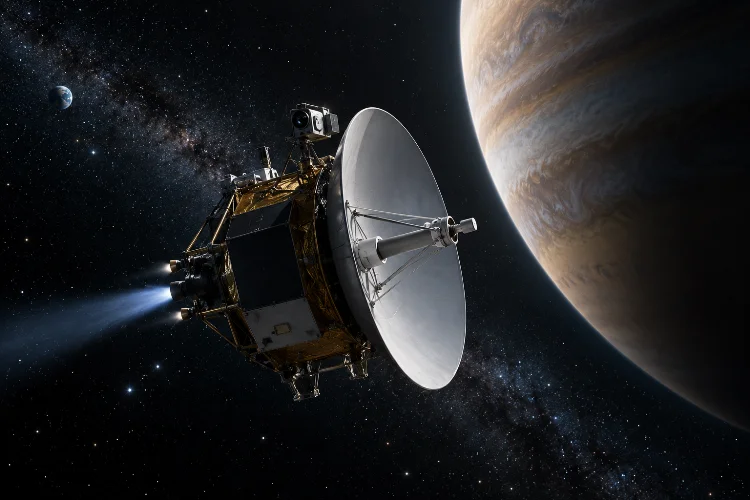
In simple terms, it is an uncrewed spacecraft designed to travel beyond Earth and collect scientific information about space or another celestial object.
Depending on the mission, a probe might fly past a planet, orbit a comet, enter an atmosphere, land on a distant world, or continue traveling toward interstellar space.
NASA describes space probes as robotic spacecraft that explore beyond Earth orbit and return scientific data for researchers to study.
These machines have completely transformed our understanding of the Solar System. They have photographed Pluto up close, landed on a comet, explored every giant planet, and even entered the Sun’s outer atmosphere.
Let’s look at how these remarkable robotic explorers actually work.
What Is a Space Probe and What Does It Do?
A space probe is essentially a robotic scientific laboratory built to operate beyond Earth.
Unlike crewed spacecraft, it does not need oxygen, food, sleeping areas, or life-support equipment. Instead, most of its available space and resources can be dedicated to computers, communication systems, power supplies, scientific instruments, and propulsion.
NASA defines a space probe as a robotic spacecraft that travels farther into space rather than simply remaining in Earth orbit. It may explore the Moon, travel between planets, fly past or orbit another world, land on a planetary body, or eventually reach interstellar space.
Its main purpose is collecting information.
A probe might measure temperature, radiation, magnetic fields, atmospheric composition, surface chemistry, or particles in space. Cameras can capture detailed images, while specialized spectrometers can reveal what distant materials are made of.
The spacecraft then stores and transmits those measurements back to scientists on Earth.
In a way, a probe works as humanity’s remote eyes, ears, and scientific instruments in places we cannot personally reach.
How Is a Space Probe Different From a Satellite?
The words spacecraft, satellite, and space probe are sometimes used interchangeably, but they do not always mean exactly the same thing.
Spacecraft is the broadest term. NASA describes it as any kind of space vehicle, including Earth satellites, crewed vehicles, and deep-space probes.
A satellite normally refers to an object placed into orbit around another body. Thousands of artificial satellites orbit Earth today, performing communication, navigation, weather monitoring, scientific research, and Earth observation.
A probe usually has an exploration-focused mission beyond ordinary Earth orbit.
There is some overlap, though.
A robotic probe sent to Mars may eventually enter orbit around the planet, making it technically an orbiter and an artificial satellite of Mars. Parker Solar Probe is classified by NASA as an orbiter because it repeatedly travels around the Sun.
So these categories are not always strict.
The easiest way to think about it is that space probe describes the exploratory role, while terms such as orbiter, lander, or flyby spacecraft describe how the mission operates.
Different Types of Space Probes
There is no single design that works for every destination. A spacecraft exploring Jupiter needs very different capabilities from one landing on Mars or flying close to the Sun.
NASA groups robotic spacecraft into several broad categories, including flyby spacecraft, orbiters, atmospheric probes, landers, rovers, observatories, and communication or navigation spacecraft.
1. Flyby Probes
A flyby spacecraft passes close to its target without entering orbit.
Because the encounter may last only hours or days, instruments often need to collect enormous amounts of information in a very short period.
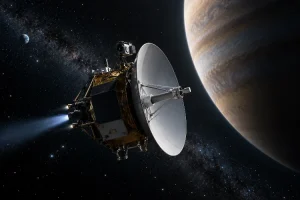
New Horizons is a famous example.
Launched in 2006, the spacecraft flew past Pluto on July 14, 2015, coming within about 12,500 kilometers of the dwarf planet. It later encountered the Kuiper Belt object Arrokoth in January 2019.
2. Orbiters
An orbiter slows down enough to become gravitationally captured by its destination.
Instead of seeing a planet only once, it can observe the same world repeatedly for months or even years.
Orbiters can map surfaces, monitor weather, investigate magnetic fields, study atmospheres, and watch seasonal changes over long periods.
The challenge is that the spacecraft must carry enough propulsion-or use another braking method-to enter the correct orbit. NASA notes that planetary orbiters require substantial capability to decelerate at exactly the right point during arrival.
Landers and Rovers
Some probes actually reach the surface.
Landers remain mostly stationary after touching down, while rovers can move across the terrain. These missions can examine rocks and soil directly rather than observing them only from orbit.
NASA notes that landers and rovers can study geology, surface history, and chemical compounds, including materials potentially relevant to the search for signs of past or present life.
These missions are especially complicated because the spacecraft must survive entry, descent, and landing before the science mission can even begin.
What Is Inside a Space Probe?
Although every spacecraft is different, most probes share several essential systems.
The onboard computer acts as the spacecraft’s brain. It processes commands from Earth, controls instruments, monitors spacecraft health, stores data, and sometimes makes decisions automatically.
Scientific instruments depend on the mission.
A probe may be equiped with cameras, radar systems, spectrometers, magnetometers, particle detectors, plasma instruments, or atmospheric sensors.
Power is another major concern.
Spacecraft operating relatively close to the Sun can often use solar panels. Missions traveling much farther away may use radioisotope power systems because sunlight becomes weaker with distance.
Communication equipment is equally important.
A spacecraft can make an extraordinary discovery, but the information is useful only if it can be transmitted home.
Large antennas send radio signals containing scientific observations and engineering data back to Earth. Because signals travel at the speed of light, communication becomes increasingly delayed as the spacecraft moves farther away.
Deep-space probes must therefore be able to operate somewhat independently.
NASA notes that the Voyager spacecraft include autonomous fault-protection systems capable of placing the spacecraft into safer operating states when problems occur—important when communication round trips can take many hours.
How Do Space Probes Survive and Navigate Deep Space?
Space may look empty, but it is not an easy enviroment for electronics.
A probe must survive extreme temperature changes, radiation, vacuum, high-speed particles, and years or even decades without anyone physically repairing it.
Engineers design spacecraft with insulation, thermal-control systems, radiation-resistant electronics, redundant components, and software capable of responding to failures.
Some destinations create unusually extreme challenges.
NASA’s Parker Solar Probe, for example, repeatedly travels through the Sun’s outer atmosphere. A specialized thermal protection system shields the spacecraft as it makes measurements close to our star. In 2021, Parker became the first spacecraft to fly through the solar corona.
Navigation is another challenge.
Mission teams calculate trajectories using orbital mechanics and track spacecraft through radio signals. Small thruster burns can adjust the trajectory during a journey.
Some probes also use gravity assists.
Instead of carrying enough fuel to make every velocity change by themselves, spacecraft can fly past a planet and use its gravity and orbital motion to alter their trajectory.
Once observations are collected, data are often stored onboard and transmitted seperately when the spacecraft’s antenna can point toward Earth.
This balance between navigation, communication, power, and scientific operations can continue for decades.
Famous Space Probes and What They Discovered
Some of the most important discoveries in planetary science came from robotic probes.
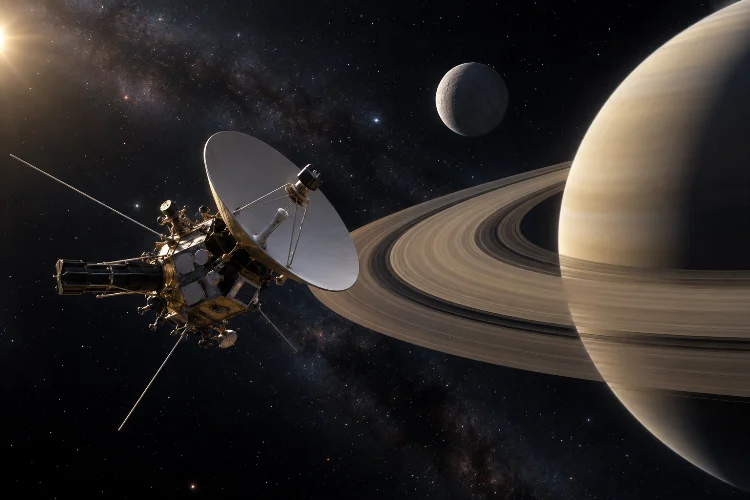
NASA’s Voyager 1 and Voyager 2 were launched in 1977. Both explored the outer Solar System, while Voyager 2 remains the only spacecraft to have visited Uranus and Neptune at close range.
Voyager 1 entered interstellar space in 2012, followed by Voyager 2 in 2018. They remain the only spacecraft to have operated beyond the heliosphere, the huge region dominated by the Sun’s solar wind and magnetic influence.
New Horizons completely changed our picture of Pluto.
Before its 2015 flyby, even powerful telescopes showed Pluto mostly as a tiny distant world. New Horizons revealed mountains, plains, glaciers, atmospheric layers, and unexpectedly complex geology during its historic encounter.
ESA’s Rosetta mission took exploration in another direction.
Rosetta became the first spacecraft to orbit a comet’s nucleus and deployed the Philae lander to Comet 67P/Churyumov-Gerasimenko in 2014. The mission studied the comet’s gas, dust, surface, and composition in extraordinary detail.
Then there is Parker Solar Probe, which explores a region once considered nearly impossible for spacecraft to visit.
These missions show why probes are so useful. Each can be designed for a specific scientific question and sent into conditions that would be far too dangerous for humans.
They have succesfully turned distant points of light into real worlds with landscapes, weather, chemistry, and complicated histories.
So, what is a space probe? It is an uncrewed robotic spacecraft built to explore destinations beyond Earth and return scientific information.
Depending on its mission, a probe may perform a flyby, enter orbit, land on a surface, travel through an atmosphere, or continue into interstellar space.
Space probes have allowed humanity to study worlds that astronauts cannot currently visit.
Voyager revealed the outer planets, New Horizons transformed our understanding of Pluto, Rosetta explored a comet, and Parker Solar Probe has ventured into the Sun’s corona.
And robotic exploration is far from finished. Future probes will investigate asteroids, icy moons, planetary atmospheres, and other unexplored regions.
Keep following upcoming space missions-the next small robotic explorer could completely change what we know about our cosmic neighborhood.