
Every sunrise delivers an enormous amount of energy to Earth. Sunlight warms the ground, powers photosynthesis, drives weather patterns, and makes most life on our planet possible.
Yet the Sun is around 150 million kilometers away, so how can it continuously produce so much light and heat? The answer begins deep inside the Sun, where temperatures reach about 15 million degrees Celsius.
Under these extreme conditions, hydrogen nuclei combine through a process called nuclear fusion. A small amount of mass is converted into energy, which slowly travels from the solar core to the surface before escaping into space as electromagnetic radiation.
Although people sometimes describe the Sun as a giant ball of fire, it does not burn like wood, coal, or gasoline. Its power comes from nuclear reactions rather than ordinary combustion.
Understanding how the Sun produces light and heat reveals not only how stars work, but also why Earth has a stable source of energy billions of years after the Solar System formed.
The Sun Is a Giant Ball of Plasma, Not Fire
The Sun is made mainly of hydrogen and helium. However, its material is so hot that it exists mostly as plasma, a state of matter in which electrons are separated from atomic nuclei.
A normal fire requires fuel, oxygen, and a chemical reaction. The Sun does not rely on oxygen to keep “burning.” Instead, it produces energy by changing atomic nuclei through nuclear fusion.
This distinction matters because chemical burning could not power the Sun for billions of years. Even if the Sun were made from a highly combustible material, it would run out of chemical fuel relatively quickly.
Nuclear fusion releases far more energy than ordinary chemical reactions. That is why the Sun has been shining for more than four billion years and is expected to remain a main-sequence star for roughly another five billion years.
Nuclear Fusion Begins in the Solar Core
The Sun’s energy factory is its core, the central region where gravity creates tremendous pressure and heat. Temperatures there reach approximately 15 million degrees Celsius, while the surrounding material compresses hydrogen to an extraordinary density.
Normally, positively charged hydrogen nuclei repel one another. In the core, however, the particles move fast enough and are packed closely enough for some of them to overcome that repulsion.
When they get sufficiently close, the strong nuclear force can bind them together. This begins the sequence of fusion reactions that powers the Sun.
Fusion also creates outward pressure. That pressure pushes against gravity, which is constantly trying to pull the Sun inward.
The balance between the two is known as hydrostatic equilibrium, and it keeps the Sun relatively stable instead of collapsing or rapidly expanding.
How Hydrogen Becomes Helium
The Sun primarily generates energy through a series of reactions called the proton-proton chain. It does not simply push four hydrogen atoms together in a single collision. The transformation happens through several steps.
The process starts when two protons interact. One eventually changes into a neutron, producing a form of hydrogen called deuterium. Additional reactions create helium-3, and two helium-3 nuclei can then combine to form helium-4.
The overall result is that four hydrogen nuclei help produce one helium nucleus, along with energy, photons, neutrinos, and other particles. The proton-proton chain is the primary nuclear cycle powering stars with masses similar to the Sun.
Neutrinos are especially interesting because they interact only weakly with matter. They can escape from the Sun’s core almost immediately, giving scientists direct information about the nuclear reactions happening deep inside a region that telescopes cannot see.
Why Fusion Releases So Much Energy
A helium nucleus created through fusion has slightly less mass than the original hydrogen nuclei involved in the process. The missing mass has not disappeared. It has been converted into energy.
This relationship is described by Albert Einstein’s famous equation:
E = mc²
In the equation, energy equals mass multiplied by the speed of light squared. Because the speed of light is such a large number, even a small amount of mass can become an enormous quantity of energy.
NASA estimates that the Sun converts roughly four billion kilograms of mass into energy every second. That sounds unsustainable, but the Sun is so massive that this energy production represents only a tiny portion of its total material.
Fusion energy initially appears in several forms, including high-energy electromagnetic radiation and the motion of particles. Countless interactions inside the Sun gradually redistribute and transform this energy before it reaches the surface.
Energy Takes a Long Journey to the Surface
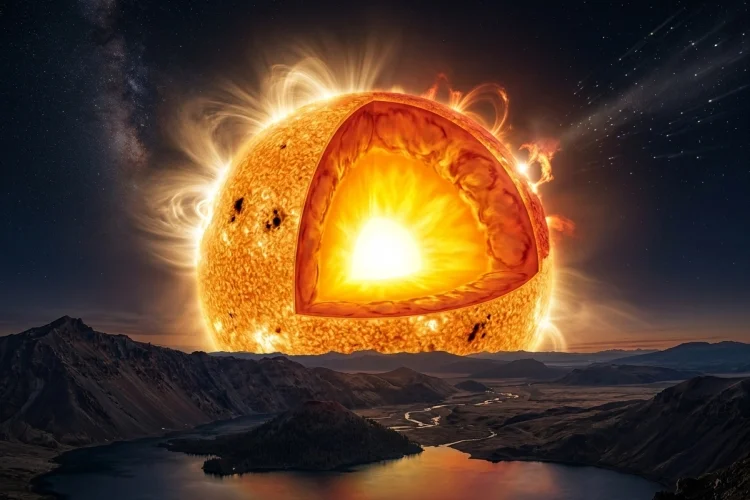
Once energy is produced in the core, it must travel through the Sun’s interior. This journey is divided into two major stages: movement through the radiative zone and movement through the convection zone.
1. Through the Radiative Zone
The radiative zone surrounds the core and covers much of the Sun’s interior. Here, energy moves outward mainly through radiation.
A photon may be absorbed by a particle and then re-emitted in a different direction. This process happens repeatedly, producing a random, zigzagging journey rather than a straight trip toward the surface.
Because the solar interior is extremely dense, energy can take hundreds of thousands or even more than a million years to move from the core to the surface, depending on the model used.
The original high-energy photons are also transformed during this process. By the time energy reaches the Sun’s outer layers, it has been redistributed across many lower-energy photons.
2. Through the Convection Zone
Farther outward, the solar material becomes cooler and less dense. Radiation becomes a less efficient way to transport energy, so convection takes over.
Hot plasma rises toward the surface, releases some of its energy, cools, and then sinks again. It works somewhat like boiling water circulating in a pot, although the Sun’s convection occurs on a vastly larger scale.
The grainy patterns visible in detailed images of the Sun, known as granulation, are connected to these rising and sinking flows of plasma. ESA divides the solar interior into the core, radiative zone, and convection zone based on how energy is produced and transported.
How the Sun Produces Visible Light
Energy finally reaches the photosphere, the layer commonly described as the Sun’s visible surface. It is not a solid surface, but it is the region from which most visible solar radiation escapes into space.
The photosphere has a temperature of around 5,500 degrees Celsius. At that temperature, it emits a broad spectrum of electromagnetic radiation, including visible light, infrared radiation, and ultraviolet radiation.
Visible light contains the colors of the rainbow. Although the Sun may look yellow from the ground, its combined visible light is closer to white. Earth’s atmosphere scatters shorter blue wavelengths more strongly, which affects how the Sun and sky appear to us.
The Sun also releases radio waves, X-rays, gamma rays, and energetic particles. Solar flares and other magnetic events can briefly increase emissions at some wavelengths, but the steady flow of radiation from the photosphere supplies most of the energy Earth receives.
How Sunlight Becomes Heat on Earth
The Sun does not send “heat” through empty space in the same way that a hot pan transfers heat to your hand. Space contains too little matter for normal conduction or convection between the Sun and Earth.
Instead, solar energy crosses space as electromagnetic radiation. After sunlight reaches Earth, land, oceans, buildings, plants, and the atmosphere absorb part of that radiation.
Absorbed energy increases the movement of atoms and molecules in those materials, raising their temperature. Energy can then move between warmer and cooler objects as heat.
Some sunlight is reflected back into space. Snow and clouds, for example, reflect relatively large amounts, while oceans and forests generally absorb more.
Earth also releases energy back into space mainly as infrared radiation, creating an energy balance that strongly influences the planet’s climate.
Once solar radiation escapes the photosphere, it travels through space at the speed of light. Sunlight takes approximately eight minutes and twenty seconds to cover the average distance between the Sun and Earth.
Why the Sun Does Not Explode or Collapse
The Sun contains an enormous amount of hot, active plasma, yet it remains relatively stable because two powerful forces are balanced.
Gravity pulls the Sun’s material toward the center. At the same time, pressure created by hot plasma and energy from fusion pushes outward.
When these forces are balanced, the Sun maintains its general size and shape. If fusion slowed significantly, gravity would cause the core to contract. That contraction would raise the core’s temperature and pressure, which could increase the fusion rate again.
This self-regulating behavior allows the Sun to produce energy steadily over incredibly long periods.
However, the balance will eventually change when the core’s hydrogen supply becomes depleted. The Sun will then enter later stages of stellar evolution and eventually expand into a red giant.
The Sun produces light and heat through nuclear fusion in its core. Extreme pressure and temperatures allow hydrogen nuclei to form helium, converting a small amount of mass into a huge supply of energy.
That energy slowly moves through the radiative and convection zones before escaping from the photosphere as electromagnetic radiation. After sunlight reaches Earth and is absorbed by matter, part of its energy becomes the warmth we feel.
This continuous process powers ecosystems, influences weather, supports the water cycle, and keeps our planet habitable. The next time sunlight comes through your window, remember that its energy began deep inside the Sun long before humans existed.
Explore solar images from NASA or safely observe the Sun using certified equipment to learn more about the star that powers our world.