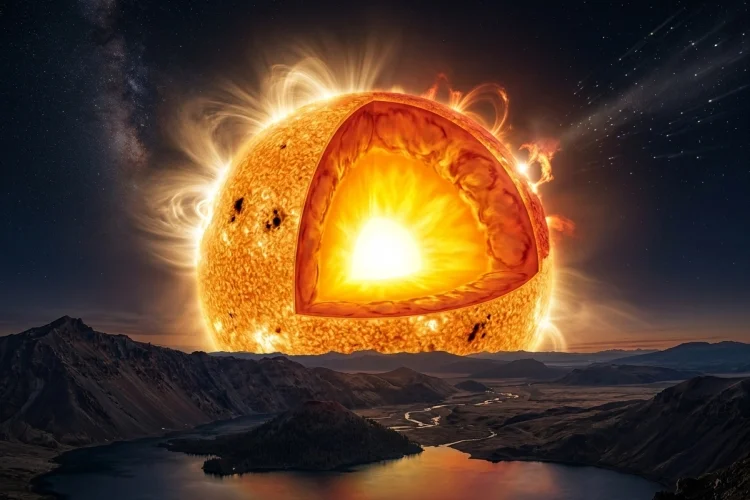
The Sun may look like a smooth, glowing circle in the sky, but it is anything but simple. Beneath the visible surface lies a collection of distinct layers, each with different temperatures, densities, and jobs.
Some create energy, others transport it, and the outer layers release it into space. Understanding the structure of the Sun helps explain nearly everything our star does.
Its inner regions power sunlight through nuclear fusion, while its atmosphere produces sunspots, solar flares, and streams of charged particles that can affect Earth.
The Sun does not have solid layers like a rocky planet. It is made mostly of plasma-a superheated state of matter containing electrically charged particles. Scientists divide this plasma into regions based on how energy moves and how the material behaves.
From the center outward, the main layers are the core, radiative zone, convection zone, photosphere, chromosphere, transition region, and corona. Let’s travel through each one and discover what happens inside our nearest star.
The Sun Is a Layered Ball of Plasma
The Sun is a medium-sized star composed mainly of hydrogen and helium. Its enormous gravity pulls all its material inward, while pressure from hot plasma and nuclear reactions pushes outward.
These opposing forces create a balance called hydrostatic equilibrium. Without it, the Sun would either collapse under its own gravity or expand uncontrollably.
Scientists usually divide the solar structure into two main sections. The solar interior contains the core, radiative zone, and convection zone. Above them is the solar atmosphere, which includes the photosphere, chromosphere, transition region, and corona.
The boundaries between these regions are not solid walls. Instead, temperature, density, pressure, and energy transport gradually change as you move outward.
How Scientists See Inside the Sun
No spacecraft can travel through the Sun’s interior, so researchers use a method called helioseismology. It studies sound-like waves that travel through the Sun and make its surface vibrate.
The technique works somewhat like earthquake seismology on Earth. By examining how solar waves move, scientists can estimate internal temperatures, rotation rates, material flows, and the locations of different layers.
The Core: The Sun’s Energy Factory
The core is the innermost and hottest part of the Sun. It extends from the center to approximately one-quarter of the Sun’s radius.
Temperatures in this region reach about 15 million degrees Celsius. The pressure is also incredibly high because the weight of the entire star compresses the material above the center.
These extreme conditions allow nuclear fusion to take place. During the main fusion process, hydrogen nuclei eventually combine to form helium. A small amount of mass is converted into a huge quantity of energy.
Every second, the Sun converts roughly four million metric tons of matter into energy. Despite that impressive rate, the Sun contains so much hydrogen that it has already been shining for billions of years and can continue for billions more.
Fusion also produces neutrinos, extremely small particles that rarely interact with matter. Unlike light energy, which takes a very long time to escape the interior, neutrinos can travel through the Sun almost immediately.
Scientists detect them on Earth to confirm that fusion is happening inside the core.
The Radiative Zone: A Slow Journey Outward
Surrounding the core is the radiative zone. In this dense region, energy moves mainly through radiation rather than through large circulating flows of plasma.
Energy released by fusion begins as extremely energetic photons. However, these photons cannot simply fly straight from the core to the surface because the solar interior is packed with particles.
A photon may travel only a short distance before being absorbed. It is later re-emitted in a random direction, absorbed again, and then released once more.
This repeated process creates an extremely slow, zigzagging journey called a random walk. NASA and ESA estimates indicate that energy can take around 170,000 years to pass through the radiative region and reach the upper interior.
During that journey, the original high-energy radiation is repeatedly redistributed. By the time the energy reaches the outer layers, it has been transformed into many lower-energy photons.
The plasma in the radiative zone is still hot and dense, but it is stable enough to prevent large-scale convection. Energy therefore continues moving mainly through the absorption and re-emission of radiation.
The Convection Zone: A Churning Ocean of Plasma
Above the radiative zone is the convection zone, the outermost region of the solar interior. It begins roughly 200,000 kilometers below the visible surface and extends to the photosphere.
Here, the plasma is cooler and less dense than in the deeper layers. Radiation becomes a less efficient way to transfer energy, so convection takes over.
Hot plasma rises toward the surface because it is less dense. As it releases energy and cools, it becomes denser and sinks again. This continuous movement creates enormous convection currents.
The process is similar to water circulating in a boiling pot, although the scale is far greater. Some flows are small enough to create surface granules, while others stretch across tens of thousands of kilometers.
The convection zone also plays a major role in the Sun’s magnetic behavior. Flowing electrically charged plasma generates and twists magnetic fields, contributing to the solar cycle, sunspots, and powerful eruptions.
The Photosphere: The Surface We Can See
The photosphere is commonly called the surface of the Sun, although it is not solid. It is the deepest solar layer that can be observed directly and is only a few hundred kilometers thick.
Most of the visible light that reaches Earth escapes from this region. Its average temperature is approximately 5,500 degrees Celsius, although temperatures vary across the layer.
Detailed images of the photosphere show a grainy pattern known as granulation. Each granule marks an area where hot plasma rises, cools, and sinks back into the convection zone.
The photosphere is also where sunspots appear. They look dark because they are cooler than the surrounding surface, not because they are actually black.
Strong magnetic fields interfere with normal convection in these areas, reducing the amount of heat reaching the surface. Sunspots can range from relatively small features to groups many times larger than Earth.
The number of sunspots rises and falls over an approximately 11-year solar cycle. Periods with many sunspots are usually associated with greater solar activity.
The Sun’s Outer Atmosphere
Above the photosphere are several thin but highly active atmospheric layers. These regions become much less dense as they extend outward, yet their temperatures unexpectedly rise.
1. The Chromosphere
The chromosphere sits directly above the photosphere. Its name means “sphere of color” because it can appear as a reddish layer around the Sun during a total solar eclipse.
It is roughly 1,000 to 2,000 kilometers thick. Temperatures initially fall near its base but then rise to tens of thousands of degrees toward the upper part.
The chromosphere contains narrow jets of plasma called spicules. These fast-moving structures can rise thousands of kilometers before falling back toward the Sun.
2. The Transition Region
The transition region is a thin, irregular boundary between the chromosphere and corona. Across a relatively short distance, temperatures climb dramatically from tens of thousands to hundreds of thousands of degrees.
This region does not form a perfectly even shell. Magnetic fields shape its plasma into complex loops and structures, making its appearance constantly change.
3. The Corona
The corona is the Sun’s expansive outer atmosphere. It extends millions of kilometers into space but is much fainter than the photosphere, so it is difficult to see without special instruments.
During a total solar eclipse, the Moon blocks the bright photosphere and reveals the corona as a glowing white crown. Astronomers also use devices called coronagraphs to create an artificial eclipse and monitor this region.
Surprisingly, the corona can reach temperatures of one to several million degrees Celsius, making it much hotter than the visible surface below.
The exact combination of processes responsible for this coronal heating remains an active research topic, although magnetic waves and energy released through reconnecting magnetic fields appear to play important roles.
The corona is also the source of the solar wind, a continuous flow of charged particles and magnetic fields traveling away from the Sun. This flow creates the heliosphere, a vast bubble of solar influence surrounding the planetary system.
Solar flares and coronal mass ejections can release sudden bursts of energy and plasma from the atmosphere. When directed toward Earth, these events may produce auroras, disrupt radio signals, affect satellites, and interfere with electrical systems.
The structure of the Sun consists of several connected regions, each performing an essential role. Nuclear fusion generates energy inside the core, radiation slowly carries it through the radiative zone, and convection transports it toward the visible surface.
Light escapes from the photosphere before passing through the chromosphere, transition region, and incredibly hot corona. Magnetic fields connect these layers and produce sunspots, flares, prominences, and solar storms.
Learning about these regions turns the Sun from a simple glowing disk into a complex and dynamic star.
Explore current solar images from NASA or ESA, compare views captured at different wavelengths, and remember to use certified solar-viewing equipment whenever observing the Sun directly.