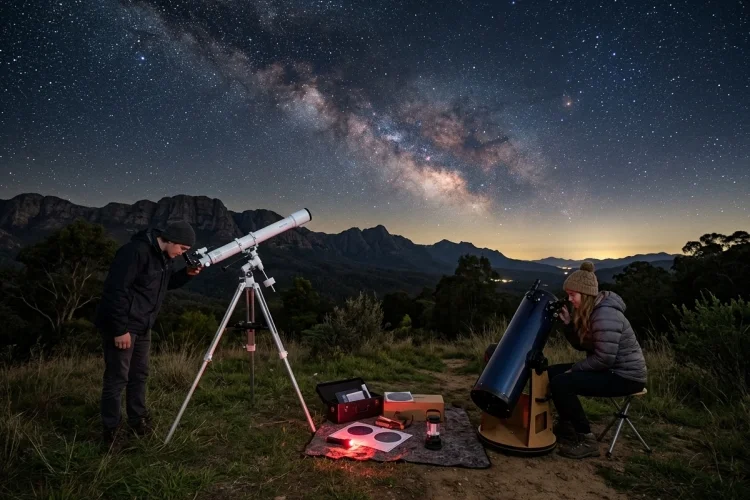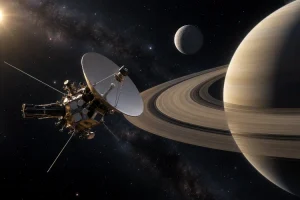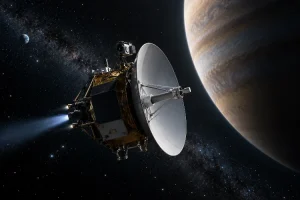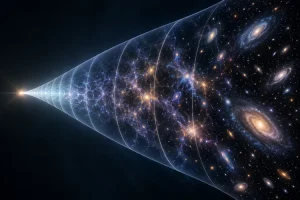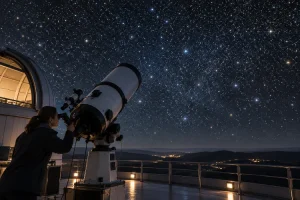
A telescope can reveal lunar craters, Saturn’s rings, glowing nebulae, and galaxies located millions of light-years away. Yet it does not pull those objects closer or physically reach into space.
Its real job is to collect light that has already traveled across the universe and organize that light into a useful image. So, how does a telescope work? Most optical telescopes use a curved lens or mirror to gather incoming light and bring it to a focus.
An eyepiece can enlarge the focused image for your eye, while professional observatories usually direct the light toward cameras, spectrographs, and other scientific detectors.
The larger the telescope’s main lens or mirror, the more light it can collect. This allows astronomers to observe objects that are too faint for the unaided eye and distinguish finer details in distant targets.
Although telescope designs vary, they all follow the same basic idea: capture a signal, focus it, and record or display the information it carries.
A Telescope Is Mainly a Light-Collecting Tool
People often assume that magnification is a telescope’s most important feature. In reality, light-gathering ability matters more.
Your pupils collect only a small amount of light. A telescope has a much larger opening, allowing it to capture more photons from a faint planet, star cluster, or galaxy. Its optics then concentrate that light into an image that your eye or a detector can examine.
This explains why a telescope can reveal objects that are invisible to the naked eye. A distant galaxy may be sending light toward Earth, but your eyes cannot collect enough of it to form a noticeable image.
A telescope does not create extra light or attract it from space. It simply intercepts light that is already moving in its direction.
NASA describes the primary mirror of the James Webb Space Telescope as a “light bucket” that gathers faint infrared radiation over its collecting area.
Aperture Determines How Much Light Enters
The diameter of a telescope’s main lens or mirror is called its aperture. A larger aperture collects more light and generally provides a brighter, more detailed view.
For example, a telescope with a 200-millimeter aperture gathers considerably more light than one with a 100-millimeter opening. The increase is greater than two times because collecting area grows with the square of the diameter.
Aperture also influences resolution, which is the ability to separate small details. A telescope with better resolution may distinguish two closely spaced stars instead of showing them as one blurred point.
This is why professional observatories use enormous primary mirrors. Webb has a segmented primary mirror measuring 6.6 meters across, while Hubble uses a 2.4-meter mirror. Their large collecting areas allow them to detect extremely faint cosmic signals.
For a beginner choosing a telescope, aperture is usually a more meaningful specification than an impressive magnification claim printed on the box.
Refracting Telescopes Use Lenses
A refracting telescope, or refractor, uses a curved objective lens at the front of its tube. As light passes through the lens, it bends inward through a process called refraction.
The lens brings incoming rays to a focal point, creating a small image. An eyepiece then enlarges that image so it can be viewed comfortably.
Refractors often have enclosed tubes and require relatively little maintenance. Small models can provide sharp views of the Moon, planets, double stars, and bright terrestrial objects.
However, large refracting telescopes are difficult to build. A big lens becomes heavy, must be supported around its edges, and needs extremely smooth, accurate surfaces. Thick glass can also absorb some incoming light.
Lenses may bend different colors by slightly different amounts, creating colored edges around bright objects. This optical problem is called chromatic aberration, although modern multi-element lenses can reduce it substantially.
Reflecting Telescopes Use Mirrors
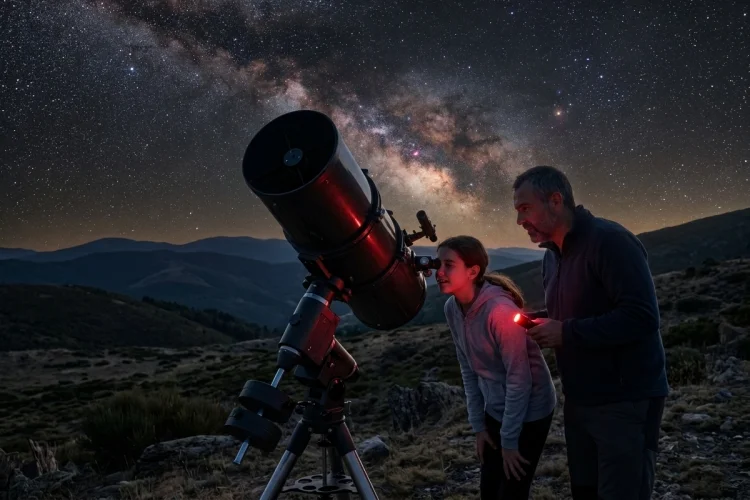
A reflecting telescope, or reflector, uses a curved primary mirror instead of a front lens. Light travels down the tube, reflects from the main mirror, and is directed toward a focal point.
In a common Newtonian reflector, a smaller secondary mirror redirects the focused light toward an eyepiece on the side of the tube. Other designs send the light through a hole in the primary mirror toward instruments behind it.
Hubble uses a Cassegrain-style arrangement. Its primary mirror reflects light to a smaller secondary mirror, which sends the beam back through an opening in the primary mirror and into cameras or spectrographs.
Mirrors can be supported from behind and made thinner than large lenses. They also do not require light to pass through thick glass, making reflectors more practical for large astronomical telescopes.
For these reasons, most major research observatories use mirrors. Even Webb’s 18 gold-coated segments work together as one large curved reflecting surface.
Reflectors do require occasional maintenance. Their mirrors can become misaligned, and exposed optical surfaces may eventually need cleaning or recoating.
What Do the Eyepiece and Focuser Do?
After the main optics create an image, a visual telescope needs an eyepiece to enlarge it. Different eyepieces provide different magnifications and fields of view.
A low-power eyepiece shows a wider section of the sky. It is useful for locating targets and observing large objects such as open star clusters.
A higher-power eyepiece provides a narrower view and may reveal more detail on the Moon or planets. However, excessive magnification makes the image dimmer and can exaggerate vibration, atmospheric turbulence, and focusing problems.
That is why higher power does not automatically produce a better view. The most useful magnification depends on the aperture, optical quality, target, and stability of the atmosphere.
The focuser moves the eyepiece or detector slightly inward and outward. This adjusts where the concentrated light forms its sharpest image.
Focusing must be precise because even excellent optics can produce a blurry view when the eyepiece or camera sits in the wrong position.
The Mount Keeps the Telescope Stable
A telescope tube is only part of the instrument. It also needs a stable mount that holds it in place and allows it to follow objects across the sky.
An alt-azimuth mount moves up, down, left, and right. It is intuitive and works well for casual visual observing.
An equatorial mount is aligned with Earth’s rotational axis. Once properly set up, it can follow a star using movement around a single main axis.
Computerized mounts use motors and software to locate and track celestial targets. Tracking is important because Earth’s rotation makes stars and planets appear to drift across the sky.
A shaky mount can ruin the experience even when the telescope has good optics. Every touch, breeze, or footstep may cause the image to bounce.
For beginners, a smaller telescope on a solid mount is often more enjoyable than a larger optical tube supported by a weak tripod.
Modern Telescopes Use Cameras and Spectrographs
Professional astronomers rarely spend the night looking through an eyepiece. Instead, telescopes direct collected light into sensitive electronic instruments.
Digital cameras can gather photons over long exposures, revealing objects much fainter than the human eye can see in real time. Multiple exposures may later be calibrated and combined to improve detail and reduce noise.
A spectrograph separates incoming light into its component wavelengths. The resulting spectrum can reveal an object’s chemical composition, temperature, movement, and other physical characteristics.
This means a telescope does more than produce attractive images. It turns light into scientific data.
Webb, for example, sends infrared light collected by its primary and secondary mirrors into four scientific instruments. These instruments create images and spectra rather than presenting a direct visual view through an eyepiece.
Telescopes may also use filters to isolate selected wavelengths. Astronomers can compare those observations to investigate gas clouds, young stars, planetary atmospheres, or energetic galactic centers.
Telescopes Observe More Than Visible Light
Human eyes detect only the visible portion of the electromagnetic spectrum. The universe also emits radio waves, infrared radiation, ultraviolet light, X-rays, and gamma rays.
Different telescope designs are needed for different wavelengths. Radio telescopes use large dishes to collect long-wavelength signals from objects such as gas clouds, pulsars, planets, and galaxies.
Because radio wavelengths are long, individual radio dishes usually require very large diameters to produce detailed images. Astronomers often connect multiple antennas into an array so that they work together like a much larger instrument.
Infrared telescopes must limit interference from unwanted heat. Webb uses a large sunshield to keep its mirrors and instruments cold enough to detect faint infrared radiation.
X-rays do not reflect from ordinary telescope mirrors in the same way as visible light. X-ray observatories use nested mirrors positioned at shallow angles so the radiation grazes their surfaces and reaches the detectors.
Gamma rays are even more difficult to focus. Instead of normal lenses or mirrors, gamma-ray observatories often use specialized detectors to determine the direction and energy of incoming radiation.
Why Put Telescopes in Space?
Earth’s atmosphere protects life, but it creates challenges for astronomy. Moving air distorts incoming light, producing the twinkling of stars and reducing image sharpness.
The atmosphere also absorbs many wavelengths, including much of the ultraviolet, X-ray, and infrared radiation arriving from space. Ground-based telescopes cannot study those signals effectively without special conditions or techniques.
Space telescopes operate above clouds, weather, and most atmospheric distortion. Hubble’s location above the atmosphere gives it a clearer view and access to a broader wavelength range than many ground observatories.
However, space telescopes are expensive, difficult to launch, and challenging to repair. Ground-based observatories can use much larger structures and receive upgrades more easily.
Modern astronomy therefore relies on both. Space and ground instruments often observe the same target at different wavelengths, creating a more complete picture than either could provide alone.
What Can a Beginner See Through a Telescope?
A modest backyard telescope can show far more than the naked eye, but realistic expectations are important.
The Moon may reveal crater walls, mountains, valleys, and shadows. Jupiter can display cloud bands and several large moons, while Saturn’s rings are visible through many beginner instruments under good conditions.
Bright star clusters may look like sparkling groups of individual points. Some nebulae and galaxies can appear as soft gray patches rather than the colorful structures shown in processed observatory images.
Those professional pictures often combine long exposures, multiple filters, and digital processing. Your eye cannot collect light for several hours, so the visual experience will naturally be subtler.
Start with low magnification, focus carefully, and allow the telescope to settle after touching it. Learning how to aim and observe patiently often improves the view more than adding another accessory.
A telescope works by collecting light with a curved lens or mirror, bringing that light to a focus, and delivering the image to an eyepiece or scientific detector.
Its aperture determines how much light it gathers and influences how much detail it can resolve. Refractors bend light through lenses, while reflectors bounce it from mirrors.
Mounts keep the instrument stable, eyepieces control the visual view, and cameras or spectrographs turn incoming radiation into research data.
Telescopes can also detect wavelengths beyond human vision, revealing a universe that would otherwise remain hidden.
Begin by observing the Moon or a bright planet through a local astronomy club’s telescope, then compare different designs before deciding which instrument best matches your interests.