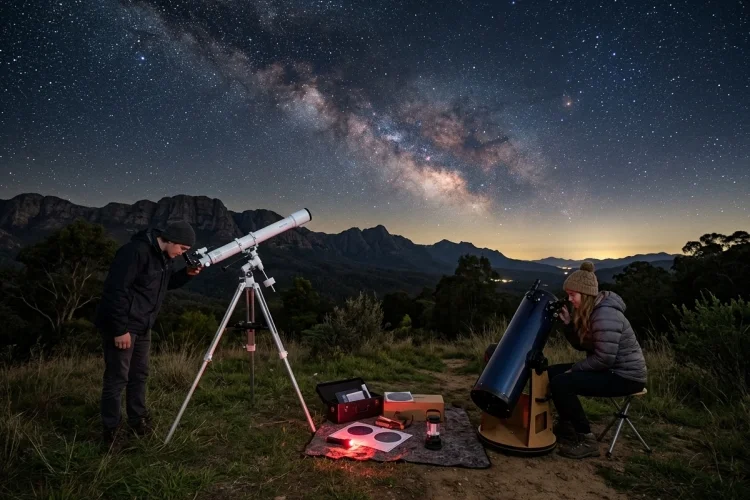
Choosing your first telescope can feel surprisingly complicated. One model has a long tube with a glass lens at the front, while another uses a wide open tube with a mirror hidden at the bottom.
Both promise impressive views, but they work differently and suit different observing styles. The refractor vs. reflector telescope debate is not really about finding one design that defeats the other.
Refractors use lenses to bend and focus light, while reflectors use curved mirrors to collect it. Both can show the Moon, planets, stars, and deep-sky objects when they are well made and placed on a stable mount.
The better choice depends on what you want to observe, how much equipment you are comfortable carrying, and whether you mind performing occasional maintenance.
Aperture, optical quality, and mount stability usually matter more than the telescope category alone. NASA explains that a larger primary lens or mirror gathers more light, making faint celestial objects easier to detect.
Let’s compare the two designs in practical, beginner-friendly terms.
How Does a Refractor Telescope Work?
A refractor uses a large objective lens at the front of its tube. Incoming light passes through this curved glass, bends inward, and comes to a focus near the eyepiece.
This is the classic telescope shape most people recognize. The first astronomical telescopes developed in the 1600s were refractors, and many small backyard instruments still use this design.
Because the main lens is fixed in a closed tube, a refractor usually stays aligned well. You can carry it outside, attach an eyepiece, point it toward the sky, and begin observing with relatively little adjustment.
Small refractors are especially convenient for quick sessions. They can deliver sharp views of the Moon, planets, double stars, bright clusters, and daytime scenery.
However, large lenses are heavy and difficult to manufacture accurately. As the aperture grows, refractors usually become longer, heavier, and more expensive than reflectors of a similar size.
How Does a Reflector Telescope Work?
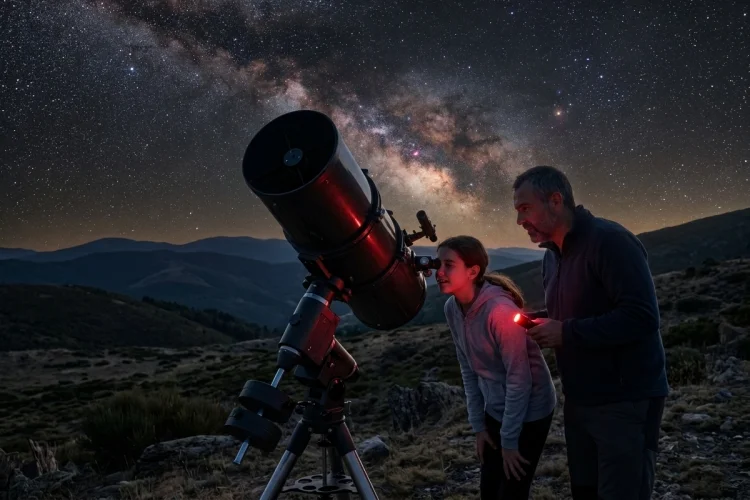
A reflector replaces the front objective lens with a curved primary mirror, usually positioned at the bottom of the tube. Light enters the telescope, reflects from this mirror, and travels toward a focal point.
The most common beginner design is the Newtonian reflector. A small diagonal secondary mirror near the top of the tube redirects the focused light into an eyepiece on the side.
Mirrors are easier to support from behind and can be made thinner than large lenses. This makes it practical to build reflecting telescopes with much larger apertures.
NASA notes that most large modern telescopes rely on mirrors because they are lighter and easier to manufacture at large sizes.
A Newtonian mounted on a simple rotating base is called a Dobsonian telescope. Dobsonians are popular because they combine straightforward movement with relatively large mirrors, offering bright views without a highly complicated mount.
The main trade-off is maintenance. Reflector mirrors can gradually move out of alignment, especially when the telescope is transported frequently. Restoring that alignment is known as collimation.
Aperture and Light-Gathering Power
Aperture is the diameter of a telescope’s main lens or mirror. It determines how much light the instrument can collect and influences how much detail it can resolve.
A larger aperture generally reveals fainter galaxies, nebulae, and star clusters. It can also show finer lunar and planetary detail when the atmosphere is stable and the optics are properly adjusted.
Reflectors have a major advantage here. For the same budget, a reflector will usually provide a larger aperture than a refractor.
Sky & Telescope describes Newtonian reflectors as the strongest choice for observers seeking the most light-gathering ability for their money.
For example, a beginner may be able to purchase a 150-millimeter reflector for a price similar to that of a much smaller refractor. The larger mirror can collect more light, which is particularly useful when viewing dim deep-sky targets.
This does not mean a small refractor is automatically disappointing. Under dark skies, a well-made instrument with an aperture around 70 to 100 millimeters can show lunar craters, Jupiter’s largest moons, Saturn’s rings, bright clusters, and several nebulae.
Which Gives Better Image Quality?
Image quality depends on more than whether a telescope uses lenses or mirrors. Optical accuracy, aperture, atmospheric turbulence, eyepieces, alignment, and mount stability all influence what you see.
Refractors are known for producing clean, high-contrast views. Since there is no secondary mirror sitting in the light path, well-made models can deliver crisp images of the Moon, planets, and double stars.
Basic achromatic refractors can show colored edges around bright targets. This effect, called chromatic aberration, happens because different colors of light are not focused at exactly the same point.
Longer focal ratios can reduce this false color, while apochromatic or ED refractors use specialized glass to control it more effectively. These improved models can produce excellent images, but they are generally more expensive than standard achromats.
Reflectors do not suffer from chromatic aberration because mirrors reflect colors rather than transmitting them through glass. A properly collimated reflector can produce detailed views of both planets and deep-sky objects.
However, poor alignment can soften the image. The open tube may also collect dust more easily, although mirrors do not require constant cleaning and should only be cleaned when genuinely necessary.
Refractors for the Moon and Planets
For casual lunar and planetary observing, a refractor is often the easiest option. Its stable alignment and enclosed tube make it suitable for observers who prefer a simple setup.
A longer-focus refractor can provide sharp views of lunar craters, Jupiter’s cloud bands, Saturn’s rings, and bright double stars. These targets are relatively bright, so an enormous aperture is not always necessary.
Small refractors also work well in urban and suburban areas. Light pollution hides many faint galaxies, but it has less effect on the Moon and major planets.
The limitation appears when you want more resolution or brightness. A high-quality large refractor can offer outstanding performance, but its lens, tube, and required mount become expensive and difficult to transport.
Short-tube achromatic refractors are more portable and provide wide views of objects such as the Pleiades. However, their false color and shorter focal length may make them less satisfying for detailed high-magnification planetary observing.
Reflectors for Galaxies, Nebulae, and Star Clusters
A reflector is often the better value for observers interested in deep-sky objects. Galaxies and nebulae are usually faint, so collecting more light makes a noticeable difference.
A Dobsonian with a medium-sized mirror can reveal objects that appear extremely weak or remain invisible through a smaller instrument. Under dark skies, it can show bright nebulae, globular clusters, planetary nebulae, and distant galaxies.
Reflectors are not limited to deep-space viewing. A well-aligned instrument can also show impressive planetary detail. The idea that reflectors are unsuitable for planets is a misconception.
Their larger tubes can be less convenient in small apartments or compact vehicles. A reflector may also need time to reach the outdoor temperature before it produces its sharpest high-power view.
Still, for visual astronomy, a simple Dobsonian often provides the largest and brightest image available within a beginner-level budget. Sky & Telescope highlights this combination as especially effective in terms of performance per dollar.
Maintenance, Portability, and Ease of Use
A refractor usually wins in the low-maintenance category. Its lens is firmly mounted, its tube is closed, and optical alignment rarely requires attention.
Compact refractors are easy to carry and can be ready within minutes. That makes them attractive for travelers, apartment dwellers, and people who enjoy short observing sessions.
Reflectors require slightly more involvement. The mirrors may need occasional collimation, and the open tube should be protected from dust during storage.
Collimation can sound intimidating, but the basic process becomes routine with practice. Many reflectors stay aligned for long periods when they are handled carefully.
Portability depends on the complete system, not just the optical tube. A lightweight telescope on an unstable tripod may be more frustrating than a heavier instrument on a solid, smoothly moving base.
Before choosing, consider where you will store the telescope, how far you must carry it, and whether it fits easily through doors or inside your vehicle. The best telescope is usually the one you will actually take outside and use.
Which Is Better for Astrophotography?
Astrophotography changes the comparison because the mount becomes extremely important. Long exposures require accurate tracking as Earth rotates.
Small ED or apochromatic refractors are popular for beginner deep-sky imaging. Their compact size places less stress on the mount, while their wide field of view makes tracking errors less obvious.
High-quality refractors can also produce sharp images without requiring frequent collimation.
Reflectors can collect more light for the price and are capable astrophotography instruments. However, they may require careful collimation, a stronger mount, and equipment to position the camera correctly.
For photographing the Moon and planets, both types can work. High-speed video cameras capture many frames, which can later be combined to produce a detailed image.
Beginners should avoid choosing a telescope for photography based only on aperture. A stable tracking mount may cost as much as, or more than, the optical tube itself.
Refractor vs. Reflector: Which Should You Choose?
Choose a refractor when you value portability, simple operation, low maintenance, and sharp views of bright targets. It is a strong option for observing the Moon, planets, double stars, and wide star fields.
A small refractor also suits people with limited storage space or those who want an instrument that can be taken outside for a quick 20-minute session.
Choose a reflector when your priority is maximum aperture for the budget. It is especially useful for exploring galaxies, nebulae, clusters, and a broader range of faint objects.
A Dobsonian reflector is often ideal for visual observers who have enough storage space and do not mind learning basic collimation. Its simple mount also avoids spending a large part of the budget on electronics.
Neither design is universally better. A high-quality, easy-to-carry telescope on a steady mount will usually be more rewarding than a larger model that is awkward, shaky, or rarely used.
In the refractor vs. reflector telescope comparison, the best design depends on your priorities. Refractors offer simple setup, minimal maintenance, and crisp views, making them excellent for the Moon, planets, travel, and quick observing sessions.
Reflectors generally provide more aperture for the money. Their larger mirrors collect more light, making them attractive for galaxies, nebulae, clusters, and observers seeking the greatest visual performance within a limited budget.
Before buying, visit an astronomy club or public star party and look through both designs. Compare how they move, how much space they require, and how comfortable they feel.
The right telescope is not simply the one with the most impressive specifications-it is the one that encourages you to keep exploring the night sky.