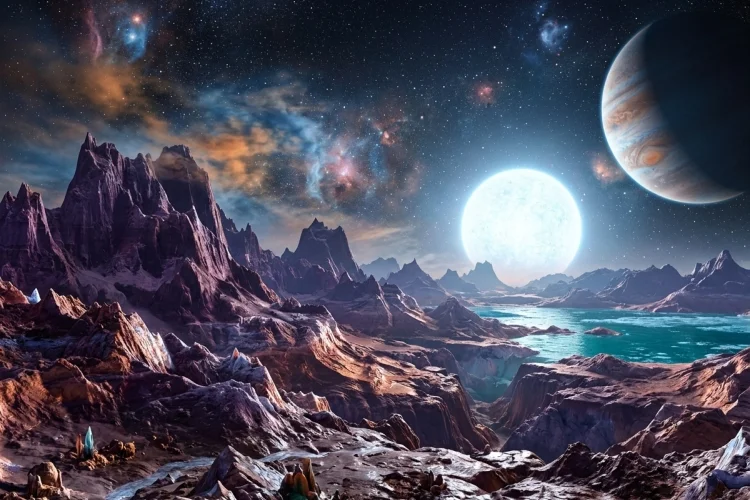
Imagine looking at a star and realizing it may not be alone. Around that tiny point of light, one planet could be racing through a four-day year, while another might be covered in frozen clouds, deep oceans, or scorching winds.
These distant worlds are called exoplanets, and they have completely changed how we view our place in the universe.
So, what is an exoplanet? An exoplanet, also known as an extrasolar planet, is a planet located outside our Solar System. Most of these worlds orbit other stars, forming planetary systems that may look very different from our own.
As of July 2026, the NASA Exoplanet Archive listed more than 6,300 confirmed exoplanets, with thousands of additional candidates still awaiting verification. The total continues to grow as telescopes collect new observations.
Although exoplanets are extremely distant and usually hidden by their host stars, astronomers can detect their shadows, measure their gravitational effects, and even examine some of their atmospheres.
What Exactly Is an Exoplanet?
An exoplanet is simply a planet beyond our Solar System. Instead of orbiting the Sun, it usually travels around another star. A star with one or more planets forms what astronomers call a planetary system.
Exoplanets can be very different from the eight planets we know. Some are larger than Jupiter, while others are smaller than Earth. A few orbit two stars, and some travel so close to their host stars that an entire year lasts only several Earth days.
The term “exoplanet” does not tell us whether a world is rocky, gaseous, hot, cold, or habitable. Scientists need additional observations to estimate its mass, radius, temperature, orbital period, and possible composition.
NASA broadly categorizes known exoplanets as gas giants, Neptune-like worlds, super-Earths, and terrestrial planets. Several subcategories, including hot Jupiters and mini-Neptunes, help describe their extraordinary variety.
When Were the First Exoplanets Discovered?
People have imagined planets around other stars for centuries, but reliable detections only arrived near the end of the 20th century.
In 1992, astronomers announced planets orbiting a pulsar, which is the extremely dense remnant of an exploded star. These discoveries proved that planetary-mass objects could exist beyond the Solar System.
A major breakthrough followed in 1995 with the confirmation of 51 Pegasi b, the first exoplanet discovered around a Sun-like star. The planet surprised astronomers because it is a gas giant orbiting extremely close to its star. It completes one year in only about 4.2 Earth days.
This type of planet became known as a hot Jupiter. Its discovery showed that planetary systems could have arrangements that looked nothing like ours.
Later missions such as NASA’s Kepler and Transiting Exoplanet Survey Satellite, or TESS, turned exoplanet research into one of astronomy’s fastest-growing fields.
What Are the Main Types of Exoplanets?
Exoplanets come in an enormous range of sizes, temperatures, and compositions. Although each world is unique, astronomers use several broad categories to organize them.
1. Gas Giants
Gas giants are similar in scale to Jupiter or Saturn. They consist mainly of hydrogen and helium and may contain deep atmospheres surrounding dense cores.
Some gas giants orbit far from their stars, while hot Jupiters travel extremely close to them. Temperatures on these close-orbiting worlds can reach thousands of degrees.
2. Neptune-Like Worlds
Neptune-like planets are generally smaller than gas giants but larger than Earth. They may have rocky or icy interiors surrounded by thick hydrogen- and helium-rich atmospheres.
Astronomers have also discovered many mini-Neptunes. These planets are larger than Earth but smaller than Neptune, and no direct equivalent exists in our Solar System.
3. Super-Earths
A super-Earth is usually more massive than Earth but lighter than Neptune. Despite the name, it is not necessarily a larger, more comfortable version of our planet.
A super-Earth could be rocky, covered in water, or wrapped in a dense atmosphere. The label mainly describes its size or mass rather than its surface conditions.
4. Terrestrial Planets
Terrestrial exoplanets are smaller, rocky worlds comparable in scale to Earth, Venus, Mars, or Mercury. Some may have atmospheres or liquid water, but these features are difficult to confirm from such great distances.
How Do Astronomers Discover Exoplanets?
Most exoplanets are too faint and too close to bright stars to photograph directly. Instead, astronomers usually look for the effects a planet has on its host star.
1. The Transit Method
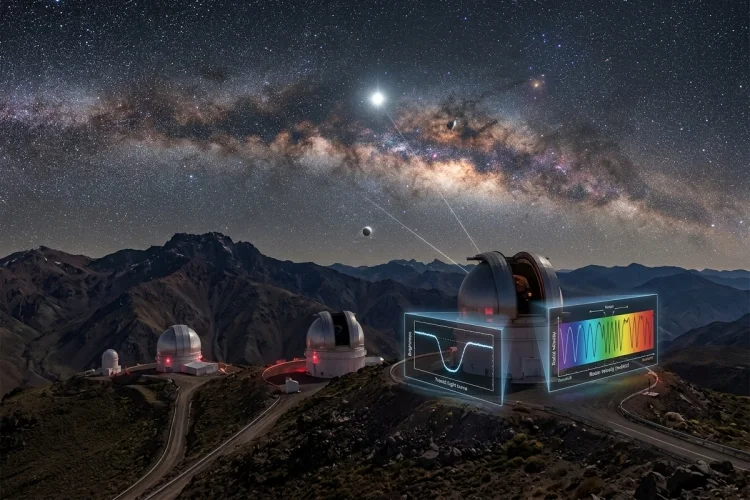
A transit happens when a planet passes in front of its star from our point of view. It blocks a tiny amount of starlight, creating a small but measurable dip in brightness.
If that dip occurs repeatedly at regular intervals, it may reveal an orbiting planet. The amount of blocked light helps scientists estimate the planet’s size, while the timing shows how long it takes to complete an orbit.
Most known exoplanets have been discovered using the transit method.
2. The Radial Velocity Method
A planet does not orbit a perfectly motionless star. Its gravity pulls on the star, causing both objects to move around a shared center of mass.
This motion makes the star appear to wobble slightly toward and away from Earth. Astronomers detect the movement by measuring tiny changes in the wavelengths of the star’s light.
The radial velocity method can provide information about a planet’s minimum mass. It is also frequently used to confirm possible planets detected through transits.
Other discovery techniques include direct imaging, gravitational microlensing, and astrometry. Each method is better suited to certain planet sizes, orbital distances, and types of stars.
What Can Scientists Learn About an Exoplanet?
Finding a distant planet is only the first step. Researchers then try to determine what that world is actually like.
By combining transit and radial velocity measurements, scientists can estimate both radius and mass. These values can be used to calculate density, which provides clues about whether the planet is rocky, gaseous, or something in between.
Astronomers can also investigate exoplanet atmospheres through spectroscopy. During a transit, a small amount of starlight passes through the planet’s atmosphere. Different gases absorb different wavelengths, leaving recognizable chemical patterns.
The James Webb Space Telescope uses infrared transmission spectroscopy to search for atmospheric substances such as water vapor, carbon dioxide, and methane. These measurements can reveal information about a planet’s chemistry, clouds, temperature, and possible weather.
Finding one interesting molecule does not prove that life exists. Scientists must examine the complete atmospheric environment and rule out non-biological explanations.
Does the Habitable Zone Mean a Planet Has Life?
The habitable zone is the region around a star where temperatures might permit liquid water on a planet’s surface, provided the world has an appropriate atmosphere.
It is sometimes called the Goldilocks zone because conditions could be neither too hot nor too cold. The zone’s distance depends on the brightness and temperature of the host star.
However, being located in the habitable zone does not guarantee that a planet is habitable. Venus and Earth demonstrate how similarly sized worlds can develop completely different climates.
An exoplanet’s atmosphere, surface pressure, geological activity, water supply, magnetic environment, and host star can all affect its suitability for life. Frequent stellar flares, for example, might damage or remove a planet’s atmosphere.
Scientists therefore describe habitable-zone exoplanets as promising research targets, not confirmed homes for living organisms. No verified evidence of extraterrestrial life has yet been found on an exoplanet.
Why Exoplanets Matter
Exoplanets help astronomers understand how planetary systems form and change. The discoveries of hot Jupiters, mini-Neptunes, super-Earths, and tightly packed systems have shown that our Solar System represents only one possible arrangement.
Studying thousands of planets also helps researchers place Earth in a wider context. Scientists can ask whether small rocky worlds are common, how frequently planets develop atmospheres, and what conditions produce stable environments.
One of the field’s biggest goals is to find nearby Earth-sized planets and study their atmospheres for possible signs of biological activity.
Future observatories are expected to analyze reflected planetary light and search for combinations of gases that could deserve closer investigation.
Beginners can explore NASA’s online exoplanet catalog and compare worlds by size, orbital period, discovery method, and host star. Famous starting points include the seven-planet TRAPPIST-1 system and 51 Pegasi b.
An exoplanet is a planet outside our Solar System, usually orbiting another star. These distant worlds include scorching gas giants, atmospheric mini-Neptunes, massive super-Earths, and small rocky planets that may resemble worlds closer to home.
Astronomers find them by watching stars dim, measuring stellar wobbles, capturing rare direct images, and observing gravitational effects.
They then use spectroscopy and other techniques to investigate planetary atmospheres, temperatures, and possible habitability. Exoplanets have revealed an astonishing variety of planetary systems throughout the galaxy.
Visit an interactive exoplanet catalog, choose one unfamiliar world, and explore its orbit, size, and host star. Every discovery adds another piece to the story of how planets-and perhaps life-develop across the universe.