Finding a planet around another star sounds simple until you consider the scale of the challenge. Stars are incredibly bright, while the planets orbiting them are much smaller, dimmer, and often dozens or hundreds of light-years away.
In most cases, astronomers cannot point a telescope at a star and clearly photograph the planets circling it. Instead, they search for tiny changes in the star’s light, position, or movement.
A regular dip in brightness might reveal a planet crossing the star, while a slight wobble can show that an unseen world is pulling on it through gravity. So, how do astronomers discover planets around other stars?
They use several detection techniques, including the transit method, radial velocity, direct imaging, gravitational microlensing, and astrometry. Each method reveals different kinds of planets and provides different information about their size, mass, orbit, or atmosphere.
By combining these clues, researchers can turn a tiny signal in telescope data into a confirmed world.
Why Are Exoplanets So Difficult to Find?
An exoplanet is a planet located outside our Solar System. Most known exoplanets orbit stars, although some free-floating worlds may travel through space without being gravitationally attached to one.
The biggest problem is contrast. A star can be millions or even billions of times brighter than a nearby planet, causing the planet’s faint light to disappear in the stellar glare.
The two objects may also look extremely close together from Earth, even when a large physical distance separates them.
Imagine trying to see a firefly flying next to a powerful lighthouse from several kilometers away. The firefly is there, but the brighter light overwhelms it.
Because of this challenge, most exoplanets have been found indirectly. Astronomers detect how a planet affects its host star rather than seeing the planet itself.
The Transit Method: Watching a Star Become Dimmer
The transit method has discovered most of the known exoplanets. A transit occurs when a planet passes between its star and the observer, blocking a small portion of the star’s light.
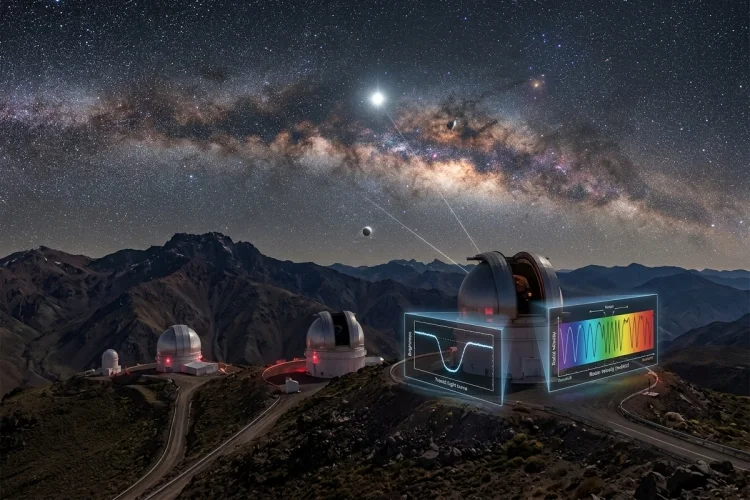
Astronomers monitor the star’s brightness over time and create a graph called a light curve. When a planet crosses the star, the graph shows a small dip. If similar dips repeat at regular intervals, they may indicate an orbiting planet.
What Can a Transit Reveal?
The time between the dips tells scientists how long the planet takes to orbit its star. This is the planet’s orbital period, or its version of a year.
The depth of the dip provides information about the planet’s radius. A larger planet blocks more light, while a smaller one produces a shallower change in brightness.
Transits can also help researchers investigate planetary atmospheres. When starlight passes through the thin outer edge of an atmosphere, gases absorb particular wavelengths.
Astronomers can analyze this pattern through transit spectroscopy to search for substances such as water vapor, carbon dioxide, or methane.
However, the system must be aligned correctly from our viewpoint. A planet may exist without ever crossing the face of its star as seen from Earth, so the transit method cannot detect every planetary system.
Radial Velocity: Measuring a Star’s Wobble
People often say that a planet orbits a star, but both objects actually move around a shared center of mass. A large star moves only slightly, yet sensitive instruments can measure this motion.
When the star moves toward Earth, its light shifts slightly toward shorter, bluer wavelengths. When it moves away, the light shifts toward longer, redder wavelengths. This change is called the Doppler effect.
Astronomers measure these repeating spectral shifts using the radial velocity method. A regular pattern may reveal the gravitational pull of an unseen planet.
Radial velocity is particularly useful because it provides an estimate of the planet’s mass. Larger or more nearby planets generally create a stronger stellar wobble and are easier to detect.
The method is often combined with transit observations. A transit can provide the planet’s radius, while radial velocity estimates its mass. Scientists can then calculate density and determine whether the world is likely rocky, gaseous, or rich in water or ice.
Direct Imaging: Photographing a Distant Planet
Direct imaging is the closest astronomers come to taking a traditional picture of an exoplanet. Instead of measuring a change in the host star, scientists detect light coming from or reflected by the planet itself.
This is extremely difficult because the host star’s glare can hide the much fainter world. Astronomers use special instruments called coronagraphs to block much of the starlight.
Advanced image-processing techniques and adaptive optics can further reduce glare and correct distortion caused by Earth’s atmosphere.
Direct imaging works best for large, young planets orbiting far from their stars. Young gas giants are still hot from their formation and can glow brightly in infrared wavelengths.
A distant orbit also creates more visible separation between the planet and its star. Small rocky worlds close to Sun-like stars are much harder to image with current technology.
Once a planet has been photographed, astronomers may analyze its light to investigate atmospheric chemistry, clouds, temperature, and weather patterns.
Direct imaging is rare, but it offers valuable opportunities to study a planet without depending entirely on its effect on the host star.
Gravitational Microlensing: Using Gravity as a Magnifying Glass
Gravitational microlensing uses one of the stranger effects predicted by Einstein’s theory of gravity. A massive object can bend the light passing near it, acting somewhat like a natural magnifying glass.
The method works when a foreground star passes almost directly in front of a more distant background star. The foreground star’s gravity bends and magnifies the background light, causing a temporary increase in brightness.
A planet orbiting the foreground star may create an additional, shorter spike in that light. By studying the pattern, astronomers can estimate properties of the planetary system.
Microlensing is useful for finding planets with wide orbits and worlds located thousands of light-years away. It can also detect free-floating planets that do not orbit stars.
The main limitation is that the exact alignment usually happens only once. Astronomers cannot simply wait for the same event to repeat, so they must collect as much data as possible while it is occurring.
Microlensing therefore complements transit surveys, which are especially effective at detecting planets in shorter orbits.
Astrometry: Tracking Tiny Changes in Position
Astrometry searches for planets by measuring a star’s exact position in the sky over a long period. If an orbiting planet pulls on the star, the star may trace a tiny repeating path around the system’s center of mass.
This movement can be incredibly small, which makes astrometry technically challenging. Telescopes must separate the planet-induced wobble from the star’s normal motion through the galaxy and the apparent changes caused by Earth’s orbit.
Unlike radial velocity, which measures movement toward and away from us, astrometry measures side-to-side movement across the sky. It is particularly useful for massive planets in relatively wide orbits.
ESA’s Gaia mission measures the positions and motions of more than a billion stars with extraordinary precision. Its data are helping astronomers identify stellar wobbles that may be caused by previously unknown planets.
Other specialized techniques also exist. Pulsar timing, for example, detects changes in the extremely regular signals produced by rapidly rotating neutron stars. The first confirmed exoplanets were discovered around a pulsar using this kind of measurement.
How Does a Planet Candidate Become Confirmed?
A suspicious signal does not immediately become an official exoplanet. Many other events can imitate a planet’s signature.
A star may dim because it has a stellar companion, clouds of dust, starspots, or natural changes in brightness. Telescope errors and data-processing problems can also create false signals.
Researchers first check whether the signal repeats consistently. They examine the star, compare observations from different instruments, and rule out explanations such as eclipsing binary stars.
Whenever possible, they follow up with another detection technique. For example, a planet candidate found through transits may later be observed with radial velocity.
Detecting the same object through independent methods provides much stronger evidence that it is real.
Confirmation also helps scientists learn more about the new world. Combining measurements may reveal its mass, radius, density, temperature, orbital shape, and atmospheric composition.
Professional astronomers are not the only people who can participate. Citizen-science projects allow volunteers to examine telescope light curves and identify possible transit signals that automated systems may have missed.
Why Astronomers Need Multiple Discovery Methods
No single technique can find every kind of planet. Transit surveys are good at detecting worlds that cross their stars, particularly those with relatively short orbital periods. Radial velocity is sensitive to gravitational effects, while direct imaging favors large planets in wide orbits.
Microlensing can reveal distant and free-floating worlds. Astrometry is useful for tracking wider planetary systems from a different viewing angle.
Each approach has its own selection bias. A catalog dominated by transiting planets does not necessarily mean short-orbit planets are the only common type. It partly reflects which worlds are easiest for existing instruments to detect.
By combining surveys and techniques, astronomers can build a more representative picture of planetary systems throughout the Milky Way. They can compare rocky planets, gas giants, compact systems, wide orbits, and planets unlike anything found around the Sun.
Astronomers discover planets around other stars by searching for small but measurable clues.
They watch stars dim during transits, measure spectral shifts caused by stellar wobbles, block starlight to capture direct images, observe gravitational microlensing events, and track tiny changes in stellar positions.
A possible signal must then be tested carefully to eliminate false positives. Follow-up observations and independent detection methods can transform a planet candidate into a confirmed exoplanet.
Together, these techniques have revealed that planetary systems come in an extraordinary range of sizes and arrangements.
Visit an interactive exoplanet catalog or examine a real transit light curve to see how a barely noticeable change in starlight can reveal an entirely new world.