Imagine rewinding the history of the universe like a video. Galaxies would move closer together, stars would disappear, and matter would become hotter and more tightly packed.
Continue far enough, and you would reach an early universe that looked nothing like the cosmos we see today.
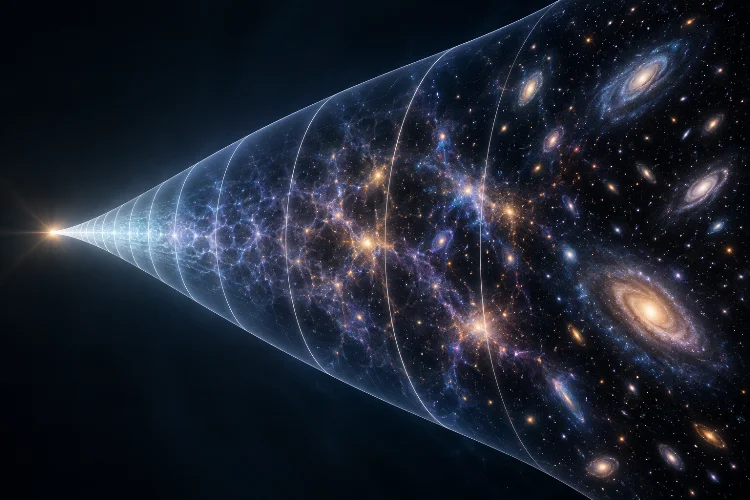
The Big Bang Theory is the leading scientific explanation for how the universe developed from an extremely hot, dense early state. It says that space expanded and cooled over billions of years, eventually allowing particles, atoms, stars, planets, and galaxies to form.
Scientists estimate that this expansion began about 13.8 billion years ago. However, the Big Bang was not simply a bomb exploding at one point inside empty space. It was an expansion of space itself, happening throughout the universe.
This beginner-friendly guide explains the Big Bang Theory in simple terms, explores the evidence behind it, and clears up several common misunderstandings about the origin of the cosmos.
What Does the Big Bang Theory Actually Say?
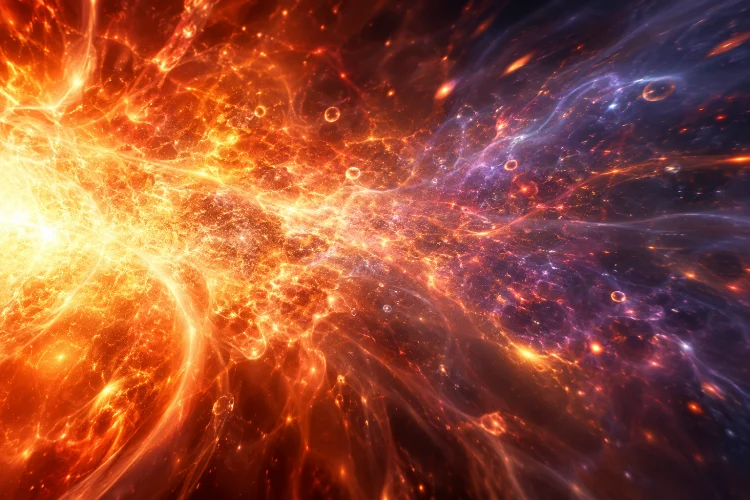
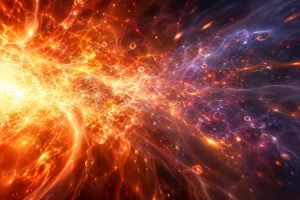
The Big Bang Theory describes the early development of the universe. According to the model, the cosmos was once much hotter, denser, and more compact than it is today.
As space expanded, the universe cooled. This cooling allowed energy to form particles, particles to form atomic nuclei, and nuclei to combine with electrons to create atoms.
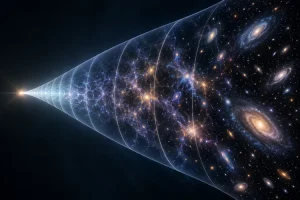
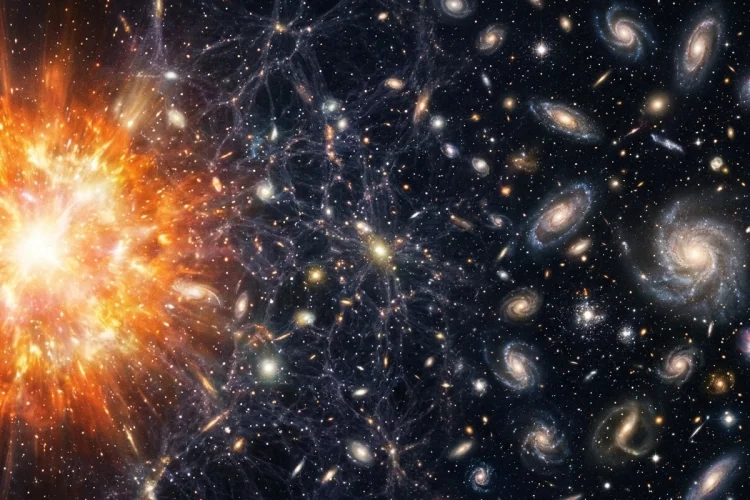
Gravity later pulled matter into denser regions. Over hundreds of millions of years, those regions developed into the first stars and galaxies. The large and complex universe around us is therefore the result of a long process of cosmic expansion and evolution.
The theory does not claim that everything exploded outward from a single location into a surrounding emptiness.
There is no known central point of the universe from which all galaxies are traveling. Instead, distances between widely separated regions of space have been increasing.
What Happened During the Universe’s Earliest Moments?
Scientists can reconstruct much of cosmic history, but the very first moment remains difficult to describe. Current physics cannot yet provide a complete explanation of the earliest conditions or what may have existed before expansion began.
1. Cosmic Inflation
Many cosmological models include a brief period called inflation. During this stage, the universe expanded extraordinarily quickly for a tiny fraction of a second.
Inflation may help explain why the observable universe appears so uniform and nearly flat on very large scales. However, scientists are still investigating exactly what caused this rapid expansion and how it ended.
After inflation, the universe was filled with an extremely hot mixture of radiation and subatomic particles. As expansion continued, its temperature and density decreased.
2. The First Atomic Nuclei
Within the first few minutes, the cosmos cooled enough for protons and neutrons to combine. This process, called Big Bang nucleosynthesis, mainly produced the nuclei of hydrogen and helium, along with small amounts of lithium and related light elements.
The universe was still far too hot for complete atoms to survive. Free electrons moved through space and repeatedly scattered light, making the early cosmos opaque, somewhat like an extremely dense fog.
How Did Atoms, Stars, and Galaxies Appear?
About 380,000 years after the beginning of expansion, the universe had cooled enough for electrons to join atomic nuclei. This era is known as recombination.
Once free electrons became bound inside neutral atoms, light could travel much more easily. The cosmic fog cleared, and the universe became transparent. That ancient light is still detectable today as the cosmic microwave background.
The cosmos then entered a period sometimes called the cosmic dark ages. There were no stars yet, but gravity was slowly pulling gas into increasingly dense clumps.
The first stars probably began appearing hundreds of millions of years after the Big Bang. Their light and radiation transformed the surrounding gas, while groups of stars gradually became early galaxies.
Over billions of years, galaxies grew through star formation, gas collection, and mergers with other systems.
Why Is the Universe Still Expanding?
One of the strongest clues supporting the Big Bang model is the expansion of the universe. Astronomers discovered that light from distant galaxies is generally shifted toward longer, redder wavelengths.
This effect is called cosmological redshift. As light travels through expanding space, its wavelength becomes stretched. In general, more distant galaxies show greater redshift, indicating that the space between galaxies has expanded while their light was traveling toward us.
A common comparison is dots drawn on the surface of an inflating balloon. As the balloon grows, every dot becomes farther from the others, even though no dot is the center of the balloon’s surface.
The comparison is not perfect because the universe is not necessarily expanding into a larger external space. Still, it helps demonstrate how every distant galaxy can appear to move away without Earth occupying a special central position.
Expansion also does not cause everything to grow. Gravity holds galaxies and planetary systems together, while electromagnetic forces keep objects such as people, buildings, and atoms from expanding along with the wider cosmos.
What Is the Cosmic Microwave Background?
The cosmic microwave background, or CMB, is often described as the afterglow of the Big Bang. It is the oldest electromagnetic light astronomers can observe directly.
This radiation was released when the universe became transparent about 380,000 years after expansion began. As space continued expanding, the radiation’s wavelengths stretched until they reached the microwave part of the electromagnetic spectrum.
Today, the CMB fills the universe and has a temperature of only about 2.7 kelvin, slightly above absolute zero. Space missions such as COBE, WMAP, and ESA’s Planck observatory have mapped this ancient radiation across the sky.
The CMB is remarkably uniform, but it contains tiny temperature differences. These variations reveal small density differences in the young universe.
Over billions of years, gravity amplified those differences. Slightly denser regions attracted more material and eventually became the foundations of galaxies, galaxy clusters, and the enormous cosmic web.
What Other Evidence Supports the Big Bang?
The Big Bang Theory is not based on one observation. Several independent types of evidence support the model. The expansion of space shows that the universe was denser in the past.
The cosmic microwave background provides a snapshot of the hot young cosmos, while the observed quantities of hydrogen, helium, and other light elements generally match calculations based on early-universe nuclear reactions.
Astronomers also observe that extremely distant galaxies often look less developed than nearby ones. Because their light has taken billions of years to reach us, we see these galaxies as they existed much earlier in cosmic history.
Large galaxy surveys provide another test. The distribution of galaxies across the universe resembles structures produced by computer models that begin with the small density variations seen in the CMB.
Scientific theories gain strength when several different measurements point toward the same explanation. Cosmic expansion, ancient radiation, elemental abundances, and galactic evolution collectively make the Big Bang the best-supported model of the universe’s early history.
Common Misunderstandings About the Big Bang
The name “Big Bang” makes the event sound like an ordinary explosion. A normal explosion sends material from one location into the space around it, but the Big Bang involved space expanding everywhere.
Another misconception is that scientists know exactly what caused it. The model describes how the universe evolved from an early hot and dense condition, but it does not yet fully explain why expansion began.
The theory also does not say that stars and galaxies appeared immediately. The early universe first had to cool enough to form nuclei and atoms. Stars developed much later, followed by galaxies, planets, and eventually life.
Finally, “theory” does not mean a casual guess in science. A scientific theory is a broad explanation supported by evidence, tested predictions, and repeated observations. Like all scientific models, it can be refined when better data become available.
What Happened After the Big Bang?
The Big Bang was the beginning of a continuing cosmic story rather than one isolated event. The universe kept expanding while gravity organized matter into increasingly complicated structures.
Stars produced heavier chemical elements in their cores. Exploding stars distributed those elements into space, where they became ingredients for later stars, rocky planets, oceans, and living organisms.
Expansion is also continuing today. Observations indicate that it began accelerating several billion years ago, a phenomenon scientists currently associate with dark energy. Its true nature remains one of cosmology’s greatest mysteries.
The universe may continue expanding indefinitely, causing distant galaxies to become increasingly separated. However, its ultimate fate depends on how dark energy behaves over enormous periods, so the final chapter remains unknown.
What the Big Bang Theory Does Not Explain
Despite its success, the Big Bang model does not answer every question. It does not provide a confirmed explanation for what powered cosmic inflation or whether the idea of “before the Big Bang” is physically meaningful.
Scientists also do not yet understand dark matter and dark energy, even though these components strongly influence the universe’s structure and expansion.
There are additional questions about how the earliest supermassive black holes and galaxies grew so rapidly. New observations from instruments such as the James Webb Space Telescope are helping researchers investigate these early periods.
These gaps do not automatically weaken the entire model. Instead, they show where current knowledge ends and where new discoveries may transform cosmology.
The Big Bang Theory explains how the universe developed from an extremely hot, dense early state about 13.8 billion years ago. As space expanded and cooled, particles formed nuclei, nuclei became atoms, and gravity eventually created stars, galaxies, and the cosmic web.
The main evidence includes cosmic expansion, cosmological redshift, the cosmic microwave background, and the observed abundance of light elements. Together, these discoveries provide a strong and testable picture of cosmic history.
Many mysteries remain, including what caused the earliest expansion and what dark matter and dark energy really are. Explore a Planck CMB map or a Webb deep-field image to see how scientists use ancient light to investigate the beginning of everything.