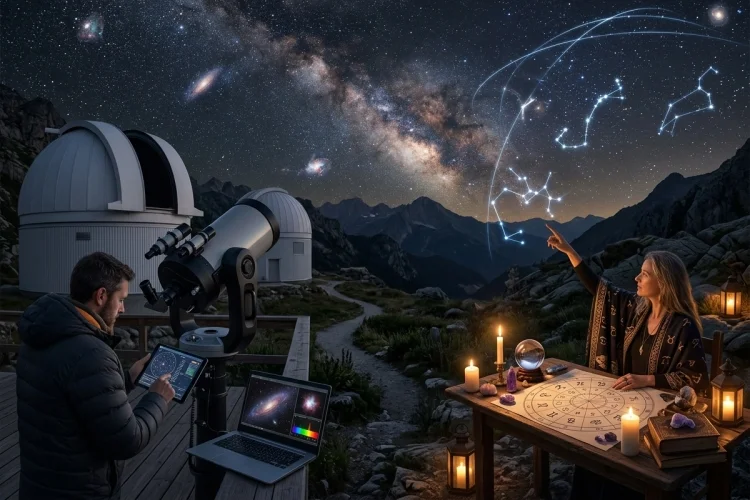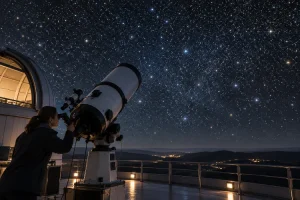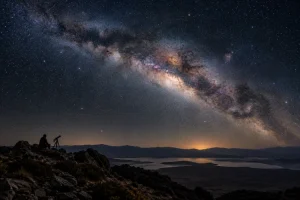
Look up on a clear night and the sky can feel both familiar and mysterious. You may recognize the Moon, a bright planet, or a famous constellation, yet those visible lights are only a tiny part of a universe filled with stars, galaxies, black holes, gas clouds, and worlds orbiting distant suns.
So, what is astronomy? Astronomy is the scientific study of objects and events beyond Earth’s atmosphere. It examines how celestial bodies form, move, change, and interact while asking larger questions about the origin, structure, and future of the universe.
Scientists estimate that the universe is about 13.8 billion years old, so astronomy is also a way of looking back through cosmic history. You do not need a powerful telescope or a physics degree to begin.
Curiosity is enough. This beginner’s guide explains what astronomers study, how they gather information, the field’s major branches, and practical ways to start exploring the night sky.
What Does Astronomy Study?
Astronomy covers almost everything outside Earth, from nearby objects in our Solar System to galaxies billions of light-years away. Our Solar System includes the Sun, eight planets, officially recognized dwarf planets, hundreds of moons, and thousands of asteroids and comets.
Beyond it, astronomers investigate stars, nebulae, galaxies, black holes, and exoplanets-planets orbiting stars other than the Sun. They also study events such as eclipses, stellar explosions, comet passages, and galaxy collisions.
These observations help scientists test ideas about gravity, matter, energy, and time. Astronomy is therefore more than naming objects in the sky; it is an effort to understand how the universe works.
The Main Branches of Astronomy
Because space is such a broad subject, astronomers often specialize. Planetary astronomy studies planets, moons, asteroids, comets, and planetary systems. Stellar astronomy explores how stars are born, change, and eventually die.
Galactic astronomy focuses on the Milky Way, while extragalactic astronomy examines galaxies beyond it. Cosmology studies the origin, development, large-scale structure, and possible future of the universe.
ESA describes space science as a field that investigates questions ranging from the formation of Earth and the Solar System to the earliest stars, galaxies, and the nature of space and time.
Astrophysics overlaps with nearly all these branches because it applies physics to celestial objects. Astrobiology combines astronomy with biology, chemistry, and geology to explore whether life could exist elsewhere.
How Astronomers Study Distant Objects
Most cosmic objects are too far away to visit, so astronomers mainly study the light and other signals that reach Earth. Visible light is only a small part of the electromagnetic spectrum. Radio, infrared, ultraviolet, X-ray, and gamma-ray observations reveal details that human eyes cannot see.
Infrared telescopes can look through some clouds of gas and dust, making them valuable for observing star-forming regions. X-ray telescopes detect extremely hot environments near objects such as neutron stars and black holes. Combining several wavelengths creates a fuller picture of the same target.
Astronomers also use spectroscopy, which separates light into wavelengths. The resulting patterns can reveal an object’s chemical composition, temperature, and motion-almost like reading a cosmic barcode.
Telescopes, Spacecraft, and Astronomical Data
Telescopes collect more light than the human eye, allowing astronomers to detect faint or distant objects. Ground-based observatories can use very large mirrors, while space telescopes avoid many of the blurring and blocking effects caused by Earth’s atmosphere.
Spacecraft provide close-up information. Orbiters, landers, rovers, and probes can study planets, moons, comets, and the Sun directly. ESA’s science fleet includes missions aimed at the Solar System, exoplanets, distant galaxies, and the dark universe.
Modern astronomy also relies heavily on computers. Researchers process enormous datasets, compare observations with simulations, and use automated tools to detect patterns.
In practice, a professional astronomer may spend far more time analyzing data and writing code than looking through a telescope.
Distance and Time in Space
The universe is so large that kilometers soon become awkward. Astronomers often use the astronomical unit, or AU, for distances within the Solar System. One AU is roughly the average distance between Earth and the Sun.
For distances between stars and galaxies, they use light-years. A light-year is a unit of distance, not time, and equals about 9.46 trillion kilometers.
This creates one of astronomy’s most fascinating effects: looking farther away means looking further into the past.
Sunlight takes about eight minutes to reach Earth, so we always see the Sun as it appeared minutes earlier. A galaxy millions of light-years away is seen as it existed millions of years ago.
Why Astronomy Matters
Astronomy places Earth in a much wider context. Comparing our planet with Mars, Venus, and distant exoplanets helps scientists investigate how atmospheres, climates, surfaces, and planetary systems develop.
NASA has confirmed thousands of planets beyond our Solar System, showing that other planetary systems are common.
The field also drives progress in imaging, sensors, optics, computing, and data analysis. Just as importantly, it strengthens scientific thinking by teaching people to measure carefully, test explanations, and revise ideas when new evidence appears.
Astronomy also has cultural value. People have used the sky for navigation, seasonal planning, timekeeping, and storytelling for thousands of years. The International Astronomical Union notes that cultures worldwide developed astronomical traditions as practical tools for survival.
How Beginners Can Start Learning Astronomy
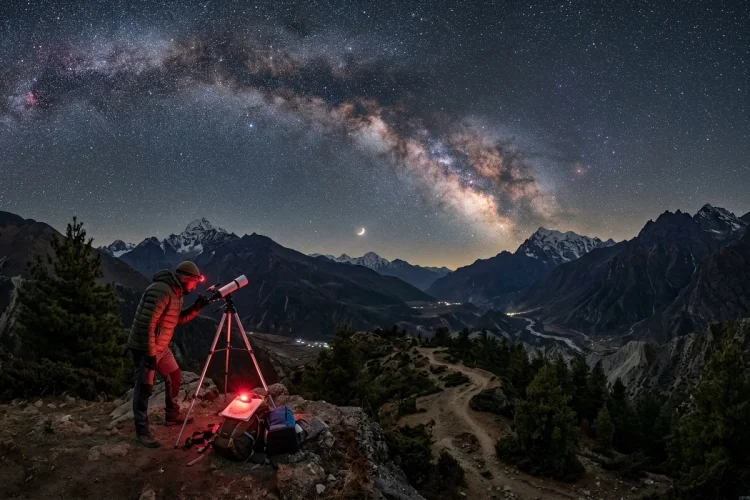
Start with the sky you can already see. Learn to identify the Moon, bright planets, and a few major constellations. Watch how their positions change over several nights and record the date, time, weather, and what you notice.
Use your eyes first, then try binoculars before buying a telescope. Binoculars are easier to handle and can reveal lunar craters, bright star clusters, and several large deep-sky objects. A sky map or astronomy app can help you identify what is visible from your location.
You can also explore professional data online. ESA’s ESASky platform allows anyone to view observations from multiple space missions across different wavelengths, offering a simple introduction to how scientists see the universe.
Astronomy is the science of exploring everything beyond Earth, from nearby planets and moons to distant galaxies and the universe itself. It combines observation, physics, chemistry, mathematics, technology, and computing to explain how cosmic objects form and behave.
The best part is that anyone can begin. You can watch the Moon, learn a constellation, explore images from space missions, or read about a planet that catches your attention.
Each small step turns the night sky from a collection of mysterious lights into a map filled with evidence, history, and unanswered questions. On the next clear night, step outside, choose one object above you, and begin your own journey into the science of space.