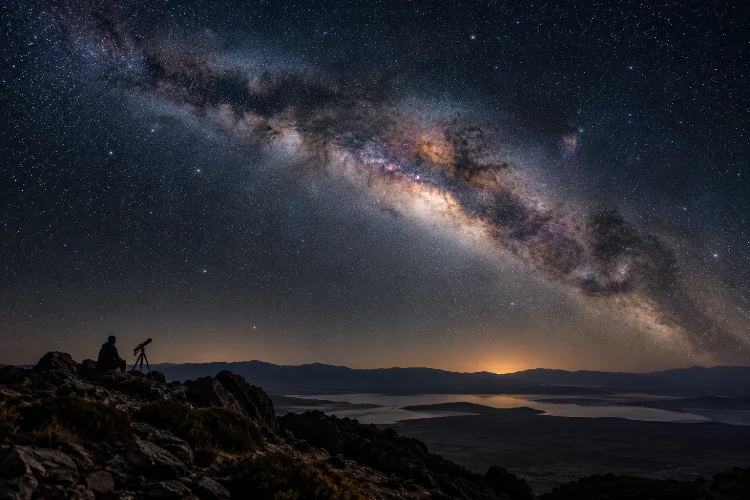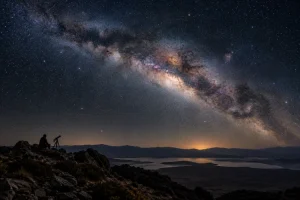
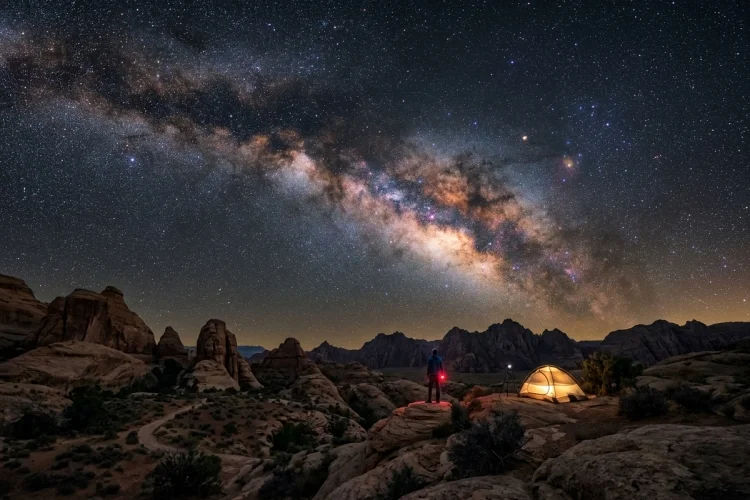
When you look at the Milky Way on a dark night, you are seeing only a small part of an enormous cosmic system. Our galaxy contains stars, planets, gas, dust, stellar remains, black holes, and a large amount of invisible dark matter, all held together by gravity.
So, what is a galaxy and how does it form? A galaxy is a gravitationally connected collection of cosmic material. Some contain only a few thousand stars, while the largest hold trillions.
They do not appear in a single moment. Instead, galaxies grow over billions of years as gas collects, stars form, smaller systems merge, and gravity reshapes their structure.
The first galaxies began developing when the universe was still young. Small differences in the density of matter grew into larger structures, eventually producing the galactic groups and clusters we observe today.
Understanding galaxy formation helps astronomers investigate cosmic history, the origin of stars and planets, and the future of our own Milky Way.
What Exactly Is a Galaxy?
A galaxy is much more than a crowd of stars. It includes planetary systems, gas clouds, dust, nebulae, stellar remnants, and usually a supermassive black hole near its center.
Galaxies vary dramatically in size. NASA notes that the smallest can contain only a few thousand stars and span several hundred light-years, while the largest may hold trillions of stars and stretch more than a million light-years.
The visible material is only part of the picture. Astronomers conclude that most galaxies sit inside much larger halos of dark matter. This substance cannot be seen directly, but its gravity affects how stars and gas move.
How Did the First Galaxies Form?
After the early universe expanded and cooled, matter was not distributed perfectly evenly. Some regions were slightly denser than others, so gravity pulled additional material into them.
Dark matter formed an invisible framework that attracted ordinary matter, mainly hydrogen and helium gas. NASA describes it as part of the scaffolding on which galaxies and galaxy clusters developed.
As gas gathered inside these dark matter halos, it cooled and became denser. Pockets of gas collapsed, producing early generations of stars. Groups of stars and small galactic structures then combined into increasingly large systems.
Astronomers have observed galaxies that existed when the universe was less than a billion years old. However, the exact sequence in which the first galaxies and their central black holes developed remains an active area of research.
Gas and Stars Drive Galactic Growth
Gas is the main raw material for star formation. When cold gas becomes dense enough, gravity causes parts of it to collapse into molecular clouds and, eventually, new stars.
Stars then return some material to space through winds and explosions. That recycled gas contains heavier chemical elements and can later become part of new stars, planets, and dust clouds.
Star formation happens at different rates in different galaxies. Spiral arms often contain bright young stars because gas is compressed there. Many elliptical galaxies contain less cold gas, so they generally create fewer new stars.
Massive stars also influence their surroundings. Radiation, stellar winds, and supernova explosions can either compress nearby clouds or scatter and heat the gas. Astronomers call this process stellar feedback.
What Are the Main Types of Galaxies?
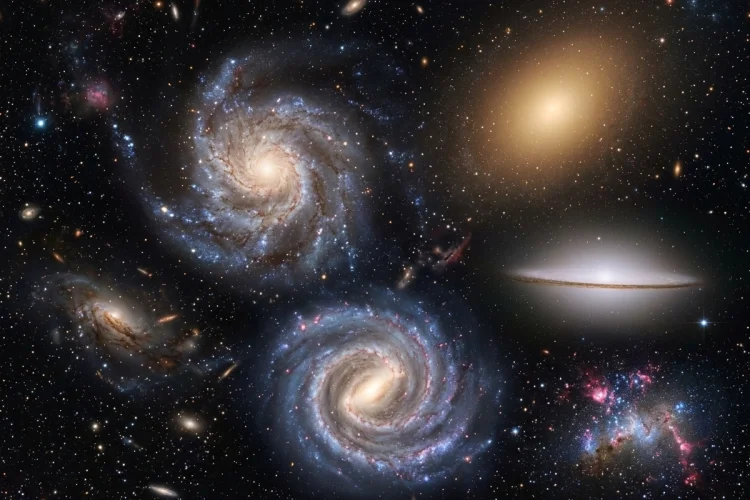
Astronomers classify galaxies mainly by their visible shape. The major categories are spiral, elliptical, lenticular, and irregular galaxies.
1. Spiral Galaxies
Spiral galaxies have rotating disks, central bulges, and curved arms rich in gas, dust, and young stars. The Milky Way is a barred spiral galaxy with a stellar disk spanning more than 100,000 light-years.
Our Solar System is located within a smaller spiral feature called the Orion Spur. Because we live inside the Milky Way, mapping its complete shape is more difficult than studying a distant galaxy from the outside.
2. Elliptical and Lenticular Galaxies
Elliptical galaxies range from almost round to stretched oval shapes. They usually contain older stars and relatively little cold gas.
Lenticular galaxies have disks and central bulges but no clear spiral arms. Like elliptical galaxies, many have older stellar populations and limited ongoing star formation.
3. Irregular Galaxies
Irregular galaxies lack an organized spiral or elliptical form. Their unusual shapes may result from gravitational interactions, intense star formation, or an uneven distribution of gas and stars.
These categories are useful, but galaxies do not always fit perfectly into one group. Their appearance can change as they interact with neighboring systems and use up or gain new gas.
How Collisions and Mergers Transform Galaxies
Galaxies rarely evolve in complete isolation. Gravity brings neighboring systems together, producing close encounters and sometimes full mergers.
Individual stars usually do not collide because the spaces between them are enormous. Gas clouds, however, can crash together and become compressed, triggering powerful bursts of star formation.
Mergers can completely change a galaxy’s appearance. Two spiral galaxies may combine into a larger, rounder system, while a massive galaxy may absorb many smaller neighbors over time.
These events can also push gas toward a central black hole. As the material heats up, it may produce an extremely bright area called an active galactic nucleus.
The Milky Way itself contains evidence of previous mergers with smaller galaxies. Galactic formation is therefore better understood as continuous assembly rather than one simple moment of birth.
Dark Matter and Black Holes Shape Galaxies
Dark matter provides much of the gravity needed to organize galaxies. Its extended halos influence the motion of visible stars and help galactic systems remain connected.
Most large galaxies also contain supermassive black holes. Sagittarius A*, the black hole at the center of the Milky Way, has a mass of roughly four million Suns.
A central black hole does not hold the entire galaxy together by itself. Most stars orbit because of the combined gravity of stars, gas, dust, and dark matter.
However, a feeding black hole can affect galactic evolution. Powerful radiation and jets may heat gas, slow star formation, or push material away from the central region.
Scientists are still investigating how galaxies and supermassive black holes grew together. It remains unclear whether early black holes helped galaxies develop or whether growing galaxies supplied the material that built their black holes.
Galaxies Form Part of the Cosmic Web
Galaxies are not scattered randomly through space. They gather into groups and clusters under the influence of gravity.
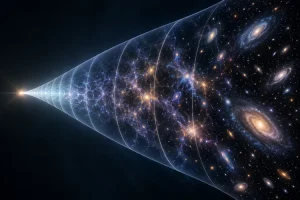
Groups may contain around 100 or fewer galaxies, while clusters can include thousands. On larger scales, galaxies trace long filaments and dense knots separated by enormous, relatively empty areas called voids.
This large-scale pattern is known as the cosmic web. Dark matter provides much of its underlying framework, and galaxies tend to develop in its densest regions.
The Milky Way belongs to the Local Group, along with the Andromeda Galaxy and numerous smaller systems. Studying these nearby neighbors helps scientists understand galactic interactions, mergers, and long-term evolution.
How Do Astronomers Study Galaxy Formation?
Astronomers cannot watch one galaxy evolve for billions of years, so they combine observations of many systems at different distances.
Because light takes time to travel, distant galaxies appear as they existed in the past. Deep observations by the Hubble Space Telescope and James Webb Space Telescope reveal galaxies across more than 13 billion years of cosmic history.
Scientists analyze starlight, gas movement, chemical composition, black hole activity, and the gravitational effects of dark matter. Different wavelengths reveal different details, from hot young stars to cold gas hidden behind thick clouds of dust.
Researchers also build computer simulations to test whether models involving gravity, gas, dark matter, star formation, and mergers can produce galaxies similar to those in the real universe.
By combining nearby details, ancient light, and digital simulations, astronomers can build an increasingly complete picture of how galaxies were born and transformed.
A galaxy is a vast system of stars, planets, gas, dust, black holes, and dark matter bound together by gravity. Galaxies began growing from small density differences in the early universe, as matter collected inside dark matter halos and gas produced the first stars.
They continued evolving through star formation, chemical recycling, interactions, and mergers. These processes created the spiral, elliptical, lenticular, and irregular galaxies visible today.
The story is still unfolding. The Milky Way continues forming stars and interacting with smaller neighbors. Explore a Hubble or Webb deep-field image and focus on one tiny galaxy. That faint patch of light may contain billions of stars and billions of years of cosmic history.