Imagine taking something smaller than a subatomic particle and stretching it to an enormous scale in an almost unimaginably tiny fraction of a second.
That is roughly the idea behind cosmic inflation, one of the most influential concepts in modern cosmology.
Scientists think the very early universe went through a brief period of extraordinarily rapid expansion roughly 13.8 billion years ago.
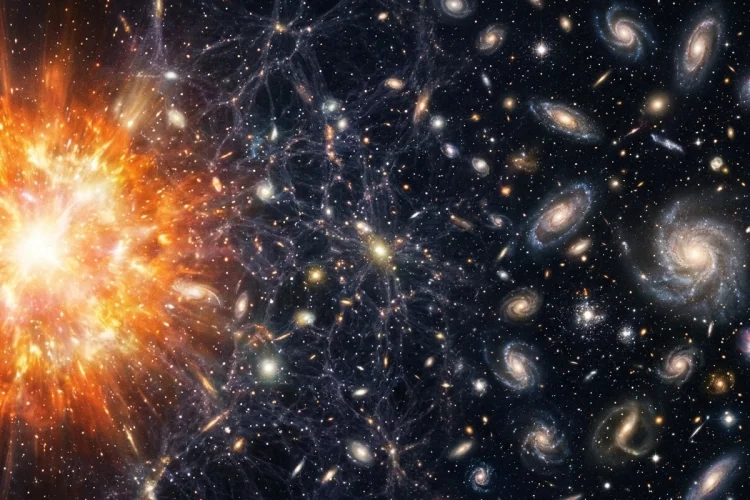
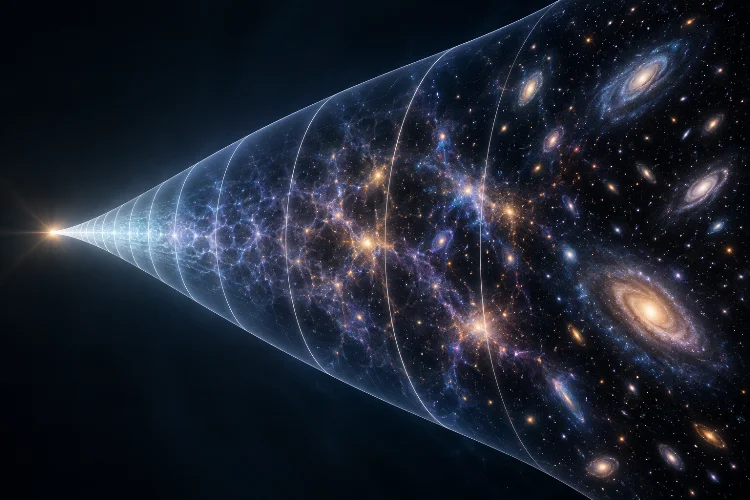
During this episode, space itself expanded dramatically, potentially transforming microscopic quantum fluctuations into the seeds of galaxies and galaxy clusters we see today.
So, what is cosmic inflation, and why do cosmologists need the idea in the first place?
Inflation was developed to explain several puzzling features of the universe that the basic hot Big Bang model alone does not naturally explain, including its remarkable uniformity and near-flat geometry.
NASA describes inflation as a fraction-of-a-second period of extremely rapid expansion, although scientists still do not know exactly what powered it or what preceded it.
Understanding inflation means travelling as close as modern physics can get to the beginning of cosmic history.
What Is Cosmic Inflation in Simple Terms?
Cosmic inflation is the hypothesis that the early universe underwent a short period of accelerated, approximately exponential expansion.
Instead of objects simply flying outward through existing space, space itself expanded. This distinction is important because inflation is sometimes described as the universe expanding “faster than light.”
Einstein’s relativity prevents ordinary objects from locally moving through space faster than light. However, the geometry of space can expand in such a way that very distant regions become separated at an effective rate greater than the speed of light.
ESA describes a commonly discussed inflationary scenario in which the episode had ended by roughly 10⁻³² seconds after the beginning of cosmic expansion. During that extraordinarily short interval, the scale of the universe may have increased by an enormous factor.
The precise timing and amount of expansion depend on the inflation model being considered, so these numbers should not be treated as one universally established timeline.
The important idea is simpler: a very small early region expanded extermely rapidly before the familiar hot, radiation-filled universe developed.
Why Did Scientists Introduce Inflation?
Inflation was not invented simply because an extremely fast-expanding universe sounds interesting. Cosmologists introduced it because the traditional Big Bang framework left several important questions unanswered.
The Horizon Problem
One puzzle involves the remarkable uniformity of the universe.
The cosmic microwave background, or CMB, is radiation released when the universe became transparent about 380,000 years after the Big Bang. When astronomers measure it in opposite directions, its temperature is remarkably similar.
The problem is that some widely separated regions appear too distant to have exchanged information under a simple non-inflationary expansion history.
Inflation offers a solution.
Before rapid expansion, regions now separated by enormous distances could have been close enough to interact and reach similar physical conditions. Inflation then stretched that small, relatively uniform region across an immense volume.
It is similar to taking a tiny piece of evenly colored rubber and rapidly stretching it until the original patch covers a huge surface.
How Inflation Helps Explain a Flat Universe
Another classic puzzle is known as the flatness problem.
In cosmology, “flat” does not mean the universe resembles a sheet of paper. It describes the geometry of space on very large scales.
Space could theoretically possess positive curvature, somewhat analogous to the surface of a sphere, or negative curvature, somewhat analogous to a saddle. Observations instead indicate that the observable universe is remarkably close to geometrically flat.
Inflation naturally pushes curvature toward flatness.
Imagine standing on Earth. The planet is curved, but if you examine only a tiny patch of ground, that surface looks almost perfectly flat.
Inflation works somewhat like an extreme version of that effect. By expanding space enormously, any initial curvature within our observable region would become increasingly difficult to detect.
Planck observations combined with other cosmological measurements have placed very tight constraints on spatial curvature, supporting a universe that is close to flat.
That agreement is one reason inflation remains such an important framework in modern cosmology.
Quantum Fluctuations May Have Seeded Galaxies
Perhaps the most fascinating consequence of inflation involves something incredibly small: quantum fluctuations.
Quantum physics predicts that fields cannot remain perfectly smooth at microscopic scales. Tiny fluctuations naturally occur.
During inflation, these microscopic differences may have been stretched to astronomical scales.
Some regions ended up slightly denser than others. The differences were tiny, but gravity had billions of years to amplify them.
Denser regions gradually attracted additional matter. Over cosmic time, those fluctuations helped produce stars, galaxies, clusters of galaxies, and eventually the enormous web-like structure observed across the universe.
ESA explains that primordial fluctuations amplified during inflation are thought to be the seeds from which later cosmic structures developed.
This creates an extraordinary connection between quantum physics and astronomy.
The galaxies visible through modern telescopes may ultimately trace their origins back to microscopic quantum effects from the earliest moments of cosmic history.
What Powered Cosmic Inflation?
This is where the story becomes much less certain.
Physicists often describe inflation mathematically using a hypothetical field associated with a particle or degree of freedom informally called the inflaton.
The energy stored in this field could potentially produce the accelerated expansion.
As the inflationary phase ended, that energy would be converted into particles and radiation through processes generally associated with reheating, producing the hot early universe that later developed nuclei, atoms, stars, and galaxies.
But scientists have not identified the inflaton experimentally.
NASA states clearly that researchers do not yet know what powered inflation or what occurred before it.
There are also many competing inflation models.
Some involve one scalar field, while others introduce additional fields or more complicated physics. Different models can predict slightly different patterns in primordial density fluctuations or gravitational waves.
Finding those subtle differences is one of the central goals of observational cosmology.
The exact mechanism therefore remains a major mistery, even though the broader inflationary framework explains several important observations remarkably well.
What Evidence Do We Have for Inflation?
Scientists cannot point a telescope directly at inflation.
The event, if it happened, occurred vastly earlier than the release of the oldest electromagnetic radiation we can directly observe.
Instead, researchers look for fingerprints left behind.
The most important evidence comes from the cosmic microwave background. Tiny temperature variations in the CMB follow patterns that broadly agree with predictions produced by simple inflationary models.
ESA’s Planck mission measured these variations with extraordinary precision. Planck data found a primordial fluctuation spectrum close to, but not exactly, scale invariant-one of the important characteristics expected in many inflationary scenarios.
That does not prove every version of inflation.
Observations actually rule out or place pressure on some models while allowing others to survive. Inflation is better understood as a broad framework containing many possible physical mechanisms rather than one single theory with every detail already established.
Scientists therefore continue looking for a more distinctive signature.
Could Primordial Gravitational Waves Prove Inflation?
One of the biggest targets is a background of primordial gravitational waves.
Certain inflation models predict that rapid expansion generated gravitational ripples in spacetime. Those waves could potentially leave a distinctive polarization pattern called primordial B-modes in the cosmic microwave background.
Detecting such a signal would provide extraordinarily important information about physics during inflation.
However, the search is difficult.
Dust inside our own Milky Way can also produce polarized microwave signals, while gravitational lensing creates another form of B-mode polarization. Researchers must carefully seperate these effects from any primordial signal.
The BICEP/Keck Collaboration has placed increasingly strong limits on primordial gravitational waves rather than producing an uncontested detection.
A 2026 South Pole Observatory summary described the existing limit as r < 0.036 at 95% confidence, with new observations aiming for substantially greater sensitivity.
So the hunt continues.
A future detection could reveal the energy scale at which inflation occurred and help researchers discriminate between competing theories.
Is Cosmic Inflation the Same as the Big Bang?
Inflation and the Big Bang are closely connected, but the terms should not simply be treated as interchangeable.
The hot Big Bang model describes the universe evolving from an extremely hot, dense state, expanding and cooling until particles, atomic nuclei, atoms, stars, and galaxies could form.
Inflation describes an earlier or initial accelerated-expansion phase incorporated into many modern versions of that cosmic history.
NASA describes the end of inflation as the point when the energy driving rapid expansion was transferred into matter and light, leading into the hot Big Bang phase.
That distinction also highlights something important: inflation does not necessarily answer the ultimate question of how existence began.
It does not yet tell us with confidence what happened before inflation, whether “before” even has a conventional meaning under those conditions, or why the inflationary state existed.
Those questions take physics into territory where quantum gravity and other incomplete theories may eventually become essential.
What Scientists Still Don’t Know
Inflation successfully addresses several major cosmological puzzles, but large gaps remain.
Scientists do not know what physical field caused inflation, exactly when it began, why it stopped, or whether the inflationary process happened only once.
Researchers are also testing alternatives and extensions to standard inflation.
Better measurements of the CMB, galaxy distributions, gravitational waves, and other features of the large-scale universe can narrow the possibilities.
NASA’s SPHEREx mission, for example, is studying the distribution of galaxies across enormous cosmic volumes.
One of its science goals is to investigate signatures such as primordial non-Gaussianity, which can provide clues about the physics operating during inflation.
This is why cosmology remains so exciting.
A theory describing an occurence lasting an almost unimaginably tiny fraction of a second can potentially be tested using structures spread across billions of light-years.
So, what is cosmic inflation? It is the leading framework proposing that the very early universe experienced a brief period of extraordinarily rapid expansion.
Inflation helps explain why the observable cosmos is so uniform, why its geometry is close to flat, and how tiny quantum fluctuations could eventually grow into galaxies.
Yet important pieces of the story remain unresolved. Scientists still do not know what powered inflation, exactly how it ended, or which specific inflation model-if any-describes reality.
Future measurements of the cosmic microwave background, galaxy distributions, and primordial gravitational waves may provide the missing clues.
If you want to understand how our universe grew from microscopic beginnings into today’s enormous cosmic web, inflation is one of the most fascinating places to start.