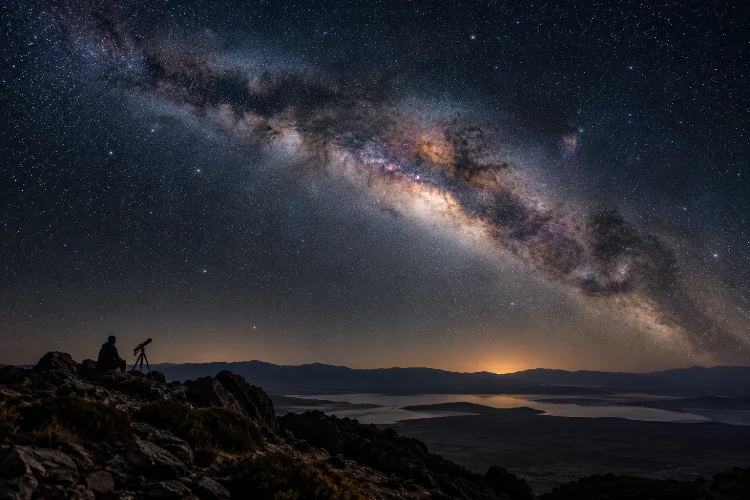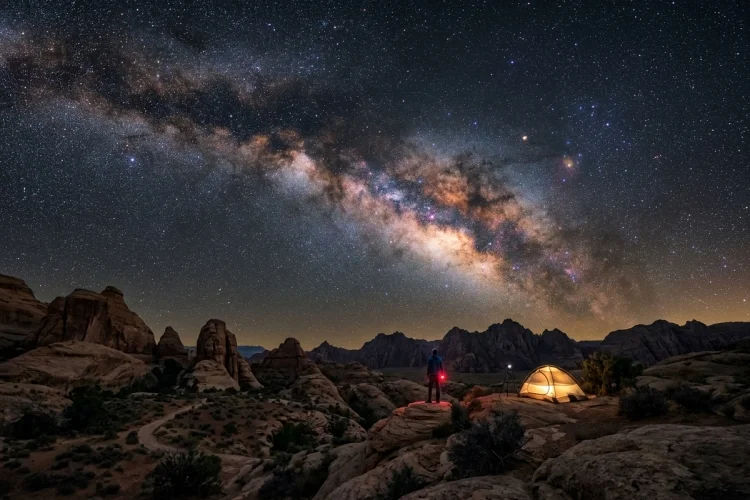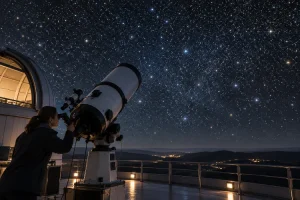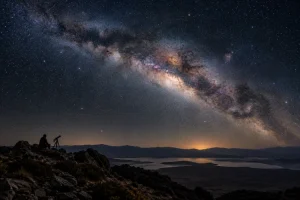
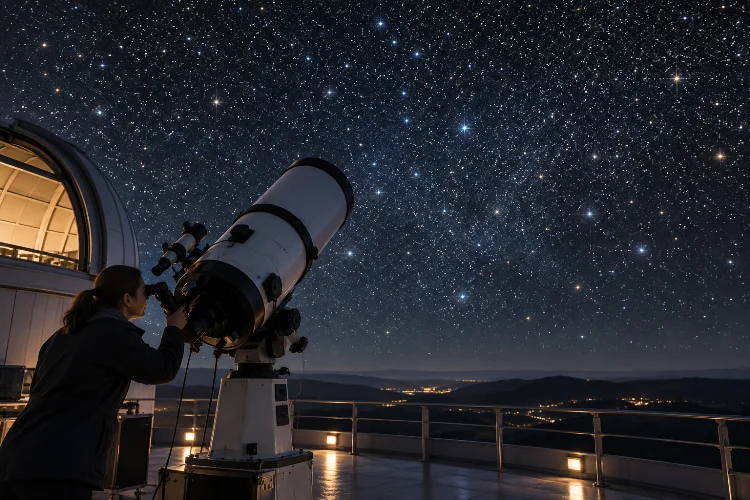
On a clear night away from city lights, the sky can look packed with stars. Yet everything we can see with the naked eye represents only an unbelievably tiny sample of the stellar population surrounding us.
So, how many stars are in the Milky Way? The most widely used scientific estimate puts the number somewhere between 100 billion and 400 billion stars. NASA currently gives this range for our home galaxy, which spans roughly 100,000 light-years across.
That is obviously a pretty wide range. You might wonder why astronomers cannot simply point powerful telescopes at the Galaxy and count every star.
The problem is that we live inside the Milky Way rather than observing it conveniently from the outside. Dust hides distant stars, many stars are extremely faint, and huge areas of the galactic disk are difficult to observe directly.
Instead of literally counting every star, scientists combine observations, statistical models, stellar brightness measurements, and estimates of the Galaxy’s total mass. The result is one of astronomy’s most fascinating cosmic counting problems.
So, How Many Stars Are Actually in the Milky Way?
The safest answer is currently somewhere around 100 billion to 400 billion stars.
NASA uses this range when describing the Milky Way, while other scientific sources sometimes give estimates closer to roughly 100 billion or 200 billion.
The difference does not necessarily mean anyone is wrong. It reflects the difficulty of measuring such an enormous system from within.
Even the lower estimate is difficult to imagine.
If you counted one star every second without stopping, reaching 100 billion would take more than 3,000 years. Counting 400 billion at the same speed would require over 12,000 years.
And remember, those numbers represent stars-not planets.
NASA notes that the Milky Way may contain at least as many planets as stars, meaning our galaxy could contain hundreds of billions of worlds as well.
Why Can’t Astronomers Simply Count Every Star?
Counting stars sounds straightforward until you consider our position.
Imagine standing deep inside a huge forest and trying to determine exactly how many trees exist. Nearby trees block your view of distant ones, some are hidden behind others, and you cannot easily see the boundaries of the forest.
Astronomers face a similar problem.
1. We Are Inside the Galactic Disk
Earth sits inside the Milky Way’s disk, in a smaller feature known as the Orion Arm or Orion Spur, between the Sagittarius and Perseus arms.
Because we are embedded inside the Galaxy, stars overlap along our line of sight.
A single patch of sky can contain stars located hundreds, thousands, or tens of thousands of light-years apart. Determining which stars belong where requires extremely precise measurements.
2. Dust Blocks Our View
Interstellar dust creates another problem.
Large dust clouds absorb and scatter visible light, preventing optical telescopes from seeing many objects on the opposite side of the galatic disk.
Astronomers work around this limitation by observing infrared and radio wavelengths, which can penetrate dusty regions more effectively than ordinary visible light.
Even then, building a complete inventory is extremely challenging.
Most Stars Are Much Harder to See Than the Sun
When people imagine stars, they often picture objects similar to the Sun or extremely bright stars such as Sirius.
But many stars in the Galaxy are much dimmer.
Red dwarfs, for example, are small, relatively cool stars that produce far less visible light than the Sun. Because they are faint, distant red dwarfs can be difficult to detect even with advanced instruments.
This matters because these low-mass stars are extremely common.
A galaxy containing huge numbers of faint stars can have a very different total stellar count from what researchers might estimate by looking only at bright stars.
Astronomers therefore study representative samples of stars and use models to estimate how many faint objects are likely hiding beyond current observational limits.
That statistical approach helps explain why the final number is usually presented as a range rather than one exact figure.
How Astronomers Estimate the Number of Stars
Scientists use several complementary techniques rather than relying on one giant star-counting project.
One method involves estimating the amount of stellar mass in the Milky Way and determining how that mass is distributed among different types of stars.
If researchers know the approximate total mass contained in stars and understand the typical distribution of stellar masses, they can estimate the number of individual stars required to produce that mass.
Studying Representative Areas
Another technique involves counting stars within carefully observed sections of the Galaxy.
Astronomers can analyze a nearby region where stars are relatively well documented. They then study how stellar density changes as distance from the galactic center increases.
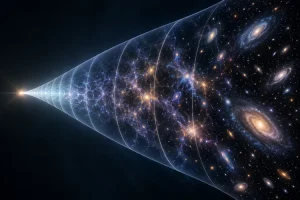
Those measurements can be combined with models describing the size and structure of the Milky Way.
It is similar to estimating how many trees exist across a huge forest by carefully examining smaller representative areas instead of individually counting every tree.
The result is not absolutely precise, but it can provide a scientifically useful approximation.
What Gaia Has Taught Us About the Milky Way’s Stars
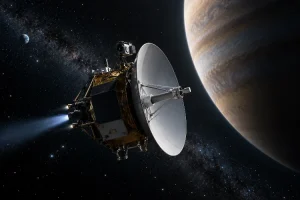
One of the biggest advances in galactic astronomy came from the European Space Agency’s Gaia mission.
Gaia operated scientifically from July 2014 until January 2025 and made more than three trillion observations of around two billion stars and other astronomical objects.
That sounds enormous—and it is.
However, even two billion stars represent only a fraction of the Milky Way’s expected stellar population. ESA has described Gaia’s roughly two billion observed stars as representing about 1% of the stars populating the Milky Way.
Gaia measured far more than simple locations.
It recorded information about stellar positions, distances, motions, luminosities, temperatures, and compositions. These measurements allow astronomers to construct an increasingly detailed three-dimensional picture of our galaxy.
Rather than giving scientists one final number of stars, Gaia provides something arguably more valuable: a massive dataset that improves models of how the Milky Way is structured.
Future Gaia data releases will continue refining that picture. ESA currently expects Gaia Data Release 4 in December 2026, with the final Data Release 5 not expected before the end of 2030.
Why the Estimate Has Such a Huge Range
At first glance, the difference between 100 billion and 400 billion sounds surprisingly large.
But astronomers are dealing with several layers of uncertainty.
Researchers must estimate how many faint stars remain unseen, how stellar density changes throughout the disk, how many stars exist near heavily obscured regions, and how much stellar mass belongs to different populations.
There are also objects that make classification complicated.
Binary and multiple-star systems can sometimes appear as single points of light from great distances. Brown dwarfs are also challenging because they form somewhat like stars but are not massive enough to sustain ordinary hydrogen fusion like true main-sequence stars.
Astronomers must carefully define what they are actually counting.
As observations improve, some uncertainties shrink while others become more obvious. This is normal science: measurements are refined when better data become available.
So an estimate of approximatly 100–400 billion is not a sign that scientists have no idea. It represents the realistic range supported by current observations and models.
What Types of Stars Fill the Milky Way?
The Milky Way contains an incredible variety of stars.
Some are small and faint, while others are massive enough to shine tens of thousands of times brighter than the Sun. The Galaxy also contains young stars that formed relatively recently alongside ancient stellar populations that have existed for billions of years.
The visible spiral arms contain many young stars and star-forming regions, while the central bulge includes large populations of older stars.
NASA describes the Milky Way as a barred spiral galaxy with younger stars extending through its spiral structure around a central region dominated by older populations.
Stars are also constantly evolving.
New stars form inside clouds of gas and dust. Others reach the end of their lives and become white dwarfs, neutron stars, or black holes depending largely on their original mass.
That means the Milky Way’s stellar population is not completely fixed.
Stars are being born while others die, although these changes occur on timescales that make the overall population seem almost unchanged during a human lifetime.
How Many Milky Way Stars Can We See From Earth?
Here is where things become especially surprising.
Although the Galaxy probably contains hundreds of billions of stars, humans can see only a few thousand individual stars with the unaided eye under excellent viewing conditions. ESA notes that a dark, clear sky allows observers to see only a few thousand stars individually.
Light pollution reduces that number dramatically.
From a bright urban environment, you may see only dozens or a few hundred stars. Travelling to a remote dark-sky location can suddenly make the sky appear much richer.
The pale Milky Way band itself contains enormous numbers of stars that are too distant or faint for our eyes to distinguish separately.
Instead, their combined light creates the soft, glowing appearance that inspired the Galaxy’s name.
It is an impressive reminder that our eyes capture only a tiny portion of what is actually there. Even modern telescopes have not individually cataloged every visibile star in our cosmic neighborhood.
Why Knowing the Number of Stars Matters
Estimating the Milky Way’s stellar population is not just about producing an impressive number.
The calculation helps astronomers understand how galaxies form and evolve.
Knowing how many stars exist-and what kinds of stars dominate the population-provides clues about the Galaxy’s history, star-formation rate, chemical evolution, and mass distribution.
The number also matters when scientists consider planets.
If planetary systems are common, hundreds of billions of stars could mean hundreds of billions of opportunities for planets to form. NASA states that the Milky Way is estimated to contain at least as many planets as stars.
That does not mean hundreds of billions of Earth-like worlds exist.
But it dramatically expands the number of places astronomers can investigate when searching for potentially habitable planets and possible signs of life.
When discussing the scale of our Galaxy, it is worth remembering one simple fact: the Sun is only one star among an almost unimaginable stellar population.
So, how many stars are in the Milky Way? Current estimates suggest roughly 100 billion to 400 billion, although astronomers cannot yet provide one perfectly precise number.
Dust, faint stars, our location inside the galactic disk, and the sheer scale of the Galaxy all make direct counting impossible.
Missions such as Gaia have transformed our understanding by observing around two billion stars and helping scientists build increasingly accurate maps of our cosmic home.
Yet even this extraordinary survey covers only a fraction of the stellar population.
The next time you look at a star-filled night sky, remeber that nearly everything you can see represents just a microscopic sample of the Milky Way.
Explore more astronomy discoveries, follow upcoming stellar surveys, and keep looking upward-the Galaxy still has countless secrets waiting to be mapped.