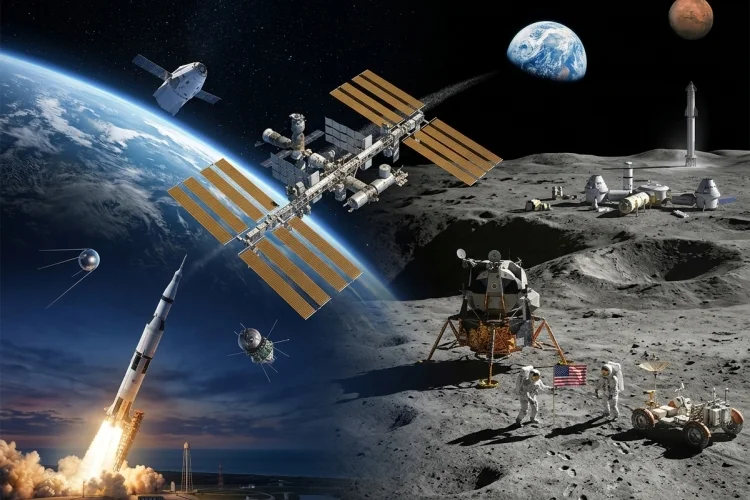
For most of human history, space travel belonged to myths, novels, and wild imagination. Then, within a few dramatic decades, people developed rockets powerful enough to leave Earth, orbit the planet, walk on the Moon, and build a permanent laboratory in space.
A brief history of human space exploration begins in the middle of the 20th century, when Cold War competition accelerated advances in rocketry.
The Soviet Union launched the first artificial satellite, sent the first person into orbit, and achieved several other early milestones. The United States responded with increasingly ambitious programs that eventually placed astronauts on the lunar surface.
Space exploration later became more cooperative and international. Space stations allowed crews to live in orbit for months, while reusable spacecraft, commercial companies, and new national programs expanded access to space.
Today, human spaceflight is entering another lunar era. The lessons learned in Earth orbit and on the Moon are helping engineers prepare for longer expeditions-and, eventually, possible crewed missions to Mars.
Before Humans Flew: Rockets and Robotic Pioneers
The journey into space began long before an astronaut entered a capsule. Early rocket researchers developed the mathematics, engines, guidance systems, and vehicle designs needed to escape Earth’s atmosphere.
The Space Age officially began on October 4, 1957, when the Soviet Union launched Sputnik 1, the first artificial satellite. Its radio signal was simple, but its impact was enormous.
It proved that an object could be placed into orbit and intensified the technological competition between the Soviet Union and the United States.
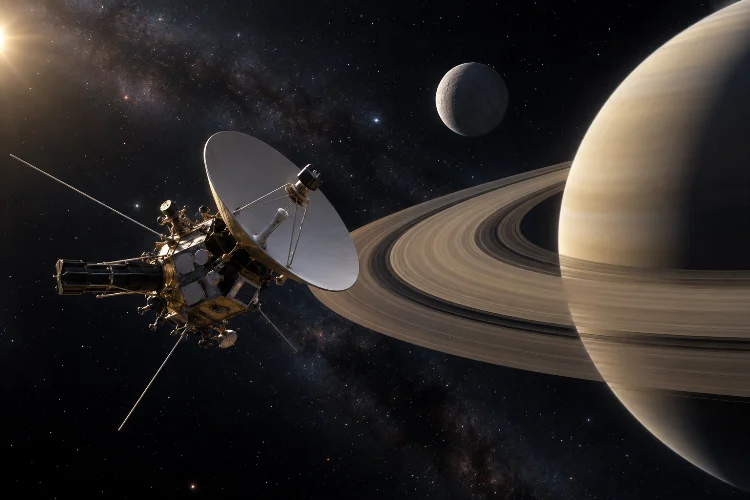
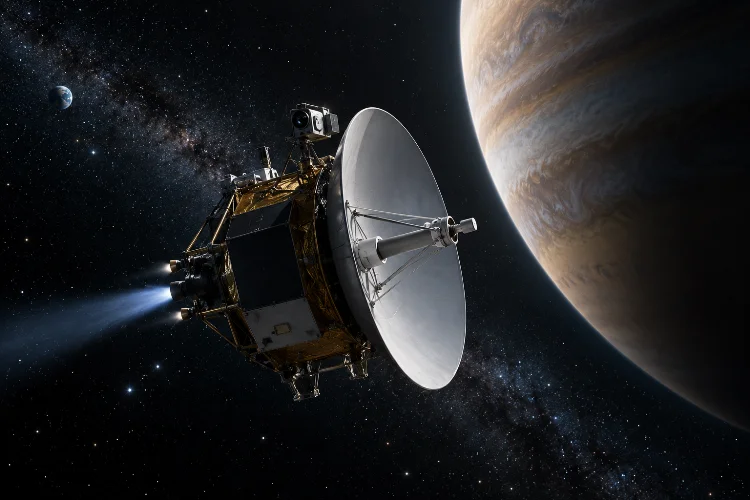
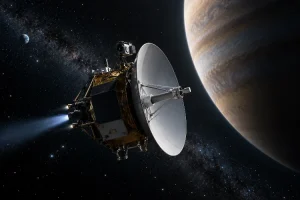
Robotic missions quickly pushed farther. In 1959, the Soviet Luna 1 spacecraft flew past the Moon, while Luna 3 returned the first photographs of the lunar far side.
These probes showed that machines could navigate deep space and gather information needed for future human missions.
The First Humans Enter Space
On April 12, 1961, Soviet cosmonaut Yuri Gagarin became the first human to travel into space and orbit Earth. His Vostok 1 mission lasted less than two hours, but it changed history by proving that a person could survive launch, weightlessness, and atmospheric reentry.
The United States followed weeks later when Alan Shepard completed a suborbital flight. In 1962, John Glenn became the first American to orbit Earth.
Other milestones arrived quickly. Valentina Tereshkova became the first woman in space in 1963, completing 48 orbits during her Vostok 6 mission. In 1965, Alexei Leonov left his spacecraft and performed the world’s first spacewalk.
These missions were risky and relatively short, but they answered essential questions. Engineers learned how humans reacted to microgravity, how spacecraft could maneuver in orbit, and how astronauts might work outside a pressurized cabin.
The Race to the Moon
The early Soviet successes encouraged the United States to set a much larger goal: landing astronauts on the Moon before the end of the 1960s.
NASA’s Mercury missions tested basic human spaceflight. Gemini then developed skills needed for lunar exploration, including longer missions, orbital rendezvous, docking, and spacewalking.
Apollo combined those lessons with the enormous Saturn V rocket. Apollo 8 carried the first humans around the Moon in December 1968, giving astronauts a close view of another world without landing.
On July 20, 1969, Apollo 11 astronauts Neil Armstrong and Buzz Aldrin landed in the lunar module Eagle, while Michael Collins remained in lunar orbit.
Armstrong and Aldrin explored the surface, collected samples, photographed the landscape, and deployed scientific instruments.
Apollo missions continued until 1972. They returned lunar rocks, installed experiments, and demonstrated that people could travel to another celestial body and return safely.
The program remains one of the most significant achievements in the history of human space exploration.
Space Stations Changed the Goal
After the race to the Moon, human spaceflight increasingly focused on living and working in Earth orbit. Instead of making short visits, astronauts and cosmonauts began testing how people could survive in space for weeks or months.
The Soviet Union launched Salyut 1, the first space station, in 1971. Later Salyut stations supported longer missions and more advanced research.
The United States launched Skylab in 1973. Its crews studied the Sun, observed Earth, performed experiments, and investigated how extended weightlessness affected the human body.
The Soviet Mir station, whose first module launched in 1986, introduced a modular design. New sections could be added over time, allowing the facility to grow and support increasingly complex missions.
Experience aboard Salyut and Mir became an important foundation for the International Space Station.
The Space Shuttle Era
NASA introduced the Space Shuttle in 1981 as a partly reusable transportation system. Unlike earlier capsules, its orbiter had wings and could return to Earth by landing on a runway.
The shuttle carried satellites, laboratories, scientific instruments, and astronauts. Crews also used it to deploy and repair the Hubble Space Telescope and transport major components of the International Space Station.
Between its first flight in April 1981 and its final landing in July 2011, the shuttle fleet completed 135 missions. Its achievements came with painful lessons: the Challenger accident in 1986 and Columbia disaster in 2003 each killed seven crew members and led to major safety investigations.
The shuttle demonstrated both the possibilities and difficulties of reusable human spacecraft. Its missions helped develop technologies and operational experience that continue to influence modern launch systems.
Cooperation and the International Space Station
Human space exploration gradually shifted from Cold War rivalry toward international cooperation. The United States, Russia, Europe, Japan, and Canada combined technology, funding, research, and astronaut training to create the International Space Station.
The first ISS module launched in 1998. The station grew as additional laboratories, solar arrays, living areas, and docking systems were assembled in orbit.
The partnership drew heavily on earlier experience. Russian designs evolved from Salyut and Mir, while Space Shuttle missions transported many station components. European, Japanese, and Canadian systems added research facilities, robotics, and other essential capabilities.
The ISS became a laboratory for studying biology, medicine, materials, fluid physics, Earth, and space technology. It also allowed researchers to examine how long periods in microgravity affect muscles, bones, vision, sleep, and other aspects of human health.
Human Spaceflight Becomes More Global
The Soviet Union and United States dominated the earliest decades, but human spaceflight eventually became more international.
Astronauts from Europe, Japan, Canada, and many other countries flew aboard American and Russian spacecraft. In 2003, China launched its first crewed mission, Shenzhou 5, becoming the third country capable of independently sending humans into space.
Commercial companies have also taken on a larger role. Privately developed spacecraft now carry professional crews to orbit, while several companies are working on lunar landers, space stations, and vehicles designed for private passengers.
This does not mean government programs are disappearing. Instead, national agencies, international partners, universities, and businesses increasingly work together to divide costs, share expertise, and develop new technology.
Returning to the Moon and Looking Toward Mars
The next major phase of human space exploration is focused on moving beyond low Earth orbit again.
NASA’s Artemis program began with Artemis I in 2022, an uncrewed test that sent the Orion spacecraft beyond the Moon and back.
Artemis II followed as the program’s first crewed flight, carrying astronauts around the Moon and testing systems intended for future surface missions.
Current lunar plans emphasize longer-term exploration rather than a single visit. Crews will need improved spacesuits, power systems, communications, habitats, rovers, and methods for using local resources.
The Moon can also serve as a testing ground for Mars. A crewed Martian mission would involve much longer travel times, greater radiation exposure, delayed communication, and limited opportunities for emergency assistance.
Mars remains a long-term goal rather than an easy next step. Each lunar expedition, orbital experiment, and life-support test helps researchers understand what will be required to send people safely deeper into the Solar System.
What Human Space Exploration Has Taught Us
The history of human spaceflight is not a simple sequence of victories. It includes failed launches, technical mistakes, political tension, budget problems, accidents, and difficult decisions.
It also shows how quickly knowledge can grow. In little more than a decade, humanity progressed from launching the first satellite to walking on the Moon.
Robotic missions remain essential because machines can travel farther, operate longer, and enter environments that are too dangerous for people.
Human explorers offer different strengths, including flexible decision-making, complex fieldwork, and the ability to respond creatively to unexpected problems.
The future will probably combine both approaches. Robots can prepare destinations, locate resources, and inspect hazards before crews arrive.
The history of human space exploration began with experimental rockets and Sputnik, then accelerated through the first orbital flights, spacewalks, and Apollo Moon landings.
Space stations shifted the focus toward long-term living and scientific research, while the Space Shuttle and ISS introduced reusable technology and international cooperation.
China’s crewed program and the growth of commercial spaceflight have made exploration increasingly global. Meanwhile, Artemis has reopened the path to the Moon and may provide experience needed for future journeys to Mars.
Humanity has explored only a tiny part of space, but every mission expands what is possible. Follow an upcoming crewed launch, explore a virtual space museum, or learn about the people behind a historic mission-and become part of the continuing story.