Have you ever wondered where the universe came from, why distant galaxies are moving apart, or what might happen to everything billions of years from now?
These may sound like science-fiction questions, but scientists investigate them through a field called cosmology. So, what is cosmology? Cosmology is the scientific study of the universe as a whole.
Instead of concentrating on one planet, star, or galaxy, it explores the origin, structure, composition, evolution, and possible future of the entire cosmos. Modern cosmology brings together astronomy, physics, mathematics, and computer science.
Researchers study ancient radiation, distant galaxies, exploding stars, and the gravitational effects of invisible matter. Current evidence indicates that the universe began expanding about 13.8 billion years ago and has continued changing ever since.
The subject may seem complicated, but its main ideas are approachable. This beginner’s introduction explains the Big Bang, cosmic expansion, dark matter, dark energy, and how scientists study a universe they can never observe all at once.
What Does Cosmology Study?
Astronomy covers objects and events beyond Earth, while cosmology focuses on the largest possible picture.
A planetary scientist might study the atmosphere of Mars, and a stellar astronomer may investigate the life of a particular star. A cosmologist asks how billions of galaxies formed and became distributed across space.
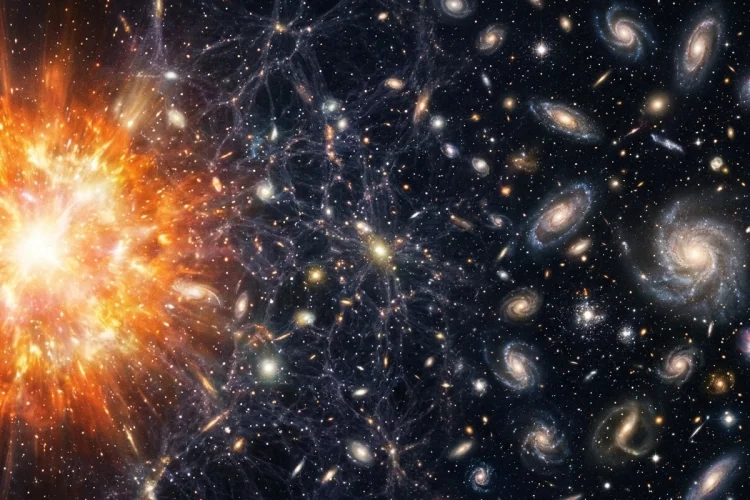
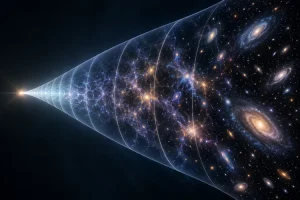
Cosmologists investigate the universe’s age, overall shape, expansion rate, ingredients, and long-term future. They also examine the cosmic web, an enormous network of galaxy clusters and filaments separated by relatively empty regions.
Smaller objects still matter because stars, galaxies, black holes, and supernovae provide evidence about cosmic history. Cosmology connects those individual observations to a broader model of how the universe works.
The Big Bang and the Early Universe
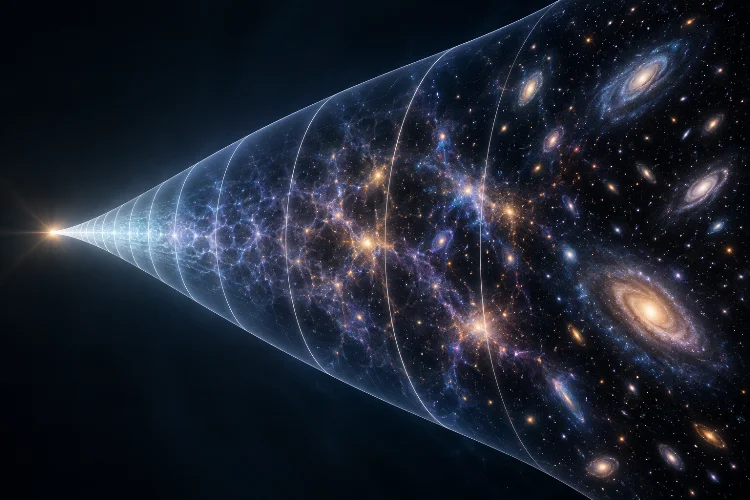
The foundation of modern cosmology is the Big Bang model. The Big Bang was not a conventional explosion sending matter into an already empty space.
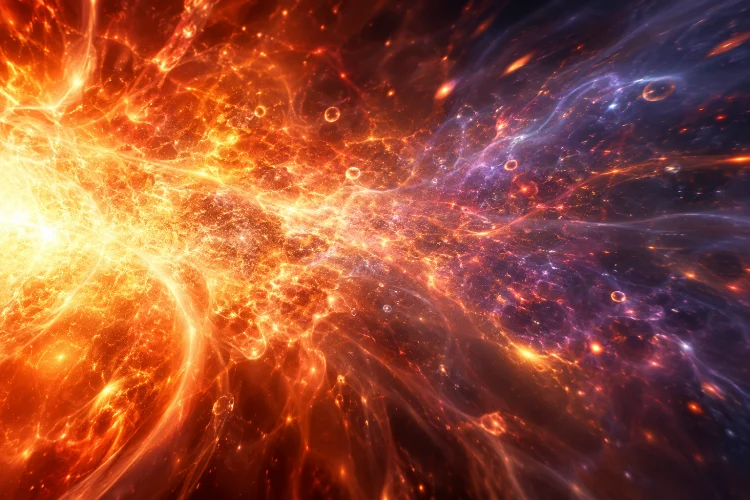
It describes an early state in which the universe was extremely hot and dense, followed by the expansion and cooling of space. As temperatures dropped, particles formed and combined into simple atomic nuclei.
Around 380,000 years after expansion began, electrons joined nuclei to form neutral atoms, allowing light to travel freely across the cosmos. Gravity later gathered matter into stars, galaxies, clusters, and the larger cosmic web.
The model explains how the observable universe developed from its early hot state. However, it does not provide a complete answer to why the universe exists or what, if anything, happened before the earliest stage that current physics can describe.
How Do We Know the Universe Is Expanding?
One major clue comes from the light of distant galaxies. In general, the farther away a galaxy is, the more its light has shifted toward longer, redder wavelengths. This cosmological redshift shows that the space between widely separated galaxies is expanding.
A common comparison is raisin bread rising in an oven. As the dough expands, each raisin becomes farther from the others. No raisin needs to be at the center of the expansion.
Scientists measure cosmic expansion using observations of galaxies, variable stars, supernovae, and other distance indicators. These measurements have also helped researchers estimate the universe’s age at approximately 13.8 billion years.
Expansion does not mean that planets, people, or individual galaxies are continually getting larger. Local forces such as gravity and electromagnetism keep smaller systems together.
The Cosmic Microwave Background
One of the strongest pieces of evidence for the Big Bang model is the cosmic microwave background, commonly shortened to CMB. It is the cooled remnant of the earliest light that could move freely through the universe.
Before atoms formed, the cosmos contained hot plasma that repeatedly scattered photons. Once the universe cooled sufficiently, light was released and began traveling across space.
Cosmic expansion gradually stretched that radiation into the microwave wavelengths detected today.
The CMB is remarkably even across the sky, but it contains tiny temperature variations. These differences represent regions with slightly different densities in the young universe.
Gravity amplified those early variations over billions of years. Denser regions attracted more material and eventually helped produce stars, galaxies, and galaxy clusters. ESA’s Planck observatory mapped these variations with exceptional precision.
Dark Matter and the Cosmic Web
The stars, planets, gas, and dust we can detect represent only a small fraction of the universe. Current models estimate that ordinary matter accounts for about 5% of its contents, while dark matter contributes around 27%.
Dark matter does not appear to emit, reflect, or absorb light in a detectable way. Astronomers infer its existence through its gravitational effects.
For example, galaxies rotate as though they contain more mass than their visible material can provide. Large collections of dark matter also bend and magnify the light of distant objects through gravitational lensing.
In cosmological models, dark matter acts as invisible scaffolding. Its gravity helped ordinary gas collect into the regions where galaxies and clusters developed. Scientists have strong evidence for its effects, but its exact nature remains one of physics’ biggest unanswered questions.
Dark Energy and Accelerating Expansion
Scientists once expected gravity to gradually slow cosmic expansion. Observations of distant supernovae instead revealed that the expansion rate began accelerating several billion years after the Big Bang.
The term dark energy describes the unknown cause of this acceleration. Current estimates suggest that it accounts for roughly 68% of the universe’s total energy budget.
Dark energy is not directly visible, and researchers do not yet understand what it is. It could be a property of empty space, an unknown energy field, or evidence that our understanding of gravity is incomplete.
This mystery is important because dark energy may determine the universe’s ultimate future. If accelerated expansion continues, increasingly distant galaxies will become more widely separated over time.
How Cosmologists Study the Universe
Cosmologists cannot observe billions of years of cosmic history directly, so they combine many types of evidence. Telescopes collect visible light, infrared radiation, radio waves, X-rays, and other signals from distant objects.
Looking far into space also means looking into the past. Light from a galaxy located billions of light-years away began its journey billions of years ago, allowing telescopes to observe earlier periods of cosmic development.
Galaxy surveys map how matter is distributed, while gravitational lensing reveals invisible mass. Certain supernovae help scientists estimate cosmic distances, and CMB observations provide a snapshot of the young universe.
Computer simulations are equally important. Researchers enter physical laws and early conditions into powerful computers, then test whether the simulated cosmos produces realistic galaxies, clusters, and large-scale structures.
What Is the Standard Cosmological Model?
The most widely used scientific description of the universe is called the Lambda Cold Dark Matter model, usually written as ΛCDM. Lambda represents dark energy, while cold dark matter refers to matter that moved relatively slowly when large cosmic structures began developing.
This model successfully explains many observations, including the CMB, cosmic expansion, galaxy distribution, and the abundance of light elements. However, a successful model is not necessarily a complete one.
Scientists still do not know the true identity of dark matter or dark energy. Questions also remain about the universe’s earliest moments and how its first stars and galaxies formed so quickly.
Cosmology therefore combines a powerful framework with significant uncertainty. New observations can strengthen the standard model, reveal its limits, or point toward better explanations.
What Could Happen to the Universe?
The future of the cosmos depends largely on dark energy. Current evidence suggests that expansion will continue and that distant galaxies will gradually move farther apart.
If this pattern continues indefinitely, star formation will eventually decline, existing stars will fade, and the universe will become colder and darker over an extremely long period. This possibility is commonly called the Big Freeze or heat death.
Other possible endings have been proposed, including a future collapse or a “Big Rip” caused by increasingly powerful expansion. These outcomes depend on assumptions about dark energy that have not been confirmed.
The honest answer is that cosmologists do not yet know the universe’s final fate. Solving the nature of dark energy may provide the missing clue.
Cosmology is the scientific study of the universe’s origin, structure, composition, evolution, and future. Its modern picture begins with an extremely hot, dense early cosmos that expanded and cooled, eventually producing atoms, stars, galaxies, and the cosmic web.
Evidence from galactic redshifts, the cosmic microwave background, supernovae, and large-scale structures strongly supports this framework. Yet most of the universe appears to consist of dark matter and dark energy, whose true nature remains unknown.
Start exploring by examining a Planck CMB map or a Hubble and Webb deep-field image. Each observation is more than a beautiful picture-it is a piece of evidence in humanity’s attempt to understand the history of everything.