Galaxies are among the largest organized structures in the universe, yet no two look exactly alike. Some display elegant spiral arms, others resemble smooth glowing balls, and many appear stretched, clumpy, or completely chaotic.
These shapes are not just decorative-they provide clues about a galaxy’s stars, gas supply, history, and surroundings. The main types of galaxies are spiral, elliptical, lenticular, and irregular galaxies.
Astronomers also use labels such as barred spiral, dwarf, and peculiar to describe systems with more specific features. Our Milky Way, for example, is a barred spiral galaxy.
Classifying galaxies gives researchers a practical way to compare vast numbers of distant systems. By studying their shape, color, star-forming activity, and movement, scientists can investigate how galaxies develop over billions of years.
This beginner-friendly guide explains the major galaxy categories, provides familiar examples, and shows you what to look for in real telescope images.
How Do Astronomers Classify Galaxies?
Astronomers mainly classify galaxies by morphology, which means their visible shape and structure. They look for features such as a flat disk, central bulge, spiral arms, stellar bar, or the absence of any regular pattern.
Shape is only the starting point. Researchers also examine the ages of a galaxy’s stars, its supply of gas and dust, its rate of new star formation, and how its material rotates.
A galaxy’s appearance therefore works like a quick summary of its physical condition and development. NASA generally groups galaxies into spiral, elliptical, and irregular categories, while lenticular galaxies occupy an important position between spirals and ellipticals.
Spiral Galaxies: Disks With Curving Arms
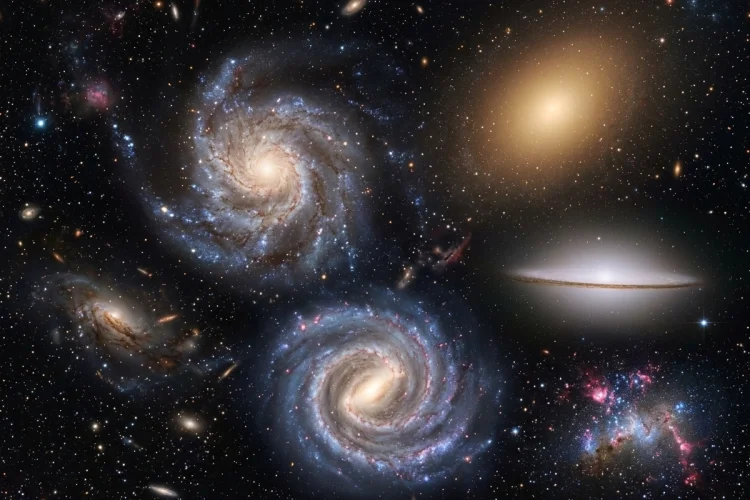
Spiral galaxies are probably the easiest type to recognize. They usually have a flat, rotating disk, a bright central bulge, and arms that curve away from the center like the blades of a pinwheel.
Their arms often appear blue because they contain young, hot stars. They are also rich in clouds of gas and dust, which supply the raw material needed to create new stars. The central bulge generally contains an older population of dimmer stars.
The Andromeda Galaxy and Whirlpool Galaxy are famous examples. A spiral may look almost circular when viewed face-on, but the same basic structure can appear as a narrow streak when seen edge-on.
Barred Spiral Galaxies
Many spiral galaxies contain a long, bar-shaped concentration of stars crossing the center. Their arms begin near the ends of this bar instead of emerging directly from a round central bulge.
The Milky Way belongs to this category. In classification labels, ordinary spirals use the letter S, while barred spirals use SB.
Additional letters such as “a,” “b,” and “c” describe structural differences. An Sa galaxy has tightly wound arms and a relatively large bulge, while an Sc galaxy usually has looser arms and a smaller central bulge.
Elliptical Galaxies: Smooth and Rounded
Elliptical galaxies have smooth shapes that range from nearly spherical to highly stretched ovals. They lack obvious spiral arms and generally do not have the thin, organized disks seen in spiral systems.
Many ellipticals contain older, redder stars and relatively little cold gas or dust. With less material available for producing new stars, they usually have much lower star-formation rates than gas-rich spirals.
Astronomers classify elliptical galaxies from E0 to E7. An E0 galaxy looks almost round, while an E7 galaxy appears much more elongated. The number describes its visible shape rather than its age.
Ellipticals also come in dramatically different sizes. Some are small dwarf galaxies, while giant ellipticals can dominate the centers of galaxy clusters. M87 is one of the best-known giant elliptical systems.
Scientists think many large ellipticals developed through collisions and mergers. When galaxies combine, their original disks and arms can become disrupted, eventually producing a smoother collection of stars.
Lenticular Galaxies: Between Spirals and Ellipticals
Lenticular galaxies, labeled S0, combine qualities of spiral and elliptical systems. They have a central bulge and a flattened disk but generally lack clearly visible spiral arms.
From far away, a lenticular galaxy may resemble an elliptical. Closer observations can reveal its disk, particularly when the galaxy is viewed from the side.
These systems often contain less cold gas than spirals, so they tend to form fewer new stars. Their older stellar populations can give them a smooth yellowish or reddish appearance.
Astronomers are still investigating the different ways lenticular galaxies form. Some may be former spirals that used up or lost their star-forming gas. Others may have gained their shape through interactions or mergers between galaxies.
Irregular Galaxies: No Orderly Shape
Irregular galaxies do not fit neatly into the spiral, elliptical, or lenticular categories. They may look asymmetrical, clumpy, stretched, scattered, or strangely distorted.
Some are naturally small and loosely organized. Others acquired their unusual appearance during close encounters with neighboring galaxies. Gravity can pull stars and gas away from their original positions, creating tails, uneven structures, and bright pockets of new stars.
The Large and Small Magellanic Clouds are well-known irregular galaxies located near the Milky Way. Both can be observed without a telescope from suitable locations in the Southern Hemisphere.
Irregular does not mean inactive. These systems can contain significant amounts of gas and dust, allowing them to host numerous young stars and bright star-forming regions.
Dwarf Galaxies: Small but Scientifically Important
“Dwarf galaxy” describes size rather than one specific shape. A dwarf may be elliptical, irregular, or, less commonly, spiral in structure.
These systems contain far fewer stars than large galaxies such as the Milky Way. Many orbit bigger galaxies, where gravitational forces can stretch them, remove their gas, or gradually pull them apart.
Dwarf galaxies are especially valuable to astronomers because they may preserve evidence from the early stages of galaxy formation. Their stars, chemical composition, and dark matter distribution can help scientists test models of how larger systems developed.
The Milky Way has numerous known dwarf satellite galaxies. Some are extremely faint because their stars are widely spread, making them difficult to separate from foreground stars in our own galaxy.
Galaxies as a whole vary enormously in scale. The smallest known systems may contain only a few thousand stars, while the largest galaxies hold trillions.
What Is the Hubble Tuning Fork?
Astronomer Edwin Hubble introduced an influential galaxy classification system in 1926. Its shape became known as the Hubble tuning fork.
Elliptical galaxies occupy the diagram’s handle. Lenticular galaxies sit near the junction, while normal spirals and barred spirals form the two branches.
The diagram remains a useful introduction to galaxy morphology, but it should not be interpreted as a simple timeline. Galaxies do not automatically begin as ellipticals and gradually transform into spirals as they move across the chart.
Modern astronomers use more detailed measurements, computer analysis, and citizen-science projects to identify features such as bars, rings, arms, and signs of past collisions. Even so, Hubble’s basic system still provides a shared vocabulary for discussing galactic structure.
Why Can a Galaxy’s Type Change?
A galaxy’s shape is not necessarily permanent. Galaxies continue forming stars, gaining or losing gas, and interacting with their neighbors throughout their lives.
A close encounter may stretch a spiral galaxy into an irregular shape. A major merger can disrupt organized disks and eventually leave a smoother remnant.
Galaxies can also absorb smaller companions. These events may throw streams of stars and gas outward while sending other material toward the central black hole. Colliding gas clouds can become compressed and trigger new periods of star formation.
The surrounding environment matters too. Galaxies inside crowded clusters experience more gravitational encounters and may lose gas as they travel through hot material between neighboring systems.
A galaxy’s present type is therefore a snapshot of a much longer cosmic story. Webb observations show that many early galaxies were small and clumpy, unlike the highly organized spiral and elliptical systems common in the modern universe.
The main types of galaxies are spiral, elliptical, lenticular, and irregular, while barred spiral and dwarf labels provide additional detail.
Spirals have rotating disks and star-forming arms, ellipticals appear smooth and contain many older stars, lenticulars have disks without prominent arms, and irregulars lack an orderly structure.
These categories help astronomers connect a galaxy’s appearance with its stars, gas, environment, and collision history. They are practical guides rather than rigid boxes because real galaxies can evolve and combine features from several groups.
The next time you view a deep-space image, search for a disk, curved arms, a central bar, or a smooth oval glow. Try classifying a few galaxies yourself and turn a beautiful cosmic picture into a simple astronomy exercise.