Those tiny points of light scattered across the night sky may look calm and delicate, but stars are actually enormous, energetic objects. Each one is a hot sphere of plasma held together by gravity, often producing enough power to shine across thousands of light-years.
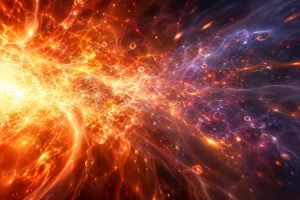
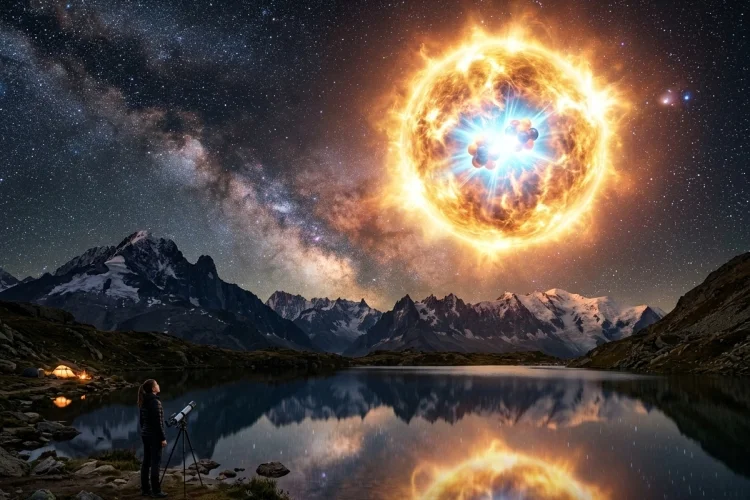
So, what is a star and how does it produce energy? A star is a massive celestial body made mainly of hydrogen and helium. Deep in its core, intense temperature and pressure allow atomic nuclei to combine through nuclear fusion.
This process releases the energy that gives a star its light and heat. Our Sun is the closest star to Earth, but it is only one member of a huge and varied population.
Stars can be smaller than the Sun, hundreds of times larger, cooler and redder, or dramatically hotter and bluer. Understanding how stars work helps explain much more than the lights in the sky.
Stars create many of the chemical elements found in planets, oceans, living organisms, and even the human body.
What Exactly Is a Star?
A star is a self-gravitating sphere of extremely hot gas, most of which exists as plasma. Plasma is a state of matter in which atoms have become electrically charged because their electrons are partly or completely separated from their nuclei.
Most stars contain large amounts of hydrogen, followed by helium and smaller quantities of heavier elements. Their gravity pulls this material toward the center, creating immense pressure and temperature inside the core.
Unlike planets, stars generate their own energy. A planet such as Earth mainly reflects light from a nearby star, while the Sun and other stars shine because nuclear reactions occur within them.
Stars also vary enormously. Some red dwarf stars are much smaller and cooler than the Sun, while massive blue stars can be dozens of times more massive and thousands of times more luminous.
NASA estimates that main-sequence stars account for around 90% of the universe’s stellar population.
How Are Stars Formed?
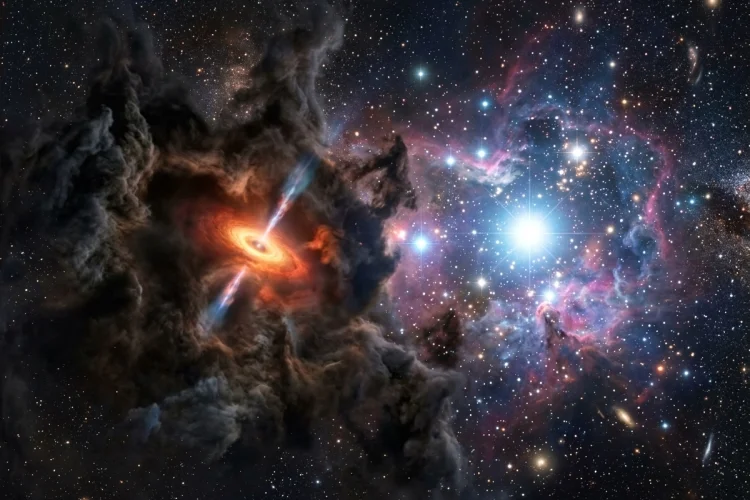
Stars begin inside enormous clouds of cold gas and dust called molecular clouds or stellar nurseries. These regions may contain enough material to form hundreds or even thousands of stars.
When part of a cloud becomes dense enough, gravity causes it to collapse. The collapsing material gathers into a growing central object known as a protostar.
As the protostar attracts more matter, its core becomes denser and hotter. It may also develop a rotating disk of leftover gas and dust, which can eventually produce planets, moons, asteroids, and other objects.
A protostar becomes a true star when its core reaches temperatures of millions of degrees and nuclear fusion begins. From that point, it can enter the long, relatively stable stage known as the main sequence.
Nuclear Fusion Is the Source of Stellar Energy
Stars do not burn like wood, candles, or gasoline. Ordinary fire is a chemical reaction, while stellar energy comes from changes inside atomic nuclei.
In stars similar to the Sun, the main energy-producing process is hydrogen fusion. Under extreme pressure and heat, hydrogen nuclei-essentially individual protons-move fast enough to approach one another despite their positive electrical charges.
When they get sufficiently close, the strong nuclear force can bind them together. Through a series of reactions known as the proton-proton chain, hydrogen is gradually converted into helium.
The overall process releases energy, along with particles such as neutrinos. The proton-proton chain is the primary nuclear cycle powering the Sun and other stars of similar mass.
More massive stars rely more heavily on another reaction sequence called the carbon-nitrogen-oxygen, or CNO, cycle. Both processes turn hydrogen into helium, but they follow different reaction pathways.
Why Does Fusion Release Energy?
The helium nucleus produced through fusion has slightly less mass than the original hydrogen nuclei used to make it. That missing mass is converted into energy.
This relationship is expressed by Albert Einstein’s famous equation:
E = mc²
In the equation, energy equals mass multiplied by the speed of light squared. Since the speed of light is an enormous number, even a tiny loss of mass can produce a huge amount of energy.
This energy initially appears as high-energy radiation and the motion of particles inside the stellar core. It is repeatedly absorbed, scattered, and transferred as it travels through the star.
By the time it reaches the surface, much of it escapes as visible light, infrared radiation, ultraviolet light, and other forms of electromagnetic energy. Fusion therefore provides both the brightness we see and the internal heat that helps support the star.
Gravity and Pressure Keep a Star Stable
A star is constantly balancing two opposing forces. Gravity pulls its enormous mass inward, while heat and pressure generated by nuclear fusion push outward.
This balance is called hydrostatic equilibrium. It prevents a healthy main-sequence star from collapsing or rapidly expanding.
Imagine squeezing an inflated balloon. The air inside pushes outward while your hands push inward. A star behaves differently in detail, but the basic idea of competing pressures is similar.
If the fusion rate increases, the star’s core becomes hotter and produces more outward pressure. The star may expand slightly, which reduces the core’s density and slows the reactions.
If fusion decreases, gravity compresses the core. The compression raises its temperature, potentially increasing fusion again. This natural regulation allows many stars to remain stable for millions or billions of years.
How Energy Reaches the Star’s Surface
Energy does not travel directly from a star’s core into space. It must pass through layers of extremely dense plasma.
In a Sun-like star, energy first moves through a radiative region. Photons are repeatedly absorbed and re-emitted by particles, causing them to follow a slow and irregular path outward.
Farther from the core, energy may be carried by convection. Hot plasma rises toward the surface, releases energy, cools, and sinks again. This circulating movement is similar to water moving in a heated pot.
Once energy reaches the visible surface, it can escape into space as starlight. That light may travel for years, centuries, or millions of years before reaching a telescope—or your eyes.
Because light takes time to travel, looking at distant stars means seeing them as they existed in the past. A star located 500 light-years away appears to us as it looked 500 years ago.
Why Stars Have Different Colors
A star’s color provides a useful clue about its surface temperature. Cooler stars appear red or orange, while hotter stars look white or blue.
Red dwarf stars may have surface temperatures of only a few thousand degrees. The Sun, which has a surface temperature of roughly 5,500 degrees Celsius, appears mostly white when viewed from space.
Hot blue stars may reach surface temperatures of tens of thousands of degrees. These stars are usually more massive, more luminous, and much shorter-lived than the Sun.
Astronomers study starlight using spectroscopy. By separating light into individual wavelengths, they can estimate a star’s temperature, chemical composition, motion, density, and other properties.
This allows scientists to learn about distant stars without physically visiting them. Their light acts like a message carrying information across space.
A Star’s Mass Determines Its Life
Mass is the most important factor controlling how a star lives and dies. It affects the star’s core temperature, fusion rate, brightness, lifetime, and eventual fate.
Small stars use their hydrogen slowly. Red dwarfs are faint, but some may remain active for hundreds of billions or even trillions of years.
Massive stars have much hotter cores and use their fuel far more quickly. Although they contain more hydrogen, they may survive for only a few million years because their fusion reactions happen at an extraordinary rate.
A Sun-like star eventually expands into a red giant after using much of the hydrogen in its core. It later releases its outer layers and leaves behind a dense stellar remnant called a white dwarf.
A massive star can fuse progressively heavier elements. Once its core can no longer gain useful energy from fusion, it may collapse and explode as a supernova.
The remaining core may become a neutron star or, if it is massive enough, a black hole. Material released by dying stars can later become part of new stars, planets, and living things.
How Stars Create the Elements Around Us
Stars are not only sources of light. They are also cosmic factories that transform simple elements into more complex ones.
Hydrogen fusion produces helium. Later stages inside some stars can create carbon, oxygen, neon, silicon, and other elements.
Massive stars can build elements up to iron in their interiors. Supernova explosions and other extreme cosmic events help produce and distribute many heavier elements.
The oxygen we breathe, the carbon in our cells, and the calcium in our bones were created through cosmic processes involving earlier generations of stars. When those stars released their material, it mixed with interstellar gas and became part of new planetary systems.
In that sense, stars are closely connected to the existence of Earth and life. They do not simply decorate the universe-they help build it.
A star is an enormous sphere of plasma held together by gravity and powered by nuclear fusion. Inside its core, hydrogen is converted into helium, and a small amount of mass becomes energy.
That energy moves through the star before escaping as the light and heat we observe. Gravity pulls inward while pressure from fusion pushes outward, allowing a star to remain stable for much of its life.
Its mass determines its temperature, color, brightness, lifespan, and final fate. Stars also manufacture and distribute many of the chemical elements needed to form planets and living organisms.
The next time you look at the night sky, choose one bright star and learn its name, color, and distance. Every point of light has its own history-and its own powerful energy engine.