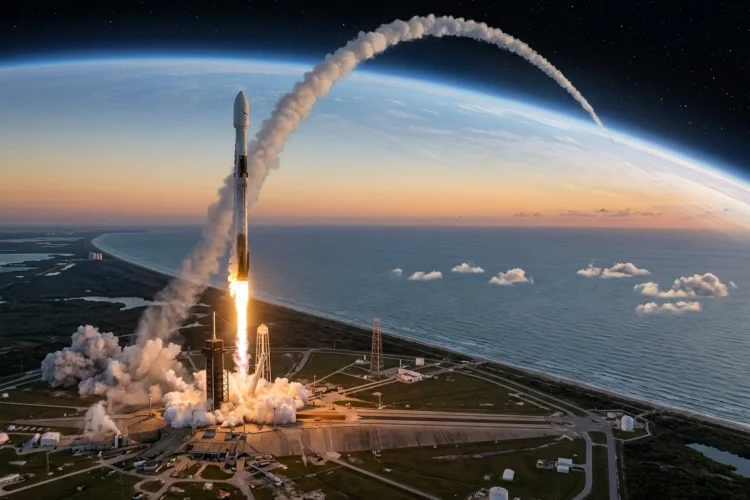
Watching a rocket rise from the launchpad can make it seem as though raw engine power simply pushes the vehicle straight through Earth’s gravity. In reality, reaching space involves a carefully planned balance of thrust, fuel, speed, direction, and timing.
So, how do rockets escape Earth’s gravity? Rocket engines burn propellant and blast hot exhaust downward at high speed. In response, the vehicle is pushed upward.
Once the rocket clears the lower atmosphere, it gradually turns sideways and accelerates until it has enough horizontal speed to enter orbit or travel away from Earth.
This distinction is important. Most rockets carrying satellites do not completely escape Earth’s gravity. Instead, they place their payloads into orbit, where gravity continues pulling them toward the planet.
The spacecraft simply moves sideways fast enough to keep missing the ground. To leave Earth entirely, a spacecraft needs even more energy.
Understanding thrust, orbital velocity, escape velocity, and rocket staging makes this impressive process much easier to follow.
Rockets Create Thrust by Expelling Exhaust
Rocket engines operate according to Newton’s third law of motion: every action produces an equal and opposite reaction. Inside an engine, propellants react and create extremely hot, high-pressure gas.
That gas is forced through a specially shaped nozzle and expelled downward at high speed. As the exhaust moves in one direction, the rocket accelerates in the opposite direction. NASA explains that this reaction allows a rocket to produce thrust even in the vacuum of space.
A rocket does not push against the ground or surrounding air. It pushes exhaust away from itself. This is why its engines continue working after the vehicle has left Earth’s atmosphere.
At liftoff, the upward thrust must be greater than the rocket’s weight. If thrust only matched its weight, the vehicle would not accelerate upward. Once thrust exceeds the downward force of gravity, the rocket begins climbing away from the pad.
Gravity Does Not Suddenly End in Space
A common misconception is that gravity disappears once a rocket crosses the boundary of space. In reality, Earth’s gravitational pull extends far beyond the atmosphere.
The Moon remains in orbit because Earth’s gravity continuously pulls on it. The same principle applies to astronauts, satellites, and space stations.
Astronauts appear weightless not because gravity is absent, but because they and their spacecraft are falling together. NASA describes orbit as a continuous freefall in which a spacecraft moves sideways quickly enough that Earth’s curved surface falls away beneath it.
Even the International Space Station is constantly falling toward Earth. Its high horizontal speed prevents it from hitting the surface.
A launch vehicle therefore does not need to “defeat” gravity permanently. It needs to provide enough energy and speed for the spacecraft to follow the required path.
Reaching Space Is Not the Same as Reaching Orbit
Crossing into space is relatively easy compared with entering a stable orbit. A rocket can travel straight upward, reach space, and then fall back to Earth without ever completing an orbit.
These missions are called suborbital flights. Sounding rockets and some crewed vehicles follow this kind of path.
To remain in low Earth orbit, a spacecraft needs a horizontal speed of roughly 7.8 kilometers per second, or about 28,000 kilometers per hour. At that speed, its forward motion matches the curvature of Earth closely enough to keep it falling around the planet.
This is why rockets do not continue flying straight upward. Shortly after launch, they begin tilting and following a curved path known as a gravity turn.
The early upward climb clears dense parts of the atmosphere. The later sideways acceleration builds the horizontal velocity needed for orbit.
Altitude keeps a spacecraft above most atmospheric drag, but speed keeps it in orbit. Without enough horizontal velocity, even a spacecraft hundreds of kilometers above Earth will eventually fall back.
What Is Escape Velocity?
Escape velocity is the minimum speed an unpowered object would need to leave Earth without falling back, assuming there were no atmosphere or additional engine burns.
Near Earth’s surface, escape velocity is approximately 11.2 kilometers per second, or about 40,000 kilometers per hour.
However, rockets do not usually accelerate instantly to 11.2 kilometers per second at launch. They apply thrust over several minutes while climbing and changing direction.
Escape velocity also decreases with altitude because Earth’s gravitational pull becomes weaker with distance. A spacecraft can first enter parking orbit and then fire an upper-stage engine to begin a journey toward the Moon, Mars, or another destination.
It is also important to ask what the spacecraft is escaping. Leaving Earth’s gravitational control does not mean leaving the Solar System. After escaping Earth, the spacecraft still travels under the influence of the Sun’s gravity.
Most satellites do not need escape velocity at all. Their goal is to remain in a carefully selected Earth orbit.
Why Rockets Use Multiple Stages
A rocket must carry its engines, tanks, structure, payload, and an enormous quantity of propellant. At launch, much of its mass is fuel that will be consumed during the first few minutes of flight.
Keeping empty tanks and unused engines attached would waste energy. Multistage rockets solve this problem by dropping sections that are no longer needed.
A first stage provides powerful thrust during the initial climb. Once its propellant is exhausted, it separates from the vehicle. The lighter upper stage then ignites and continues accelerating.
Some launch vehicles also use solid rocket boosters to provide additional thrust at liftoff. ESA’s Ariane 6, for example, combines boosters with main and upper stages that perform different parts of the flight.
Staging improves efficiency because every later engine carries less unnecessary mass. This is essential because the relationship among propellant, vehicle mass, exhaust velocity, and final speed is extremely demanding.
NASA’s ideal rocket-equation example shows that a very large percentage of a launch vehicle’s initial mass may need to be propellant, leaving a much smaller fraction for engines, structure, and payload.
Rockets Must Overcome Drag and Gravity Losses
Achieving a particular speed in theory is not the same as achieving it during a real launch. Rockets lose some energy while fighting gravity and moving through the atmosphere.
Gravity loss occurs because gravity pulls downward throughout powered flight. The longer a rocket spends climbing slowly, the more fuel it must use simply to prevent itself from falling.
Drag loss is caused by the atmosphere resisting the rocket’s movement. Drag is strongest in the dense lower atmosphere and becomes less important as altitude increases.
A rocket must therefore accelerate efficiently without moving so fast through thick air that aerodynamic forces become dangerous. Engineers design launch paths that balance gravity, drag, engine performance, structural stress, and safety.
The vehicle experiences its highest aerodynamic stress during a phase called maximum dynamic pressure, or “max Q.” Engines may be throttled during this period to reduce stress before returning to higher power.
Gravity and drag mean that reaching low Earth orbit requires more total change in velocity than the basic orbital speed alone. Launch vehicles typically need a total velocity capability of roughly 9 kilometers per second or more, depending on the mission and flight path.
Why Launch Direction and Location Matter
Most rockets launch toward the east because Earth rotates from west to east. Launching in that direction allows the vehicle to take advantage of Earth’s existing rotational speed.
The boost is greatest near the equator, where the surface moves fastest. This is one reason many major launch sites are located relatively close to the equator and have open ocean to the east.
The required path depends on the destination. A satellite entering an equatorial or geostationary orbit follows a different trajectory from one entering a polar orbit.
Mission planners also choose launch windows carefully. A Moon or Mars mission must depart when Earth and its destination are positioned correctly for an efficient transfer.
After reaching an initial orbit, the spacecraft may perform another engine burn to raise or reshape its path. A lunar mission, for example, can first enter Earth orbit and later perform a translunar injection burn that sends it toward the Moon.
How Rockets Know Where to Go
Modern launch vehicles do not rely on engines alone. Guidance computers continuously measure the rocket’s position, speed, direction, and orientation.
Sensors such as accelerometers and gyroscopes detect movement. The flight computer compares those measurements with the planned trajectory and adjusts the engines or control surfaces.
Some engines can tilt slightly through a system called thrust-vector control. Redirecting the exhaust changes the direction of thrust and allows the rocket to steer.
Guidance is especially important because small errors early in flight can become large errors later. A rocket must reach the correct altitude and speed while also moving in the correct direction.
Once the final stage completes its burn, the payload separates. If it has reached the planned orbital velocity, it continues around Earth in freefall.
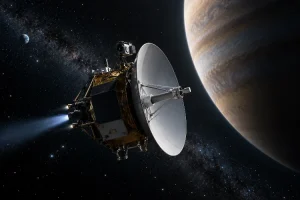
If it has received enough additional energy for an escape trajectory, it begins moving away from Earth and into a Sun-centered path.
Rockets escape Earth’s surface by producing thrust greater than their weight and accelerating with high-speed exhaust. After rising through the lower atmosphere, they tilt sideways to build the horizontal speed required for orbit.
Orbit does not mean escaping gravity. A satellite remains under Earth’s pull but moves fast enough to continually fall around the planet. A spacecraft traveling into deep space requires additional energy and may eventually exceed Earth’s escape velocity.
Multiple stages, carefully designed trajectories, precise guidance, and efficient engines make this possible.
Watch a launch replay and pay attention to the gravity turn, booster separation, staging, and final engine cutoff. Each moment is part of a carefully calculated journey from the launchpad to orbit-or far beyond it.