Every star in the night sky began in a place that looked almost empty. Hidden inside a cold, dark cloud of gas and dust, gravity slowly gathered scattered material until a new source of light appeared.
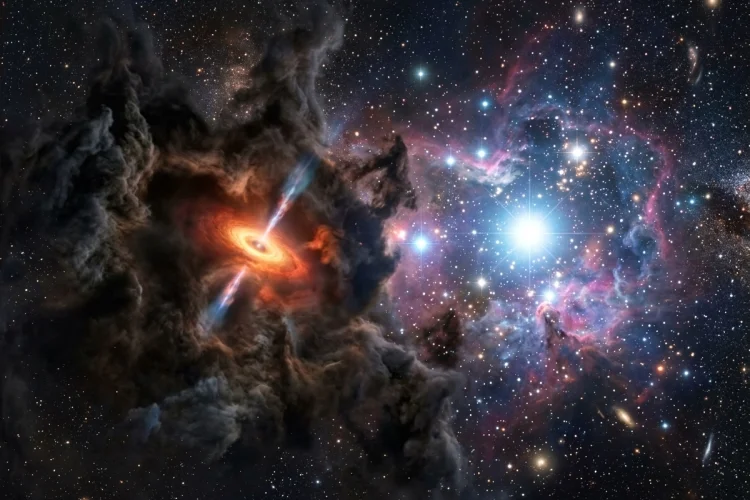
So, how are stars born? The process begins inside enormous molecular clouds, often called stellar nurseries. Dense pockets within these clouds collapse and form hot central objects known as protostars.
The young objects keep pulling in material, spinning faster, and growing hotter. When the temperature and pressure in the core become high enough for hydrogen fusion, a true star is born.
The basic story sounds simple, but stellar formation is not a neat or gentle process. Magnetic fields, turbulence, radiation, gravity, and powerful jets can all influence the result.
Some clouds produce small red dwarfs, while others create massive blue stars that shine brilliantly but live much shorter lives.
By observing regions such as the Orion Nebula and the Pillars of Creation, astronomers can watch different stages of this remarkable cosmic process.
Stars Begin Inside Molecular Clouds
Stars form inside huge, cold regions of gas and dust called molecular clouds. These clouds are made mainly of molecular hydrogen, along with helium, dust grains, and small amounts of heavier elements.
A molecular cloud can stretch across many light-years and contain enough material to produce hundreds or thousands of stars. However, the material is not evenly spread. Some parts are relatively thin, while others form dense filaments, knots, and cores.
The densest regions are the most likely places for star formation to begin. Astronomers often call active molecular clouds stellar nurseries because numerous stars may develop inside the same cloud.
One nearby example is the Taurus Molecular Cloud, located roughly 450 light-years from Earth. It contains many young stars and is an important natural laboratory for studying the early stages of stellar development.
Gravity Starts the Collapse
A cloud does not automatically turn into a star. Gravity must first become strong enough to overcome the forces supporting the gas, including pressure, turbulence, and magnetic fields.
Several events may help compress part of a cloud. A shock wave from an exploding star could squeeze nearby material, while radiation and stellar winds from massive young stars may push gas into denser formations. Collisions or turbulence inside a cloud can have a similar effect.
Once a pocket of gas becomes dense enough, its own gravity pulls more material inward. As the region contracts, its center becomes hotter and more tightly packed.
The collapsing cloud may also break into several smaller clumps. This fragmentation helps explain why stars are commonly born in groups, clusters, or multiple-star systems rather than completely alone.
A Protostar Develops at the Center
As gas and dust fall inward, they collect around a warm, dense central object called a protostar. It is often described as a baby star, but it has not yet begun the stable hydrogen fusion that powers a mature star.
At first, much of a protostar’s energy comes from gravitational contraction. Incoming material collides, compresses, and heats up, causing the growing object to glow.
Protostars are often difficult to observe in visible light because they remain wrapped in thick clouds of dust. Infrared telescopes are especially useful because infrared radiation can reveal warm structures hidden inside these dark regions.
NASA’s James Webb Space Telescope, for example, has observed the protostar L1527 embedded within a molecular cloud. Images show an hourglass-shaped structure created as material from the young object interacts with its surroundings.
A Rotating Disk Feeds the Young Star
The original cloud usually contains some rotation. As it collapses, it spins faster, much like an ice skater rotating more quickly after pulling in their arms.
Not all the material can fall directly into the center. Instead, much of it flattens into a rotating structure called an accretion disk, circumstellar disk, or protoplanetary disk.
Gas and dust move through this disk toward the protostar, allowing it to gain mass through a process known as accretion. Young stars can experience uneven growth, collecting material in bursts rather than at one steady rate.
The leftover disk material may eventually form planets, moons, asteroids, and comets. Star birth and planetary formation are therefore closely connected parts of the same cosmic story.
Our own Solar System probably began in a similar way, with the young Sun surrounded by a disk containing the raw materials that later became Earth and the other planets.
Powerful Jets Blast Material Into Space
A growing protostar does not keep everything that approaches it. Some material is redirected and launched away from the poles as narrow, high-speed jets.
These jets often appear in opposite directions, roughly perpendicular to the surrounding disk. They can travel enormous distances and create bright shock waves when they collide with nearby gas.
Magnetic fields appear to play a major role in controlling these outflows. Jets can carry angular momentum away from the disk, making it easier for other material to spiral inward and join the protostar.
The outflows also clear cavities through the surrounding cloud. Over time, they reveal more of the young star and reduce the amount of material available for further growth.
This means jets are not simply dramatic side effects. They help regulate how quickly a protostar gains mass and may influence the final size of the star.
Nuclear Fusion Turns On
As the protostar continues contracting and collecting material, its core temperature and pressure rise. If it gathers enough mass, conditions eventually become extreme enough for hydrogen nuclei to combine.
This process is called nuclear fusion. Hydrogen is gradually converted into helium, releasing an enormous amount of energy.
Fusion creates outward pressure that pushes against the inward force of gravity. When those forces become balanced, the star reaches a relatively stable condition called hydrostatic equilibrium.
The object has now become a main-sequence star. It can support itself through hydrogen fusion rather than relying mainly on heat from gravitational contraction.
For stars like the Sun, the main sequence is the longest stage of life. Our Sun entered this phase about 4.6 billion years ago and continues producing energy by converting hydrogen into helium.
Mass Determines What Kind of Star Is Born
The amount of material collected during formation largely determines the star’s temperature, brightness, lifespan, and eventual fate.
Low-mass stars have cooler cores and use their hydrogen slowly. Red dwarfs are relatively faint, but they can remain active far longer than Sun-like stars.
Massive stars have stronger gravity, hotter cores, and much faster fusion rates. They shine intensely and may appear blue or blue-white, but they use their nuclear fuel quickly and often survive for only a small fraction of the Sun’s lifetime.
An object that does not gather enough mass to sustain normal hydrogen fusion becomes a brown dwarf. Brown dwarfs are more massive than most planets but do not qualify as ordinary stars.
The birth environment matters as well. The density of the cloud, nearby radiation, magnetic fields, and competition with other protostars can all affect how much material a growing object collects.
How Long Does Star Formation Take?
Star formation is slow by human standards, but relatively fast compared with the total life of a star.
A star similar to the Sun may require tens of millions of years to progress from an unstable cloud region to a settled main-sequence star. Massive stars can form more quickly because they collect matter at much higher rates.
There is no single timeline that applies to every star. Cloud density, turbulence, magnetic activity, nearby stars, and the available supply of gas can speed up or interrupt the process.
Star formation can also produce binary and multiple-star systems. In these cases, two or more protostars form close together and remain connected by gravity.
How Astronomers Observe Stars Being Born
Young stars are usually hidden inside dusty clouds, so astronomers study them at several wavelengths.
Infrared telescopes can reveal warm protostars and disks concealed behind dust. Radio and millimeter observatories such as ALMA can map cold gas, complex molecules, disks, and stellar outflows in remarkable detail.
Astronomers also use spectroscopy to analyze the light and radio signals coming from star-forming regions. These observations reveal temperature, chemical composition, density, and whether gas is moving toward or away from a young star.
No scientist can watch one star complete its entire formation in real time. Instead, researchers compare many objects at different developmental stages.
It is similar to understanding how trees grow by examining seeds, seedlings, young trees, and mature forests. Together, those snapshots create a reliable timeline of stellar birth.
Stars are born when gravity causes dense regions inside molecular clouds to collapse. The material gathers around a protostar, forms a rotating disk, and becomes hotter as gas and dust continue falling inward.
Magnetic fields and powerful jets help control the young object’s growth, while leftover disk material may eventually create planets.
When the core becomes hot and dense enough, hydrogen fusion begins. The outward pressure produced by fusion balances gravity, allowing the newborn object to settle into life as a main-sequence star.
Explore infrared images of the Orion Nebula, the Pillars of Creation, or the protostar L1527. These observations show that stellar birth is not merely a theoretical event from the distant past-it is happening throughout our galaxy today.